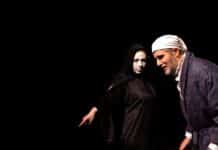
Originally published in 1953 as an allegory for McCarthyism, Arthur Miller’s The Crucible has never not been timely. But as American politics come to a head this election season, and even the idea of “civility” with one’s political opposition begins to seem trite in the face of anti-democratic views becoming explicitly mainstream, The Crucible at Dominion Stage, under Danni Guy’s direction, serves as a crucial reminder that no matter where this darkest timeline leads us, fear is the enemy of progress. The performances in this production are truly stellar and deserve as many awards as there are for community theater in the DC metropolitan area.
The Crucible is an only partially fictionalized adaptation of the events of the 1692–1693 Salem witch trials. In the play, a community of colonial Americans disintegrates following mass hysteria around the possibility of any members within it practicing witchcraft and association with the devil. As the situation spirals, despite the evolving views and developing compassion of Reverend John Hale, crimes worthy of suspicion begin to extend to ultimately any slight deviations from extreme purity in the eyes of the community’s religious authorities. Suspicion, then, leads to individuals being forced to prove themselves innocent through extreme suffering — including the year-long imprisonment of Elizabeth Proctor, protagonist John Proctor’s pregnant wife. Even she, and any other Salem innocents, are not safe. It is ultimately John Proctor’s refusal to commit to a false confession, which would have saved him in the eyes of the Salem legislature, that leads to his death.
And by the way, John and Elizabeth Proctor were real people, and they were indeed hung and jailed respectively following witchcraft accusations. Reverend John Hale also was a Puritan pastor who was an initial believer in the justice of the trials, but by the end of 1692 had come to different conclusions.
The Crucible even resulted in the U.S. House of Representatives’ Un-American Activities Committee subpoenaing Miller. It ultimately found him guilty of contempt of Congress and sentenced him to a fine, time in prison, and a place on the Hollywood blacklist, not to mention an inability to get a U.S. passport. Indeed, Miller’s play was almost hilariously prescient for his time–and of course, fear will be a driving force of human behavior for as long as we exist.
The Dominion Stage production is artfully stripped down through Alex Bryce’s set design, with a set that rotates entirely on and off the stage throughout the performance except one intricate chair. It is used by both the play’s religious figures and legal authorities as a pointed symbol of Salem’s conflation of church and state. The chair’s visual design does not explicitly designate it as a judge’s chair or a religious authority’s chair that the other then uses — don’t worry, it’s not that on the nose. It is simply outwardly beautiful, and effective at capturing attention, but is used for acts of profound cruelty — which adds new dimensions of meaning.
The cast is stellar, raising the bar for excellence in nonprofessional theater. As Rev. John Hale, Shakil Azizi is masterful and utterly captivating. I recently had the pleasure of seeing him flaunt his top-tier musical comedy chops as a Looney Tunes villain type in a production of The Drowsy Chaperone at Workhouse Arts Center; I was awed to now see him execute one of the most grave, nuanced, and demanding roles in American drama so flawlessly and captivatingly here. The program notes that he’s a court reporter in the DC area: whatever they do to you in law school apparently makes you a triple-threat thespian.
Stuart Fischer also delivers one of the best performances in any medium that I’ve seen as Governor Danforth in all his casual, divinely-rationalized cruelty. He has a conversational style of line delivery that makes him uniquely convincing and human — this tool becomes a lethal weapon in a role about humanity’s capacity for evil. When Fischer appeared to stumble over his lines in a handful of instances, it only made his performance more believable. Even more vindicatingly, he is a man who appears genuinely devoted to God and Christian causes, pointing to the dangers of unexamined belief across gods, divine and otherwise.
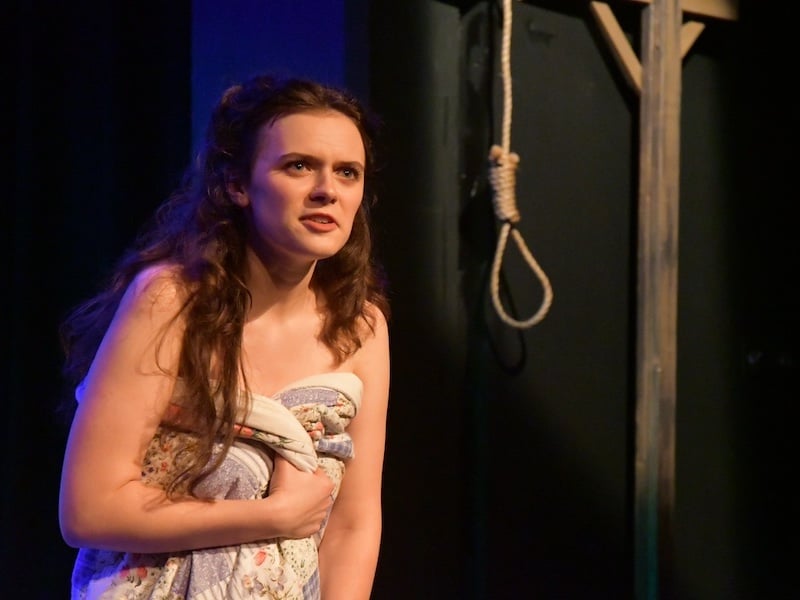
Another leading performance in this production is Malerie Goodman’s as John Proctor’s wife Elizabeth. She is utterly convincing as a woman both skeptical of her husband’s fidelity and emotionally weathered by a society that degrades and disregards her; in her final scene, as she has been imprisoned and kept in solitary confinement while pregnant, she is difficult to behold on stage — and that’s a sign of good theater. Rebecca J. Harris’s hair and makeup work for Elizabeth in this moment fully communicates her anguish to tear-jerking effect.
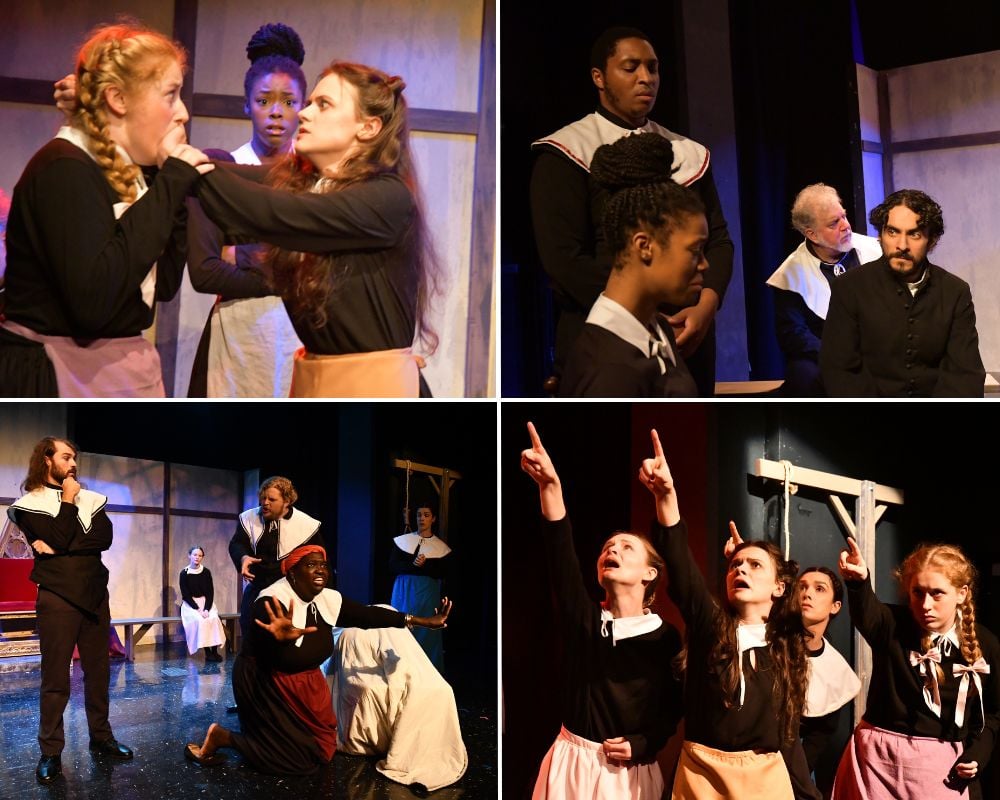
In her performance as Mary Warren, the Proctor family’s maid, Lady’Jordan Matthews-Mason invites profound sympathy while being simultaneously eerie — nothing like a wide-eyed blank stare with real tears to invite fear, pity, and just a little terror. Further, Jacqueline Youm delivers in the difficult role of Tituba, the enslaved woman owned by the Parris family, who is framed for witchcraft and is ultimately driven insane by the conditions of her imprisonment. Her raw performance is also unsettling and uncomfortable to behold — and offers an important reminder of how rampant fear in a society consistently hurts its most vulnerable.
Anna Mae Murphy creates a terrifying and truly despicable villain in Abigail Williams. She is one of the chief false accusers of her neighbors and subsequent architects of the trials, seeming to take joy in them as she sways the will of the community and legal system to suit who she wants suspected and killed. Murphy’s performance is utterly devastating; Williams delivers an otherworldly performance as this character whose evil knows no bounds. If any bones are to be thrown to Governor Danforth, at least he thinks he’s doing right by God — Abigail does not seek to justify her actions.
While canonically a 12-year-old girl, Murphy portrays Abigail as a grown woman — thank goodness, given that for a few brief seconds the audience sees her in the complete nude after she attempts the seduction of John Proctor. If you are attending and would rather not see this, the further to audience-right you sit, the less will be visible.
As John Proctor, Matthew J. Murray is excellent, especially in his moments of deep emotion. Murray’s eruptions are delivered with convincing, well-timed intensity and the air of sincerity, which is a rare gift among performers. Given the naturalness of other performances on stage — particularly the show’s villains — Murray’s polished style of delivery makes his performance less immersive and believable. To communicate the harm of his affair with Abigail, more clear chemistry with his wife Elizabeth and/or Abigail, as well as a more conversational delivery approach would bolster his performance. In any other show, Murray’s performance would be a standout — he is simply surrounded by some of the best I’ve seen in community or professional theater, and his role as the protagonist demands something of an exceptional performance among exceptional performances. He has something of an impossible task on his hands, given how much harder it is to communicate everymanness opposite cruelty with equal theatrical power.
The Dominion Stage’s Crucible appears to be a definitive production of this play for the DC area. With only the exception of Abigail, every character is simply devoted to genuine, theoretically admirable beliefs — even their goals of ridding their community of threats to themselves and their families are not unempathetic. It is how they let fear take these goals to catastrophic extremes in misguided staunchness — staunchness that some might deem praiseworthy — that makes The Crucible so timelessly devastating.
Running Time: Approximately two hours and 15 minutes, including a 15-minute intermission.
The Crucible plays through August 24, 2024 (Thursdays, Fridays, and Saturdays at 8 pm), presented by Dominion Stage, performing at Theatre on the Run
3700 S Four Mile Run Drive, Arlington, VA. Tickets are general admission and cost $25 (online coupon code “PROCTOR5” saves $5) and may be purchased online. The online box office closes at 4:30 pm the day of performance, but a limited number of full-price tickets MAY be available at the door prior to curtain. Come early to secure a seat.
The playbill for The Crucible is online here.
COVID Policy: Masks are optional.
PRODUCTION TEAM
Executive Producer: Mary Beth Smith-Toomey
Director/Producer: Danni Guy
Music Arranger: David Weinraub
Stage Manager: Lauren Markovich
Lighting Design: Jeff Auerbach & Kimberly Crago
Set Design: Alex Bryce
Props and Set Dressing: Katy Jones-Powe
Costume Design: Kit Sibley and Jean Schlichting
Hair & Makeup Design: Rebecca Harris
Graphic Design: Brittany Washington
CAST
JOHN PROCTOR: Matthew J. Murray
ELIZABETH PROCTOR: Malerie Goodman
ABIGAIL WILLIAMS: Anna Mae Murphy
MARY WARREN: Lady’ Jordan Matthews-Mason
GILES COREY: Robert Heinly
REBECCA NURSE: Margaret McCabe Janicki
REV. SAMUEL PARRIS: Jacob Reese
REV. JOHN HALE: Shakil Azizi
BETTY PARRIS: Clare Shannon
TITUBA/MARTHA COREY: Jacqueline Youm
SUSANNA WALCOTT: Jen Ware
MERCY LEWIS: Raeanna Nicole Larson
ANNE PUTNAM/SARAH GOODE: Jenn Robinson
FRANCIS NURSE: Ned Kieloch
EZEKIEL CHEEVERS: Michael Angeloni
THOMAS PUTNAM/JOHN WILLARD: Michael McCarthy
JUDGE HAWTHORNE: Cameron McBride
GOVERNOR DANFORTH: Stuart Fischer