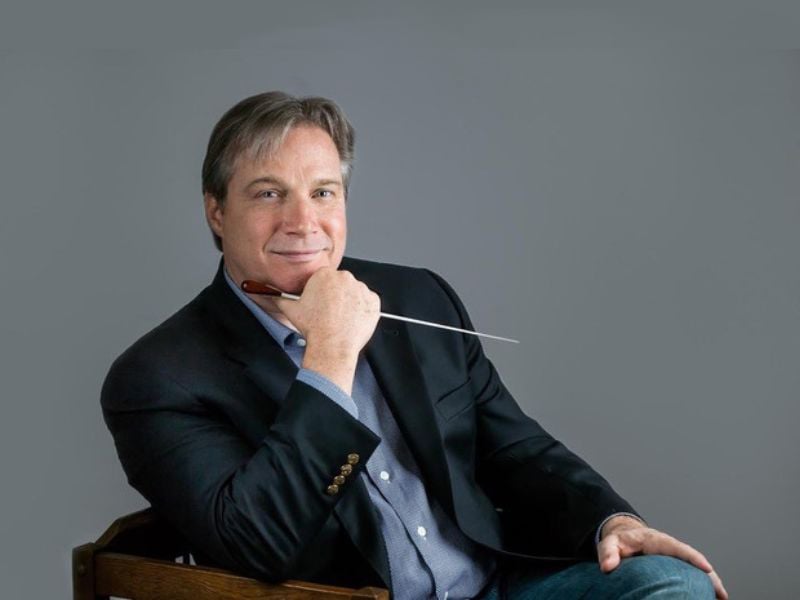
This year, J. Ernest Green celebrates 40 years as artistic director of Live Arts Maryland, a nonprofit bringing different music to the Annapolis area. He recently spoke with DC Theater Arts writer Charles Green (no relation) about his journey to Live Arts, its latest venue at Annapolis Mall, and his hopes for the future. (This interview has been edited for length and clarity.)
Charles Green: How did you come to Live Arts Maryland?
J. Ernest Green: I came to Live Arts fresh from graduate school at Peabody, because one of my teachers suggested I should. I was determined to stay five to eight years; I was conducting in South America as well as other guest conducting. Now 40 years later, I’m still here. It’s that great Harold Hill line from The Music Man: “This time, I got my foot stuck in the door.” But I feel like I put it there intentionally because soon after I got here, I fell in love with this group and what we did together. So even though I do a number of other things, for instance guest conducting the Toledo Opera for South Pacific, I’m still following what’s going on with the Annapolis Chorale.
Live Arts Maryland began as the Annapolis Chorale, which last year celebrated its 50th season. The Annapolis Chorale was a typical community chorus, and we had a great audience. Toward the end of the ’80s, we started doing more creative things, presenting other musical groups: a string quartet from Brazil, a jazz ensemble, musical theater. We noticed our audience didn’t always get why the Chorale was presenting things but not singing. When Larry Molinero did the organ accompaniment to the silent movie Phantom of the Opera, we advertised it as “The Annapolis Chorale presents,” but people kept asking if the Chorale was singing. Then we added Live Arts to the top of promotions to clear up any confusion. Now, it’s an umbrella for groups like the Annapolis Chorale, the Annapolis Chamber Orchestra, and Cantori, a women’s chorus led by my colleague Laurie Hays.
At Peabody, I was the orchestra conducting assistant and was asked to take on the chorus assistantship, which I didn’t want. I thought they wanted me to switch from orchestra to chorus, but really they wanted to give me an additional assistantship, which gave me enough money to eat and pay rent at the same time. I rehearsed with the chorus and just fell in love with choral music and working with singers and never looked back. It set the course for my musical life in a way I wasn’t expecting. No matter where I am, what I’m doing, the Annapolis Chorale is at the core of what I do. They had a rehearsal last night without me; hopefully, they didn’t have too much fun!
Live Arts offers a variety of music, from the resident ensembles of the Annapolis Chorale and Chamber Orchestra to guest artists like The Bluegrass Nutcracker and Paul Schaffer. How do you decide each season’s lineup?
I joke that groups like ours do the same 40 pieces over and over. Very few are contemporary, or if they are, they’re so esoteric audiences can’t grab onto them. So, I do programming in segregated chunks. I think about the Chorale first, not just what I want them to sing, but what I want them to sing now that’ll give them the tools and vocal, musical concepts to help them sing future pieces. For instance, this spring we’re doing a world music setting of the British composer Karl Jenkins’ “Requiem.” The chorus sings in Latin, English, Hebrew transliteration, Japanese haiku. I’m constantly thinking about what’ll benefit them musically, artistically, and creatively. And the most important part: what’s fun, because the minute it stops being fun and becomes a chore, we’re absolutely done.
I also program by finding contemporary pieces and mixing them with traditional ones. On a program last year, I did Karl Jenkins’ setting of the “Gloria” along with Bruckner’s “Te Deum,” two huge pieces evoking praise and majesty, one from the 1880s, one from the 2000s. The idea is to show that choral music is still evolving.
We have a really exciting partnership with Saint Anne’s Church, mixing sacred and secular worlds. We’re pulling people from the church to the Chorale and Choir and pulling people from the community into the church. Both groups feed each other.
Lastly, we consider pops and musical theater programming. This year is the first time in a long time we’re not doing a big musical theater production, but we’ll do some smaller shows at the Studio to keep the feel of Broadway concerts and musicals.

We can’t keep doing the same thing over and over. We need change, and I’m using that need to help drive programming. We bought Paul Shaffer here last season because he’s a friend, and I’m also his conductor. Over the years, we’ve brought in people like Marvin Hamlisch, Lindsay Mendez, Derek Davis, and Lucie Arnaz. The biggest thing when working on programming with them is asking, “What are the pieces that mean something to you?” That tells you who they are as an artist and helps figure out the rest of the puzzle. For instance, for the holiday concert with Derek Davis, I asked, “Is there anything particular you want to sing?” That’s how we ended up with his version of “My Favorite Things” because he said, “I love that song; I never really get to sing it.” I called an arranger I work with and said, “I want this song in E minor, I want Derek to sing the verse, and then I want a solo break.” Pops concerts have to be very collaborative, but a lot is knowing the artists that you’re working with; if you know them and what they want, you’re way ahead of the game.
And again, I want it to be fun — for the singers, the orchestra, the soloist, and the audience. You need that extra reason for doing a piece. I think that’s one of the reasons we’ve stayed alive over the years, being really fussy about finding that reason.
You perform in different spaces: Maryland Hall, St. Anne’s Church, and the Live Arts Studio at Annapolis Mall. How did the Studio come about?
This started off years ago when I was doing an opera tour in Europe. On one stop in northern Spain, I walked past a storefront where there was a grand piano and some people performing. If I had time I would’ve loved to drop in and see what they were doing. I wondered if we could figure out a way to change the way that we present and consume music, make it less about a destination and more about spontaneity. Years later, COVID hit, and once we realized we weren’t reopening anytime soon, we started recording music. We recorded the first movement of Dan Forest’s “Requiem for the Living” on a back lawn, bringing in 16 people at a time, each with their own mike and headphones. They all recorded individually into their own microphone, and then we brought in the next 16 people, layering the sound on top of one another.
After a while, I called the Annapolis Mall to say, “I would love to put a music studio in the mall where we could create new performances while keeping everybody socially distant.” They liked the idea and put us in an empty storefront, which needed to be completely gutted, but we produced concerts there.
Now, the Studio’s a destination spot. We have people all over the region who come to the Annapolis Mall because they’ve heard we have this studio space. We have several hundred people who buy food and stuff at the stores around us and then see a concert. It’s become a town square where the community meets and is engaged. This spring, we’ve got Paul Cullen, the bass player for Bad Company, coming for a mini-concert.
What are your hopes for the future of Live Arts?
There are two answers. The proper answer is that I want the group to continue to grow, explore new ways to create music, and bring great music to the community. That’s a given. What I really want is for Live Arts to become a beacon where people can come and experience traditional music in new ways. For instance, this spring, we’re doing a set of four concerts around music that was important to me as I grew up with this group, a big repertoire, but in a way that’s more like a chamber performance. We’ll do Fauré’s “Requiem” and have the audience sit in the middle of the chorus. For me, it’s about finding ways to make the audience, chorus, and performer experience unique and forward-looking. I don’t want to go backward into the 1800s and 1900s; I want to go forward and see what new things we can come up with.

For information about Live Arts Maryland and upcoming performances, visit their website.