As one of the world’s oldest forms of organized competition, the origins of sumo wrestling – Japan’s national art or kokugi, combining sport, sacred Shinto ritual, and cultural tradition – dates back almost 1500 years. Now making its NYC debut for a limited engagement at The Public Theater, Lisa Sanaye Dring’s new drama SUMO, a co-production with Ma-Yi Theater Company and La Jolla Playhouse, offers a rarely seen look at the communal living, strict training, elite tournaments, behind-the-scenes relationships, and moral choices of six men competing for primacy in Tokyo, with informative direct-address commentary by the characters on the terminology, history, and demands of the discipline.
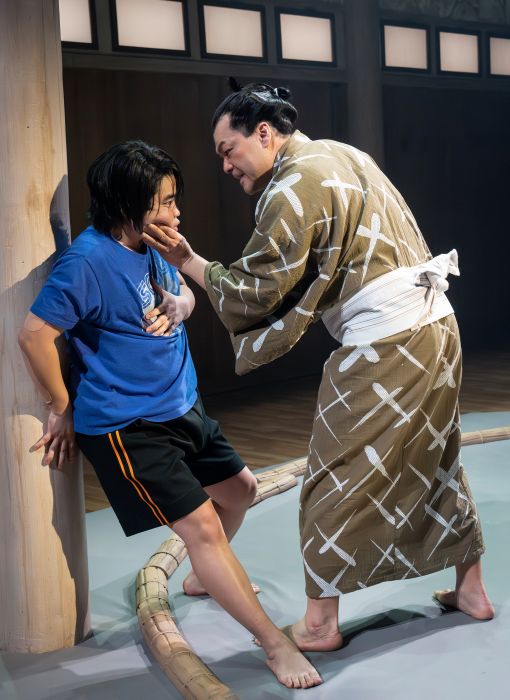
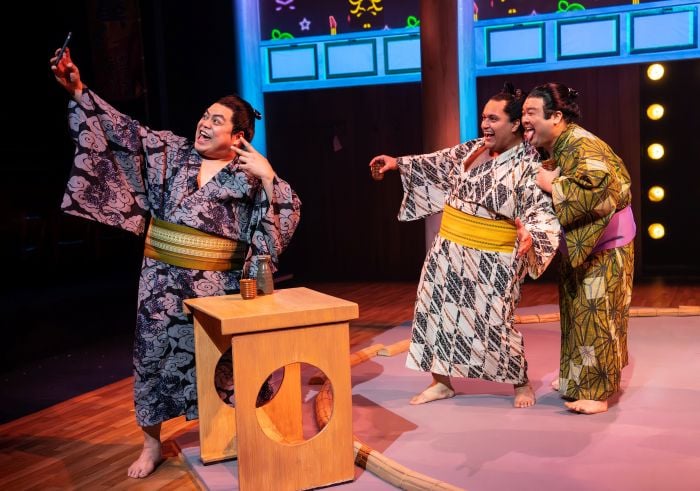
Directed by Ralph B. Peña with a mixture of physical and emotional tension, didacticism, and touches of humor to lighten the anguished tone – most notably, the opening curtain speech performed in character, and a drunken scene in a karaoke bar that’s hilarious until it isn’t – the narrative follows the journey of the achingly ambitious and scrappy young Akio (embodied with empathy by the excellent Scott Keiji Takeda), who, after a difficult childhood, is desperate to ascend to the top of his heya (the “stable” or facility where the wrestlers live and train), under the brutal command of the highest-ranking Mitsuo (David Shih, believably delivering the heartlessly tough and abusive behavior inherent in his unlikable role).
They are joined by the successful, strongest, and biggest bodied Ren (Ahmad Kamal), who, though second in rank, is more humane, respectful, guiding, and loving; Fumio (Red Concepción), with whom Ren is involved in a secret relationship; the devoted mid-level So (Michael Hisamoto), who waivers between winning and losing, being taunting and helpful to Akio; and Shinta (Earl T. Kim), an underachiever and, just above Akio, the next youngest and lowest in rank, as they work through the bodily pain, need for sponsors, and drive to win (or be expelled from the heya and sumo).
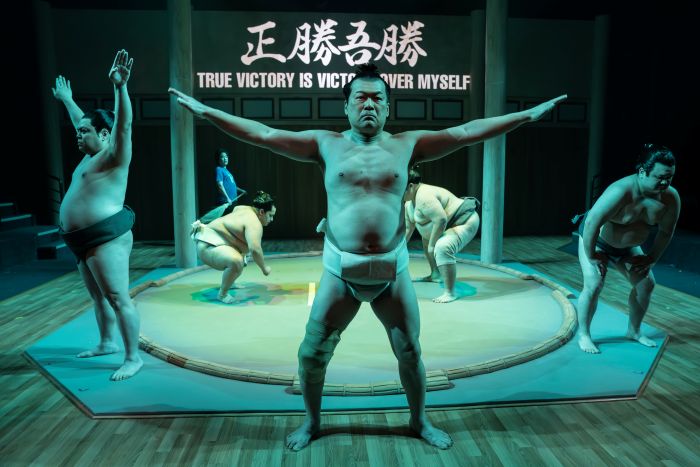
In addition to the heavyweight wrestlers are three kannushi – members of the Shinto clergy (played by Paco Tolson, Kris Bona, and Viet Vo) – who provide the explanatory and poetic asides to the audience. All bring distinctive characterizations (despite the script’s absence of background stories for most of them, which would offer a more three-dimensional understanding of their personality traits and motivations) and insights into the practices and struggles of sumo (including the fact that the spirit of sumo is a woman, though women, and any contact with them by the lower-ranking wrestlers, are forbidden), as well as mastering its moves, under the lead of sumo consultant James Yaegashi and co-fight directors Yaegashi and Chelsea Pacewill (who also serves as intimacy director).
Of primary importance to the show is its authentic artistic design. The set by Wilson Chin centers on the dohyō – the circular wrestling ring in which the training and competitions take place – with the audience in stadium seating on three sides and a back wall that opens for movable furnishings to be rolled in and out, and for scenes in which the characters and mystical figures appear. It also serves as the screens on which different levels of projections (by Hana S. Kim) set the locales, keep score of the matches, and contain images of the art and history of Japan (up to the present), with captions in both English and Japanese. Costumes by Mariko Ohigashi, and hair and wigs by Alberto “Albee” Alvarado, are true to the traditional dress of the country and the garb and mawashi (loincloths) of the wrestlers, as are the props by Thomas Jenkeleit, including the bow used in the yumitori-shiki, or twirling ceremony, which results in a fateful end for one of the characters.
The moods are enhanced by Paul Whitaker’s expressive lighting, from bright and colorful to dark and magical, and music composition and sound by Fabian Obispo that captures the applause of the crowds at the tournaments. And at the heights of the back wall, Shih-Wei Wu performs his original taiko drum compositions live, to add to the dramatic intensity and genuine cultural heritage of the story.
SUMO is an enlightening, often disturbing, sometimes funny, and ultimately revealing deep dive into the ancient Japanese tradition, with a transporting design and a cast that brings it all to life. If you’re interested in learning more about a very challenging subject, be prepared to cringe, to laugh, and to consider the moral decisions that are central to this dramatic NYC premiere. Also be advised that the production contains haze, fog, loud noises, strobes, and flashing lights, in addition to its episodes of violence and self-harm.
Running Time: Approximately two hours and 10 minutes, including an intermission.

SUMO plays through Sunday, March 30, 2025, at The Public Theater, 425 Lafayette Street, NYC. For tickets (priced at $63-93, including fees), go online.