Now playing a limited engagement at NYC’s Lucille Lortel Theatre following a sold-out run in London that opened to critical acclaim in 2023, Emmy and Olivier Award winner Andrew Scott brings to life all eight of the unhappily entangled characters (and senses the ghost of a ninth) in Vanya, a thoroughly compelling newly condensed, updated, and reset solo version of Anton Chekhov’s classic 1897 masterwork Uncle Vanya, co-created by Scott, adaptor Simon Stephens, director Sam Yates, and set designer Rosanna Vize. Combining sardonic comedy and affecting tragedy, the play, in keeping with the inherent intent of Chekhov, offers a reflection on disillusionment, regret, unrequited love, and the search for the purpose of life, as the actor flawlessly delivers a full range of human emotions and psychological insights in a tour-de-force performance that is sure to garner many more awards.
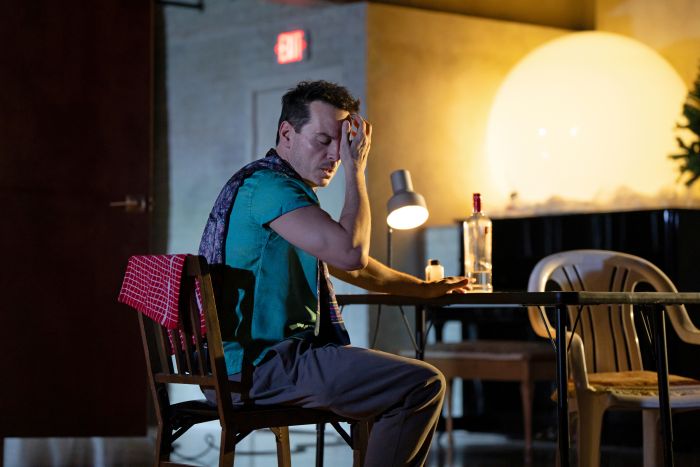
For those unfamiliar with the story, the complex narrative follows the interactions, romantic longings, and nagging dissatisfaction of a dysfunctional family on a country estate in financial decline, managed and worked by the titular Vanya and his niece Sonya, inherited by Alexander Serebryakov – the widower of his late sister and her mother Anna – now married to the beautiful and much younger Yelena, and visited daily by their heavy-drinking physician Mikhail Astrov, who, like Vanya, lusts after the new wife, while the plain Sonya harbors feelings for the doctor.
Though it helps to have some previous knowledge of the intertwined characters and plot points, Scott clearly defines each with distinctive voices, demeanors, facial expressions, body language, and props and accessories – a cigarette, a bottle of vodka, sunglasses, a dish towel, a necklace, a scarf (costume design by Natalie Pryce) – and drives home the essence of Chekhov’s serious message with irresistible humor and sly looks, heartrending distress and poignant empathy, in a post-modern adaptation that still speaks to the challenges faced in life and love.
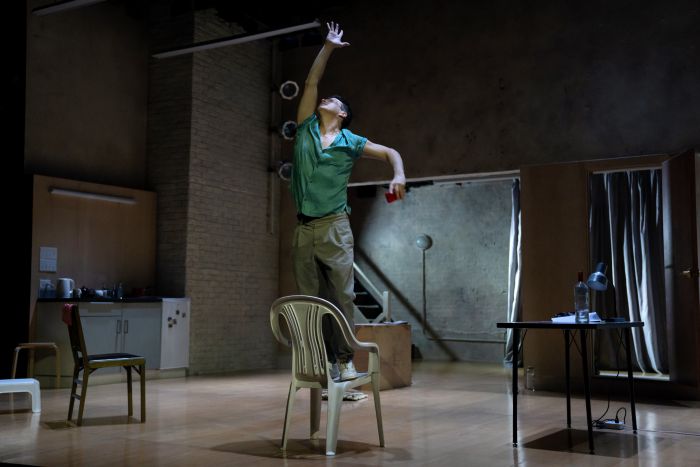
The setting here is no longer a rural estate in the Russian countryside but a potato farm (presumably in Ireland, based on Scott’s heritage and accent, and the nation’s traditional crop) and the rundown interior of the house in Vize’s scenic design contains minimal modest furnishings of the late 20th century, including a white plastic garden chair, a vintage slide projector (video design by Jack Phelan), a cassette tape player, a handheld device used to emit sound effects (sound by Dan Balfour), a recycling bin for the omnipresent vodka bottle when empty, and an upright piano played by the unseen ghost of Anna.
Such well-chosen songs as “If You Go Away” (Rod McKuen’s English translation of Jacques Brel’s 1959 ballad), softly and sensitively sung by Scott, capture the feelings inherent in the theme, and his shirt and pants, speech patterns, current vernacular, and f-bombs are all indicative of a century beyond Chekhov. The names of the characters have also been modernized and anglicized (e.g., Vanya is now Ivan, the doctor is Michael, Yelena is Helena, and the house staff Marina and Ilya are Maureen and Liam), and Alexander here is a filmmaker, not a failed professor, whose “only successful films are adaptations,” notes Ivan, in a witty self-referencing wink at the present production.
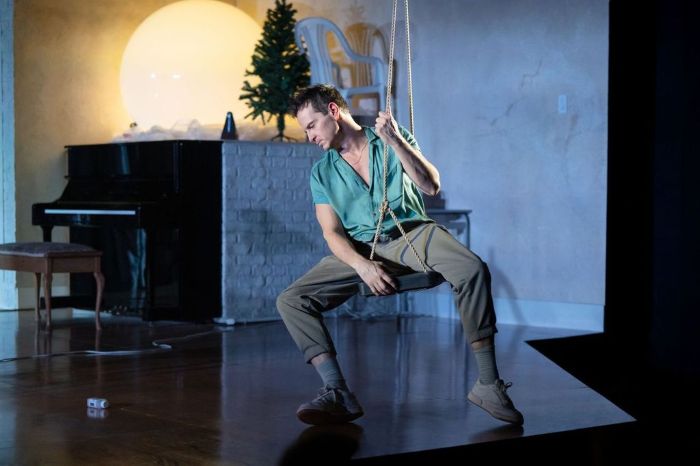
Under the incisive and engaging direction of Yates, Scott moves around the space, sits on the chairs, the stage, and an outdoor swing, climbs steps, exits the room behind a section of wall and re-enters as someone else through the adjacent central door, with non-stop split-second transitions from one role to the next, never once missing a beat or a readily identifiable characterization. There are also direct address monologues and metatheatrical segments, including the opening scene of the actor silently pulling open the background curtains and repeatedly turning the house lights on and off (lighting by James Farncombe) to set just the right tone, and an intimate scene between Michael and Helena (movement direction/physicality by Michela Meazza), with Scott playing both characters simultaneously. It’s all rendered with faultless precision, razor-sharp laughs, and spot-on understanding of Chekhov’s original.
Everything about this superb production and Scott’s phenomenal performance make Vanya a must-see, so get your tickets now because it’s a show that’s sure to sell out fast, just as it did in London.
Running Time: Approximately one hour and 55 minutes, without intermission.

Vanya plays through Sunday, May 11, 2025, at the Lucille Lortel Theatre, 121 Christopher Street, NYC. For tickets (priced at $104-434, including fees), go online.