Let me preface this review by saying that I have performed in three productions of Inherit the Wind, I have seen over 30 productions, and it remains one of my favorite plays.
One might think that coming to grips with Fauquier Community Theatre’s current production, an intensely provocative staging of Inherit the Wind, directed by Leslie Anne Ross, would be an easy task. In truth, as theatergoers in 2025, we often struggle with the image that a dramatic mirror reflects for us.
As you walk into the theater, you are greeted by pre-show music that has a calming and soothing effect on the audience. Looking upon the stage, you see a predominately seasoned wood set (designed by Scott Graham) that is simple but powerful. Looking outside some of the windows, you can interpret if it is sky or water, and others that give the illusion of crumbling buildings.
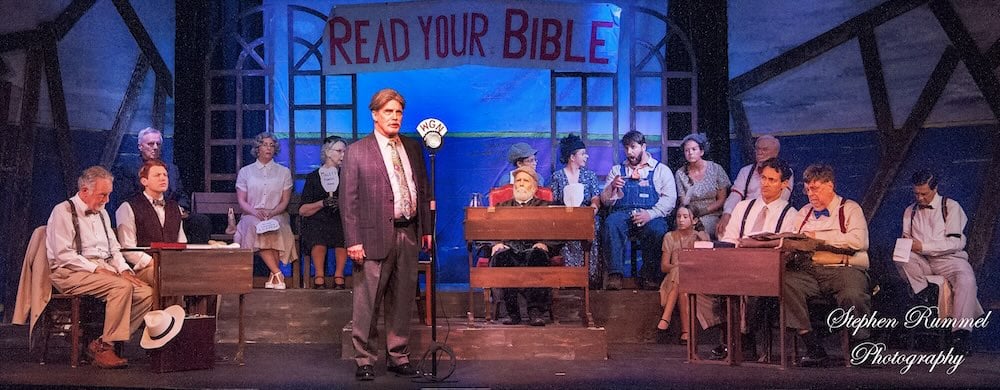
Inherit the Wind, first brought to the stage in 1955 by playwrights Jerome Lawrence and Robert Edwin Lee, has certainly proven a durable piece of American theater. The play takes its name from Proverbs 11:29, “He that troubleth his own house shall inherit the wind: and the fool shall be servant to the wise of heart.” The intent of the play’s title is to undermine the strict interpretations of the fundamentalists who condemn.
The play centers on the real-life Scopes Monkey Trial, pitting the teaching of the science of evolution against religious creationism. The trial took place in the 1920s in Dayton, Tennessee. The playwrights, though, were anxious to broaden their premise so that it encompasses more dramatic territory — in this case, the freedom to think without fear. Current-day issues were also a factor. At the time of the play’s writing, the evils of the “Red Scare” and McCarthyism were clearly on the playwrights’ minds; their script notes state: “It is not 1925. The stage directions set the time as ‘Not too long ago.’ It might have been yesterday. It could be tomorrow.”
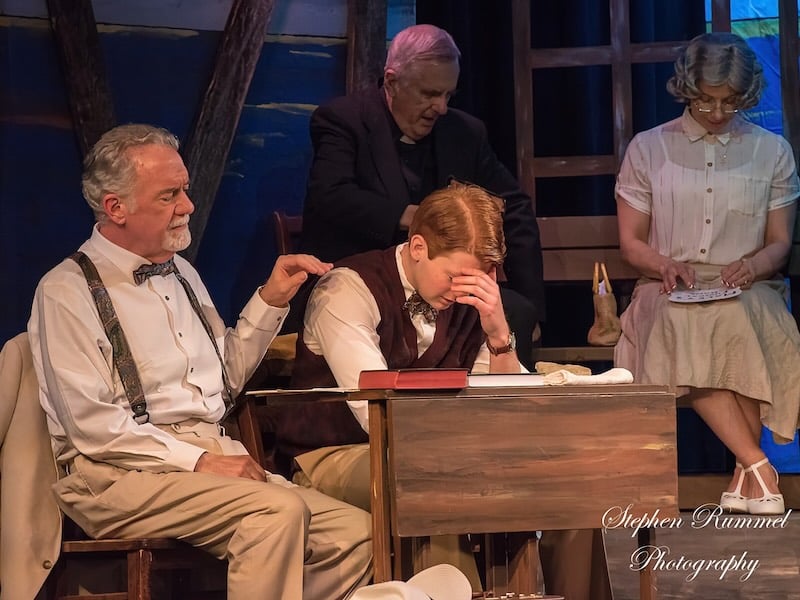
The play’s parallels to the historic trial are transparent. John Scopes has become Bertram Cates, superbly portrayed by Max Pawlak as a young, somewhat meek biology teacher in the fictional town of Hillsboro, Tennessee, who has been arrested for violating a state statute that makes teaching evolution a crime. Both sides have sought a trial to bring the issue into the spotlight of public awareness.
Heading the prosecution of Cates is Matthew Harrison Brady, based on real-life orator-politician William Jennings Bryant (Timothy Horn). Brady is opposed by feared defense attorney Henry Drummond paralleling real-life Clarence Darrow (James Mitchell), whose presence is being paid for by the Baltimore Herald. As a way of giving attention to the issue, the newspaper has sent the acerbic and die-hard cynical critic E.K. Hornbeck, based on H.L. Menken (Scott Graham), to cover the trial.
Mitchell’s portrayal of Drummond shows Drummond as an small-minded man while painting his character with wisdom and experience shaded with cynicism, his primary tools being intellect, logic and language. On the other hand, Horn has the onerous task of constructing an unsympathetic character who has lived a notable life that bristles with self-righteousness and religious rigidity. Horn fills his character with self-consuming hubris, making it a life that inevitably fails because of it.
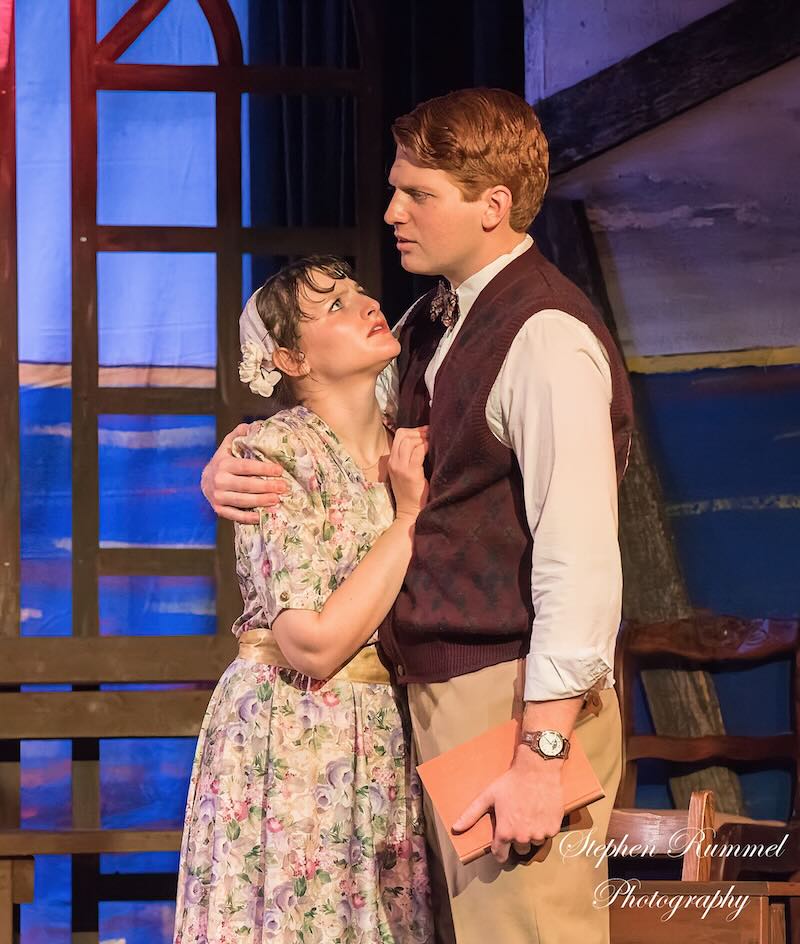
The Reverend Jeremiah Brown (Eugene Schmiel) assembles his flock for a damnation sermon. The intertwining and intractability of political and religious fundamentalism is a trait demonstrated by Schmiel belonging to Reverand Brown, but it is his school-teacher daughter Rachel (Lianne Aarons) who, as Cates’ girlfriend, is caught in the trap of having to portray conflict between what she has been taught by her father and her romantic loyalty to her boyfriend. Aarons’ characterization of Rachel answers the play’s key questions about freedom of thought.
Drummond has proved more than a match for the pontificating Brady, eventually calling him to the stand when all of his scientific witnesses are summarily dismissed by the judge (Moses Kutz). That is where the courtroom drama escalates, as Brady is forced to confront the nature of his own beliefs, and the tide turns against him. Brady oozes confidence, charm, and power as he manipulates all around him. But it is the moment in which he breaks down and collapses into self-pitying tears (“I hate it when they laugh at me”) that is the most telling and indelible image.
This is a cast of 21 very adept actors. Each one of them brings their own nuance to the stage. I wish I could call out all of them. Kudos to the creative team of Kaitlyn Nelson (sound design), Stacy King (light design), Pat Jannell (props), Jim Watkins (set construction lead) Ryan Kincade (hair and makeup), and the daughter/mother duo of Sabrina Chandler and Claudia Tameris (costume design), who effectively took us back to the 1920s. I can’t forget Don Richardson (producer), who has now produced 21 shows for FCT.
Director Ross has a clear handle on the script’s onslaught of emotions and intrigue, allowing characters to function beautifully as a well-oiled ensemble. She effortlessly tinged the seriousness of the trial drama with bits of comic relief. Leslie Anne Ross and her cast and creative team have set the bar for theater in the DMV.
One could leave a production like Fauquier Community Theatre’s Inherit the Wind charmed by it as a history story of a curious time gone by. As it turns out, though, the battle for freedom of thought and expression is apparently a universal one — and one that continues. To quote Rachel Brown, “I was always afraid of what I might think — so it seemed safer not to think at all. But now I know. A thought is like a child inside our body. It has to be born. If it dies inside you, part of you dies too.”
Running Time: Approximately two hours and 15 minutes, including a 15-minute intermission.
Inherit the Wind plays through March 30, 2025 (Fridays and Saturdays at 7:30 pm and Sundays at 2:00 pm), presented by Fauquier Community Theatre, performing at Vint Hill Theater on the Green, 4225 Aiken Drive, Warrenton, VA. All tickets ($16 youth, $18 seniors, $20 adults) are for reserved seating. Purchase tickets online or call the box office at 540-349–8760.
See Facebook for additional photos.
COVID Safety: Fauquier Community Theatre is following the latest guidance from the Centers for Disease Control and Prevention and the Virginia Department of Health. As such, we will not have any seating or distancing restrictions. Face coverings are optional. If you feel sick or are displaying any symptoms of COVID-19, or have been exposed to someone sick, please do not attend. The theater’s complete COVID Procedures are here.
Dr. Harry Kantrovich is an award-winning director, actor, and playwright in the DMV. He has premiered three original plays in Northern Virginia, two of which have earned international acclaim.