In his autobiographical memory play We Had a World, now in its extended world premiere engagement with Manhattan Theatre Club at Off-Broadway’s New York City Center, award-winning playwright Joshua Harmon exposes three decades of familial dysfunction, outrageous behavior, scathing vitriol, disturbing revelations, and lasting love between him, the grandmother in NYC who introduced him to the arts and inspired his career, and the embittered mother who suffered childhood trauma, resulting in a severely broken relationship with her own mother. Directed by Trip Cullman, the funny and increasingly poignant three-hander combines non-linear narration, re-enactments of key recollections, both good and bad, and direct-address segments by each of the characters from their own personal perspectives, affirming Joshua’s observations that “there are three sides to every story” and you “can’t see the world in black or white.”
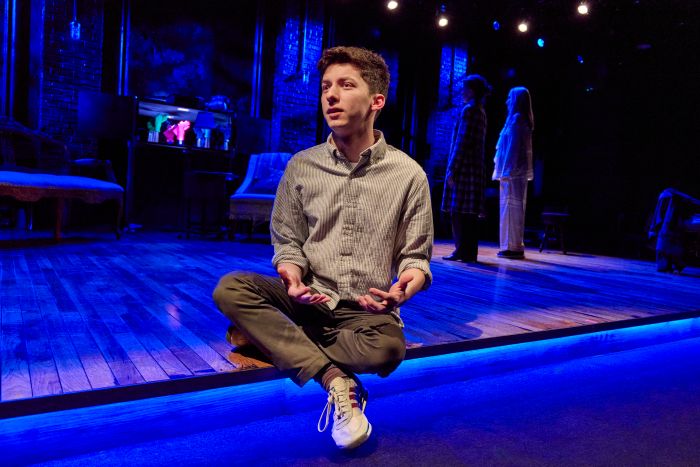
The show opens with the 94-year-old Renee, dying of pancreatic cancer, requesting her grandson write a play about their family and “make it as bitter and vitriolic as possible.” He does, then takes us back to the memorable episodes that defined their personalities and inter-relationships, and how they shaped his life and art. In his eloquent, intimate, and amusing storytelling, Joshua describes the close connection he had with the Nana he adored, who brought him with her from the young (maybe too young) age of seven to such adult-themed events as a gallery exhibition of Robert Mapplethorpe’s photographs (though, at the time, he laughingly notes, “I didn’t yet grasp the concept of fisting”), the bloody Western movie Dances with Wolves, and a Broadway production of the ancient Greek tragedy Medea (in which the eponymous enchantress kills her children). She also introduced him to the beauty of Paris and French culture (though mainly Jewish, she focused on the family’s slim percentage of French heritage), always encouraged his writing, and happily welcomed his husband into her home (first questioning if he was circumcised), but couldn’t come to terms with her daughter (Joshua’s mother) Ellen, culminating in a climactic blow-out at a planned family seder that threatened their lifelong bond, until her terminal illness brought them all back together, if only briefly.

On her part, Ellen is taken to fits of crying and hurling sarcastic zingers, then sharing a long-kept secret about Renee (no spoilers here), with which she explains to the teenage Joshua his grandmother’s sudden departure from his first professional performance (after claiming she wasn’t feeling well), which casts a new light on the women’s ongoing antipathy. Caught in the middle of the conflict, he sees that his mother could benefit from psychological counseling to preserve her mental health, but, like her mother before her, refuses to get the help she so obviously needs – whereas Joshua uses his expressive writing in We Had a World as a kind of healing self-help therapy.
Cullman keeps the characters moving around the stage and off, standing, sitting, walking, and coming to blows, recreating scenes that are carefully balanced between humor and revelations, confrontations and reflection, shock, rage, and pathos, keeping us thoroughly engaged, emotionally involved, and hoping for a resolution based on understanding, compassion, and affection triumphing over anger and estrangement.

In his stellar portrayal of Joshua, Andrew Barth Feldman proves once again that he’s one of the most empathetic and compelling young actors to grace the New York stage (and screen). He delivers the laughs, affection, and torment of his sensitive character, manifesting a full range of emotions, registering his thoughts and feelings in his voice, facial expressions, and body language, exploding with rage when he can no longer contain himself, and insightfully appreciating his family for who they are and what they’ve meant to him. The masterful Joanna Gleason turns in another superb performance as Renee, assuming a sophisticated accent and demeanor (in contrast with her character’s actual background), with lithe and graceful movements, a questioning mind, an appreciation of the arts and Paris, a readily legible love for and pride in her grandson, and an acceptance of her approaching death, until her hidden problem surfaces and she unexpectedly lashes out. Rounding out the cast as Ellen, a self-described “bitch,” Jeanine Serralles is less persuasive in her over-the-top melodramatic characterization, prone to histrionics, making faces, flinging her arms out, feigning outbursts of crying, manically rubbing her thighs, affecting a bad New York accent in imitation of her parents, and generally chewing the scenery, in a portrayal that lacks the emotional depth and control of the outstanding Feldman and Gleason, and failed to engender my sympathy.
John Lee Beatty’s minimal set contains the significant elements of the desk at which Joshua writes, the French furniture Renee purchased on a trip to Paris that decorates her tasteful apartment, and folding chairs set up by the actors to represent the movie and Broadway theaters attended by the two aficionados, with lighting by Ben Stanton and sound by Sinan Refik Zafar that enhance the shifting locales and moods. Costumes by Kaye Voyce, with wigs and make-up by Tommy Kurzman, are in keeping with the personalities, featuring multiple changes of her elegant wardrobe by Renee.
Along with his affecting reminiscences in We Had a World, Harmon employs the running metaphor of his interest in environmental conservation and concern about the effects of global warming as a parallel to his experiences with his embattled family. He leaves us with the declaration that it’s “a changing world . . . too beautiful to last, but we had it for a time with each other,” as indicated in the play’s title. It’s an uplifting conclusion that encourages us, despite all the challenges, to see the good in our lives and the people in them, as he has so brilliantly done here.
Running Time: Approximately one hour and 40 minutes, without intermission.
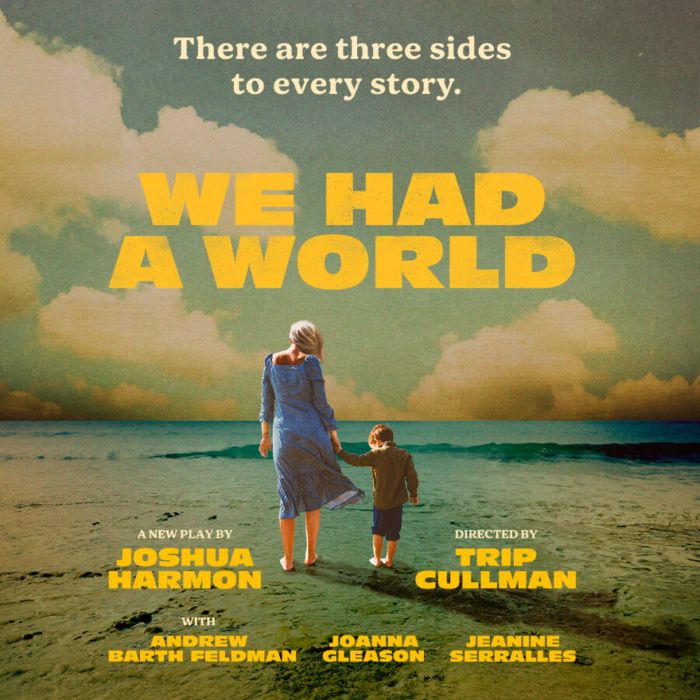
We Had a World plays through Sunday, May 11, 2025, at Manhattan Theatre Club, performing at New York City Center, Stage II, 131 West 55th Street, NYC. For tickets (priced at $125-160, including fees), go online.