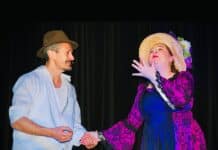
In this era when friends connect through Netflix-and-chill and group chat, does anyone have real company anymore? In my parents’ and grandparents’ generations, there used to be formal invitations, a table of homemade delicacies — either dinner or desserts — good china and silver place settings that accompanied adult conversations late into the night. Company was a big deal and a way for adults to connect and enjoy each other’s, well, company.
This idea of company informs Steven Sondheim’s 1970 musical of the same name, Company, which debuted on Broadway under the sure hand of director Harold Prince, featuring a book by Sondheim collaborator George Furth. Praised as a landmark show, it provided a sophisticated, cultured, urbane view of upper-middle-class life in Manhattan in the 1970s. The musical deals with dating — long before it became hook-up culture — love, marriage, infidelity, and divorce; in a nutshell, the ups-and-downs of modern relationships are analyzed.
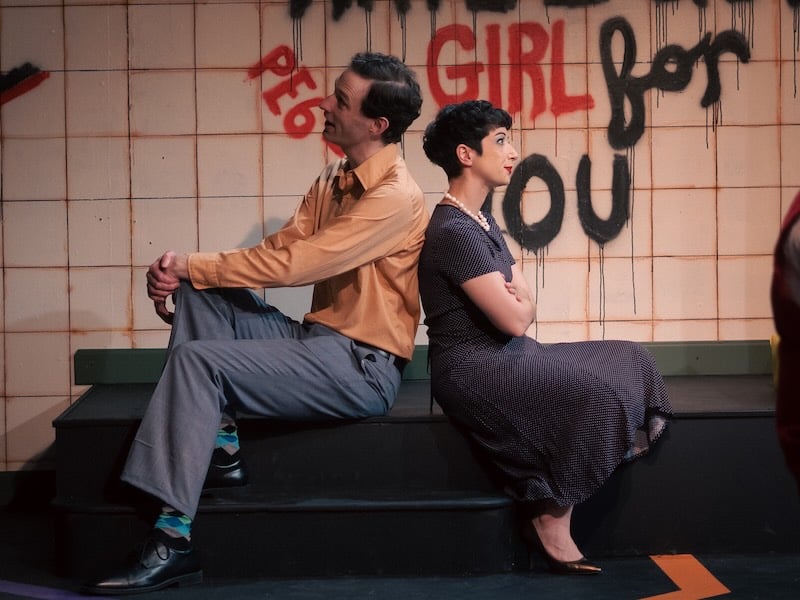
This month Silver Spring Stage, a stalwart community theater closing out its remarkable 56th season, is taking on this challenging musical, with its speedy patter songs, a heartfelt 11 o’clock showstopper, complex orchestrations and choral harmonies, as well as a script that could feel ridiculously dated more than 50 years after the show opened. Yet under the care-filled direction of Matt Bannister and music director Matthew Dohm, the production, while at times uneven, acquits itself quite nicely.
Silver Spring Stage’s space on Colesville Road in a basement shopping center under a CVS is not great. The stage is arranged like a diamond, with a support column at one corner and the audience seated in rows along two sides. But Bannister uses this industrial, inhospitable layout to advantage. This Company plays out against a backdrop of the New York City subway — Times Square station, to be exact. The walls are painted in a grid of white tiles (though not in the rectangular subway format) and graffiti that calls out to some of the song titles. This setting proves particularly apt for the Act One number “Another Hundred People,” reflecting the anonymity of urban life on the underground platforms. Bannister also designed the sets, which remain spare, featuring a series of platforms and movable boxes that serve as benches, stools, and tables throughout the two-act production.
The 14-member cast sings beautifully together. It must be because music director Dohm specializes in choirs while pursuing his master’s at Westminster Choir College. As a group, their singing is rich, filled with complex harmonies along with great personality and verve. The large numbers, including the opener, “Company,” and Act Two’s “Side by Side,” truly resonate vocally, even with pretty run-of-the-mill choreography, but this is a cast of singer/actors, not dancers, and singing comes through best in this production.

As Robert, or Bobby, the male lead, William Lewis warms into his voice and character over Act One and by Act Two, he comes into his own with a stunning rendition of “Being Alive,” Sondheim’s “I want” song, articulating what the composer called the “defining desires” of the protagonist. Unusually, the “I want” song typically comes earlier in Sondheim shows. But in Company, this song is the show’s penultimate, underscoring how long it has taken the Bobby character to come to terms with his purpose and articulate his desire with certainty.
Throughout, we follow Bobby on and after his 35th birthday, encountering friends, girlfriends, potential lovers, and strangers in an existential quest to, as E.M. Forster put it, “only connect.” We see him interact with and charm women — married, single, dating, or divorced, no matter — while he struggles with his purpose, questioning whether he needs a deep connection or if simple female companionship, physical or otherwise, is enough. He blows off his own birthday party, gets high with his married buddy and his wife, drinks plenty of bourbon with his teetotaling friends, and finds connection with Joanne (sharply played by Pamela Northrup), a married older woman whose cynical sarcasm forms the basis for a Sondheim classic: the bitter “The Ladies Who Lunch.”
Bobby’s “girls” include sweet-faced Amy, who sings the breath-defying patter song “Getting Married Today,” accompanied by her milquetoast fiancé, Paul (mild-mannered Alan Gonzalez Bisnes). As Amy, Marissa Liotta attacks “Getting Married” with vim and aplomb, finessing the tongue-twisting lyrics and comic angst of pre-marriage jitters. Rose Hutchison as April, the American Airlines flight attendant who flies in and out of Bobby’s life, provides the wistful longing needed for the duet “Barcelona,” but I’m always a bit bothered by the cheap surprise ending Sondheim and Furth concocted.
After more than half a century, Company shows its age. The elemental themes of connection, longing, friendship, and coupling remain relevant, evergreen, even; yet in 2025, we live our lives and find our loves differently. Our connections are often more matter-of-fact or, worse, digital. Perhaps, then, a reminder of the deep longing to “only connect” the old-fashioned way is necessary. In any case, anytime Sondheim’s smart, heartfelt, and scintillating music and lyrics are on tap, it’s a good time for old-school company.
Running Time: Two hours and 30 minutes, with one 15-minute intermission.
Company plays through June 29, 2025 (Fridays and Saturdays at 8:00 pm and Sundays at 2:00 pm) at Silver Spring Stage, 10145 Colesville Road, Silver Spring, MD. Purchase tickets ($23.75–$26.75 including fees) at the door, online, or by contacting the Box Office at boxoffice@ssstage.org or 301-593-6036.
Company
Music and lyrics by Stephen Sondheim, book by George Furth
Directed by Matt Bannister
CAST
Bobby: Billy Lewis
Joanne: Pamela Northrup
Larry: Bri Calleigh
Amy: Marissa Liotta
Paul: Alan Gonzalez-Bisnes
Sarah: Tanya Coyne
Harry: Brian Lyons-Burke
Susan: Isabelle Solomon
Peter: Daniel Riker
Jenny: Danielle Comer
David: James Armstrong
April: Rose Hutchison
Marta: Elizabeth Suzanne
Kathy: Laura Hepp