When the living room becomes a battlefield, no one leaves unscathed. Dark Horse Theatre Company’s upcoming production of God of Carnage promises an intimate evening of laughter, discomfort, and unnerving honesty. Yasmina Reza’s dark comedy about two sets of parents attempting to politely resolve a playground altercation between their children spirals into chaos as civility gives way to primal instinct.
“It’s brutally funny, painfully human, and exposes how thin our social masks really are,” says Arianne Warner, who stars as Annette Raleigh and also serves as producer. “I’ve always been fascinated by stories that start with polite civility and then slowly unravel into chaos. God of Carnage takes that idea to its limit.”
Warner describes the play as “a razor-sharp look at civility, ego, and the fragility of social order.” Beneath its laughs lies a mirror reflecting the absurdity of human pride. “We live in an age where outrage and self-righteousness have become sport,” she adds. “Everyone wants to be right, and few want to listen. The play mirrors that — it’s like watching a polite dinner party devolve into a Twitter thread in real time.”

For director Natasha Parnian, who also helms the company, the appeal lies in the tension between control and collapse. “This play is a masterclass in human unraveling,” Parnian says. “It’s a tight, domestic setting that somehow holds the entire spectrum of human behavior — pride, humor, cruelty, empathy, chaos. My job is to make sure the audience feels both the comedy and the ache underneath it. At Dark Horse, we don’t aim for caricature — we aim for truth, no matter how messy it gets.”
That duality, humor and honesty, runs through the entire creative team’s approach. Nate Eagle, who plays Alan Raleigh, was drawn to the play’s rawness and simplicity. “Four actors, one room, no intermission — I love that kind of play,” he says. “In a culture where loneliness is epidemic and we’re constantly told to avoid conflict, the sheer, delicious luxury of being stuck in open conflict with other people, and no one leaves, is overwhelmingly appealing.”
Eagle sees the story as a confrontation with modern repression. “As adults, we build facades of settledness — jobs, marriages, convictions — but underneath, things aren’t so stable,” he explains. “We have misgivings, regrets, desires we try to keep hidden. This play strips all that away.”
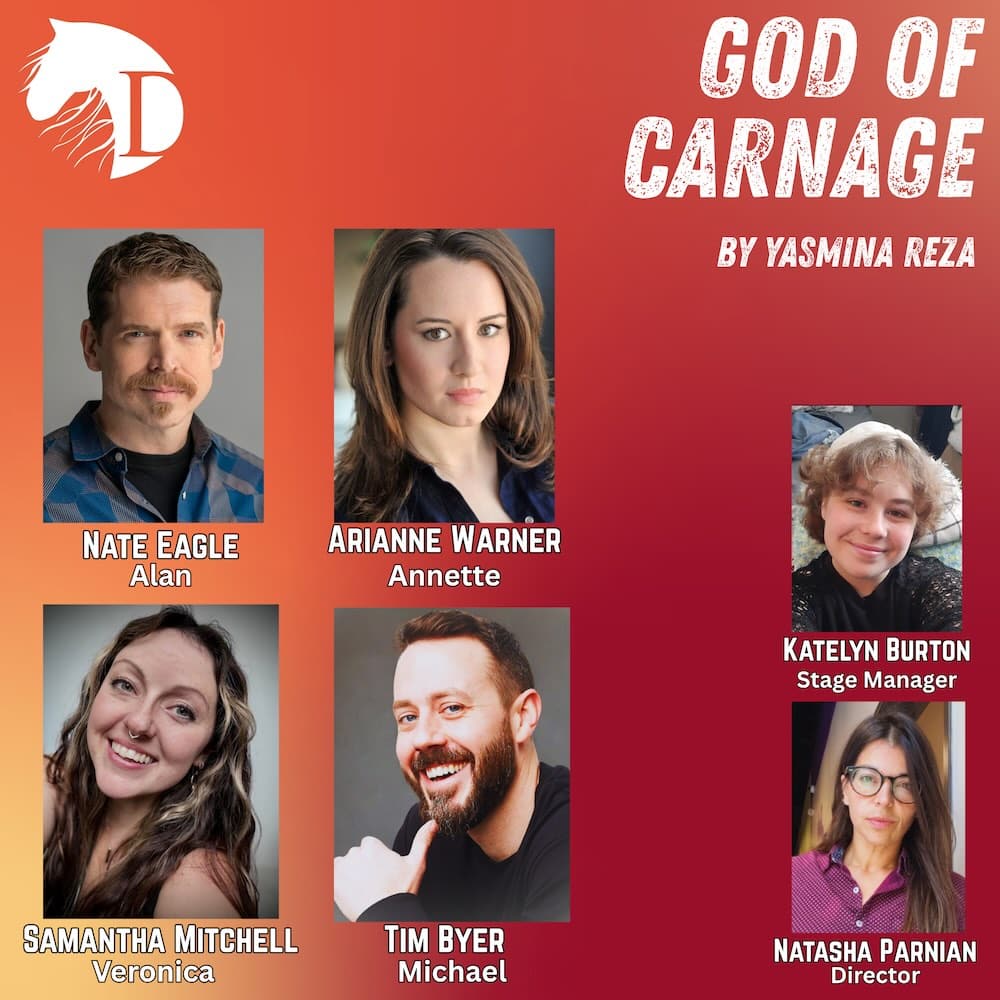
For Samantha Mitchell, who plays Veronica Novak, the show’s dark humor hits home. “I love how it starts civilized and spirals into something raw and hilariously human,” she says. “It exposes the fine line between civility and chaos. Beneath all our social polish, we’re just humans trying (and failing) to stay composed.”
Mitchell’s character begins as the voice of reason until her composure cracks. “Veronica starts composed, but her cracks show fast. That’s where the real humanity lives. She’s complex and quickly becomes raw,” Mitchell says. “The set reflects that carefully curated apartment filled with eclectic, Africa-themed art. It’s orderly and personal — and just waiting to come undone.”
Tim Byer, who plays Michael Novak, relishes that descent. “Adults standing up for their kids, devolving into childlike behavior themselves,” he says with a laugh. “The writer creates a situation both relatable and painfully awkward. And the way we’re approaching it with humor, mischief, and honesty, it lets us go deeper than temporary social norms to the core of what it is to be human.”
Byer believes the play’s message goes beyond the living room. “There are timeless themes here, like adults dealing with the outcomes of their children’s behavior, and questioning how strong our societal structures really are,” he says. “We want to make audiences laugh, but also reflect on their own relationships and to walk away thinking, ‘Okay, maybe we’re not doing that bad.’”
Stage manager Katelyn Burton describes the production as “a mix of comedy and uncomfortable truth.” To her, God of Carnage feels like a “pressure cooker with comedy.” “Two sets of parents meet to discuss a playground fight between their children,” she says. “Chaos ensues. The characters get progressively more unhinged and unpolished as the play goes on. One spark, and everything lights up.”
That combustibility is intentional. “We’re leaning into the tension and claustrophobia,” says Warner. “The comedy emerges naturally from the breakdown, which makes it both funnier and more unsettling.” Parnian agrees: “The laughter is the release valve. The humor lands because the emotion underneath is real. If you’re laughing, you’re complicit, and you see yourself in them.”
Eagle praises the rehearsal process for its intensity and depth. “Every beat of this play matters, and this production has cared about and crafted every beat,” he says. “If you want to see a play where the invisible iceberg of every character’s inner experience is real, you’ve gotta come see this one.”
Byer echoes that sentiment. “The collaboration is fearless,” he says. “We never settle or assume we know what’s best. We just keep moving further into the undefined void and creating from there.”
Mitchell describes the rehearsal room as “supportive, fearless, and committed to making thoughtful art.” Burton adds, “It’s fun, curious, always asking questions and asking why an element matters to the production.”
Parnian calls that energy the heart of Dark Horse’s work: “At Dark Horse, we build a culture of trust. We want to create an environment where artists can take big swings and explore the full range of human emotion. God of Carnage demands that. It’s not polite theater. It’s full of vulnerability.”
If the process sounds intense, it’s because it is, but that’s exactly what makes the show electric. “It’s not just a comedy, it’s a mirror,” Warner says. “You’ll laugh, you’ll squirm, and you’ll probably recognize someone you know — or yourself — in the chaos.”
Byer grins. “We’re bringing the full human experience to this play: head, heart, and hips.”
Dark Horse Theatre Company’s God of Carnage is equal parts wit and wreckage. It’s a reminder that beneath all our polite facades, the God of Carnage is never far away.
God of Carnage, presented by Dark Horse Theater Company, plays November 14–29, 2025, at St. Francis Episcopal Church in Great Falls, VA, and December 5–7, 2025. at Arts Herndon in Herndon, VA. Performances are Fridays and Saturdays at 8:00 PM, with a Sunday matinee on December 7 at 2:00 PM. Purchase tickets for both venues ($20) online.