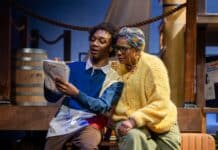
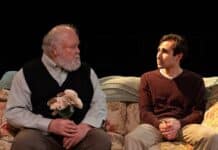
Director Jackie Madejski’s ingenious interpretation of Steven Sondheim’s famous fairy tale musical, Into the Woods, is perhaps the best thing I’ve seen this year. The popular musical brings together several classic Grimm Brothers characters as they venture “into the woods” on individual yet intertwining journeys, each in search of something. This production tells this story with a truly unique and innovative twist: it is told through the modern lens of a Dungeons & Dragons (D&D) game.
Before the show began, as the audience slowly trickled in, the performers were already engulfing us in their world. A round cafeteria-style bench table set up with the proper books and tools for a game of D&D was situated center stage. The performers joined around the table, greeted one another, discussed game strategies, and shared several snacks splayed out across the table (which they continued to snack on throughout the entire show).

The frantic, overlaid musical stylings of Sondheim’s works are perfectly mirrored by the excited back-and-forth often heard during D&D games. The performers ping-ponged the opening prologue effortlessly across the round tabletop. Throughout the show, as stories unfolded, the table was rolled around and planted at various points of the stage, which not only allowed every member of the audience a good view but also worked to continually ground us in the reality of their game.
Madejski masterfully reinterpreted the classic show without altering any of the dialogue or beloved music. Through super-clever and creative choreography and inflection in dialogue, it was clear a game was being played. The characters would recite lines as though reacting to another player’s turn, asking something of the game master, or reading from character description sheets, such as those passed out in role-playing games.
This was also achieved through the props by prop designer Martin Bernier and the costumes by costume designer Audrey Miller. To represent Milky White (Jack’s cow, which the Baker and his Wife must get as one of the items required to break the Witch’s curse on their family), they used a large dodecahedron (the 20-sided dice used in D&D) with multiple pictures of white cows on the various sides. The costumes were also simple and stripped back, each character wearing one to three pieces over their regular clothing, as is common in role-playing games.
Mel Gumina shone as the story’s imperative but precarious Narrator (or game master, if you will, in keeping with the D&D theme). And, as game masters are known to do, she also took on the roles of several other characters, including the royal steward, Little Red Riding Hood’s granny, Lucinda (one of Cinderella’s evil stepsisters), and Rapunzel’s prince. Gumina would flip back and forth between roles using simple props to represent the transition and add entertaining comedic effect.
Her exuberant physical movements — rolling, leaping, spinning, and crawling across the stage — added another layer to the sheer level of effort required for that role. She confidently carried the story’s narrative arc with an engaging level of enthusiasm that had me eagerly wanting to join the group of friends. I had the pleasure of seeing Gumina perform as Sally Bowles in Cabaret, so I knew I was in for a good show, but she reached new heights in this performance.

Her amazing theatrical voice took on several variations as she moved between characters. One song featuring Gumina that really stood out was “Agony” — a competitive ballad duet between Rapunzel’s Prince (Gumina) and his brother, Cinderella’s Prince (played by Shelby Young). Young also played several other characters in the game’s world (the NPCs, if you will), puppeteered by the Narrator (or game master), including the Giant, Cinderella’s father, and Cinderella’s other evil stepsister, Florinda.
Two women playing two princes is not the only instance of gender bending casting in this production. We also enjoy Andrew Edwards (a grown, bearded man) in the role of Little Red Riding Hood. This modern casting choice not only fits with the modern interpretation but also aligns with the tone of the show — a story wherein the princess doesn’t want the prince, a wife wants to take action rather than sit at home, and a little girl skins and wears a wolf.
The entire cast was truly incredible and surpassed all my expectations. Each performer had at least one moment during the show when their vocals felt like the night’s ultimate highlight. Hannah Siegel was perfectly cast as Cinderella, considering she possesses the magical soprano vibrato of a Disney princess that you’ll want to listen to on loop. Michael McGovern, as the Baker, nearly had me in tears during “No More,” where he stood at the very edge of the stage under a spotlight that reflected sorrowful sparkles off the soft tears resting in his eyes.
I was blown away by Ariel Friendly’s performance as the Witch. She took a character who, in the past, has been famously portrayed by some undeniable heavy hitters from Bernadette Peters to Meryl Streep and made the role completely her own. It would have been easy to fall into emulating past performances, but Friendly confidently created a brand-new rendition of the role. Her unending charisma radiated through comedic and dramatic scenes alike. Her stunning vocals with impressive range and dynamics had me melting in my seat, leaving nothing but goosebumps, particularly during “Second Midnight,” “Witch’s Lament,” and “Last Midnight.”
In addition to the night’s strong vocals, the instrumentals were phenomenal. Led by conductor Garett Jones, who also played piano, the orchestra performed the complicated score with impressive dedication. Although consisting of only five members (a sixth, a harpist, was out), they sounded like a full symphony. This is possibly due to Josh Saville, who played four instruments himself — flute, piccolo, clarinet, and bassoon. He casually yet confidently swapped back and forth without ever missing a beat or note.
In Into the Woods, the Narrator shapes the story and eventually becomes part of the story. In D&D, the game master shapes the story and acts out multiple characters in the story. Jackie Madejski shapes our story, taking the version of Into the Woods we once knew and presenting it through the lens of a collaborative storytelling game wherein each member works together to bring the story to life through their actions and reactions. This coalition of creativity reminds us (in the words of the night’s penultimate song), “No One Is Alone.”
Running Time: Three hours, with a 15-minute intermission.
Into the Woods plays through January 25, 2025, presented by Workhouse Arts Center, performing at the W-3 Theater located at 9518 Workhouse Way, Lorton, VA. Purchase tickets ($40 for general admission, $35 for military, $30 for students) at the box office, online, or by calling 703-584-2900.
Into the Woods
Music and Lyrics by Stephen Sondheim
Book by James Lapine
Originally Directed on Broadway by James Lapine
Orchestrations by Jonathan Tunick