The ubiquitous playwright William Shakespeare’s timeless tragedy Macbeth is playing now at the New Spire Arts Stages in its original format for fans of classic theater to enjoy. Being the Bard’s shortest play, however, it’s also a good introduction for those less familiar with classic theater. For those unfamiliar with the tragic tale, Macbeth follows the rise and fall of a revered general turned corrupt king. It explores the dark side of ambition and unchecked power, the psychological consequences of betrayal, and the eternal question of fate versus free will.
Macbeth is an original example of a crossover genre: Political Drama meets Fantasy meets Psychological Thriller. This play was written in a time when many believed it held commentary on King James; however, this commentary is loosely veiled behind a narrative backdrop of magical and phantasmagorical elements, including witchcraft, hauntings, and prophecies. All this unfolds through a power-hungry couple’s joint journey of psychological destruction, leading to their ultimate demise.
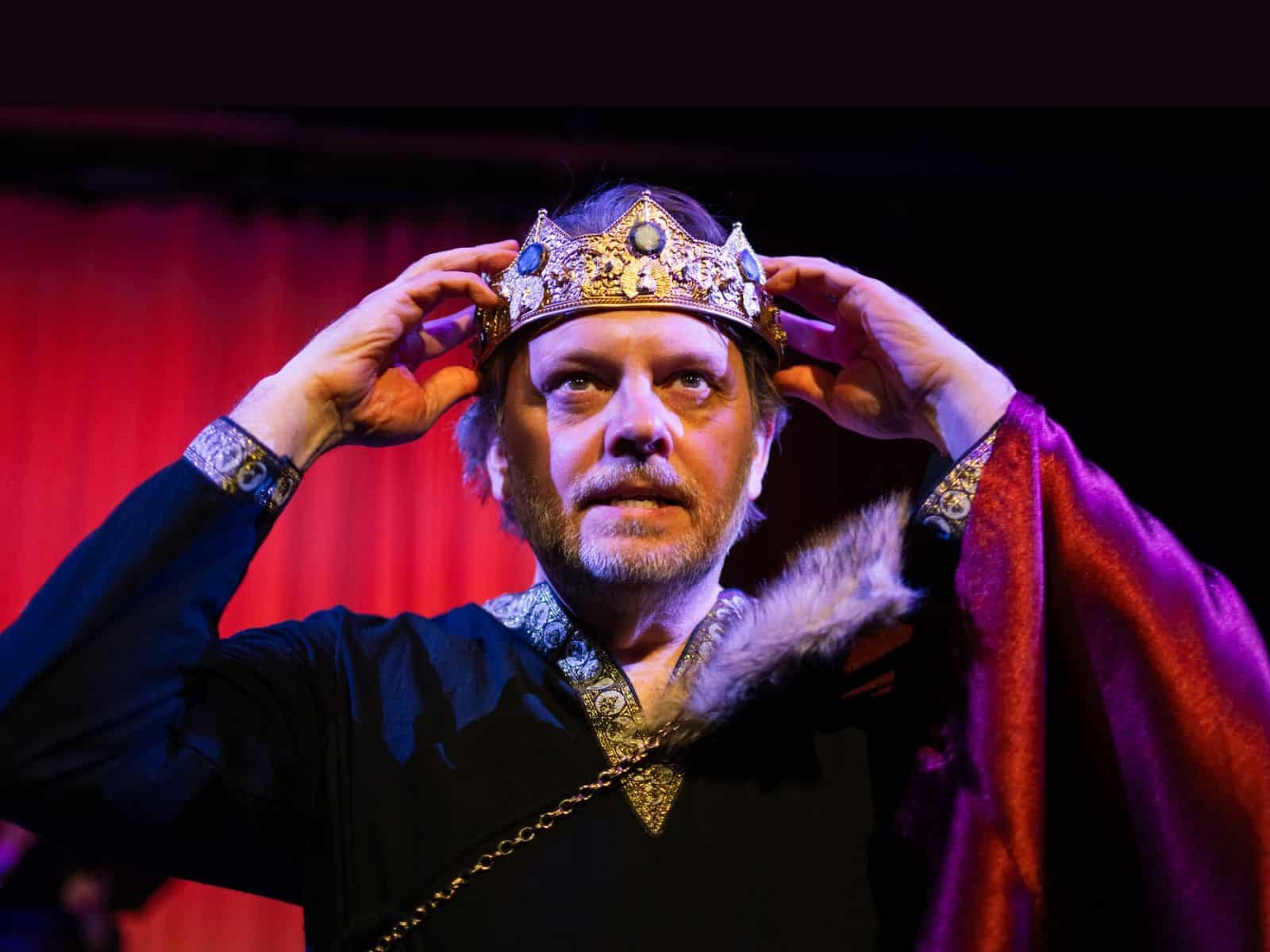
This doomed couple — Macbeth and Lady Macbeth — is one of Shakespeare’s most fascinating romantic duos. Too often, the character of Lady Macbeth is understood as just another woman leading a man astray. However, I’ve always felt this assumption to be greatly mistaken. And, as I read director Christine Mosere’s Director’s Note, I found myself nodding along in agreement. Mosere wrote, “This is not a story of a man led astray by his wife, but of two people who choose each other again and again, even as those choices lead them into darkness. Their tragedy lies not just in what they do, but in what they lose.”
Mosere’s love for this play was vastly apparent as she/they took it upon her/themself to step into the role of Lady Macbeth at the last minute due to the unfortunate circumstances of illness befalling the show’s female lead. Presumably, Sasha Carrera will be back as Lady Macbeth for the remainder of the show’s run. So, while I can’t speak to Carrera’s performance, I do applaud Mosere for stepping up.
Understandably, due to the immediacy of the change (not to mention the famously difficult and complex dialogue of the play), Mosere was unable to recite her/their lines off script. Mosere, in turn, read from a small scroll she/they carried around at all times — a scroll that at least served as a thoughtful detail intended to maintain the proper historical tone. Her/their appreciation for the character was felt deeply through the overall delivery.
Lady Macbeth’s partner in crime (her husband) was played by Dan Franko. Franko carried the show beautifully, especially considering the demanding nature of the role. With each lamenting monologue and interjected soliloquy, Macbeth’s precarious psychosis and suffocating paranoia grew more apparent through the effective intensity of Franko’s heady gaze into vast nothingness.
The standout performances, however, came from Eric Jones as Banquo and Matthew Bowerman as Macduff. Jones delivered his lines in the true lyrical tone indicative of Shakespeare’s writing. Whereas several other smaller performances felt flat in this regard, failing to align the context of what they were saying with the tone in which it was delivered (as is too often the case with people performing the Bard’s work). Jones, however, was entirely natural; every word paired perfectly, not just in tone, but with his genuine gestures and facial expressions, amplified by his fluid use of the stage. The only negative related to the performance was the unfortunate fact that the character is killed off in the first act.
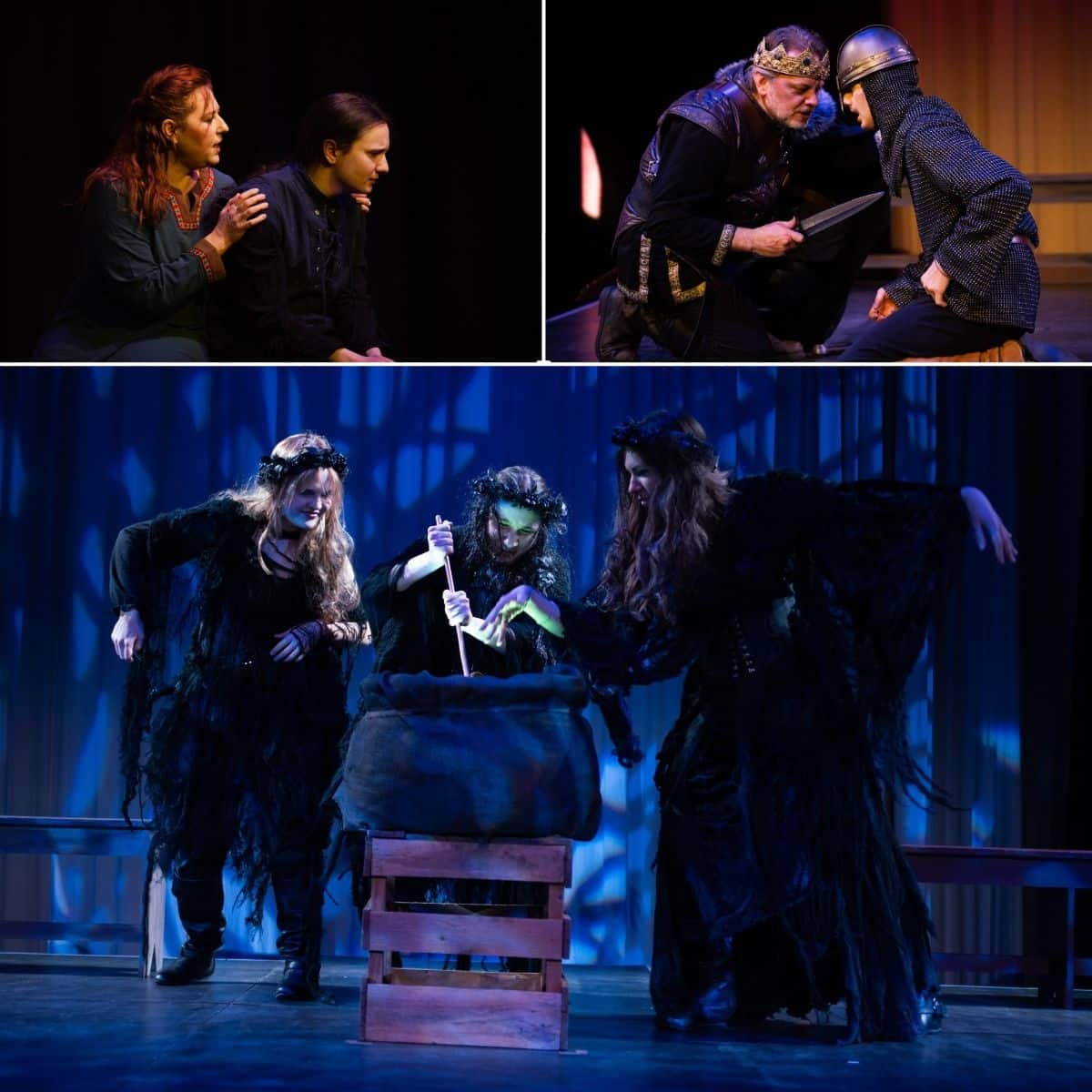
Bowerman’s emotional performance as Macduff was quite impactful. His tortured expressions and pained physicality during the scene in which he learns his family has been slaughtered under Macbeth’s order are shocking in their sincerity. This raw emotional resonance is further felt through the utterly guttural power behind his voice and the incredible commitment to physicality during the play’s final scenes: first the climactic final battle between Macbeth and Macduff and then the crowning of Malcom as King of Scotland. Bowerman was so deeply engulfed in this character that even after the play had ended, as the actors took their bows, his face maintained its anguished expression as though it was still Macduff rather than Bowerman standing before the crowd.
In addition to the intense dramatic performances, Anne Raugh, as the Porter, provided much-needed comic relief. She played the drunken and beleaguered servant beautifully. It’s not easy to act convincingly drunk, but she managed it quite successfully. Raugh’s casting as a man was only one example of the show’s blind casting. Rain Pryor (she/her) played King Duncan, Kayla Swain (she/her) played Ross, Jackson Peters-Mosere (he/they) played one of the witches, etc. This directorial/casting decision felt indicative of traditional Shakespeare (wherein the female roles were all played by men) but turned on its head with an inclusive modern lens that was quite effective and fun.
One less successful choice, however, was the decision to have the actors step down from the stage and continue various scenes at ground level. The idea, perhaps being to provide everyone with a front view, works in theory; however, I found it actually resulted in the opposite effect, as many people (myself included) were having to strain to see what was happening off the platformed stage. I also found myself really missing any sort of setting/scenery, as the play Macbeth is so entwined with the image of the haunted Scottish castle.
Despite their lack of set design, which is understandable considering the nonprofit culture of the Endangered Species Theatre Project (ESP), they more than made up for it through the lighting, props, and makeup. The lighting by lighting designer Lindsey McCormick was on point from beginning to end. Everything from highlighting scenes with varying spotlights to manipulating mood through shadow effects of tangled brambles projected against the backdrop worked to enhance the production value.
Eric Jones (in addition to playing Banquo) also served as the special-effect makeup artist. Jones significantly elevated this production by incorporating several instances of fake blood (sparingly but effectively) to heighten the show’s tragic tone. Moreover, in the scene in which Jones (as Banquo) emerges in his ghostly form to haunt the newly crowned Macbeth, Jones wore white contacts, creating a rather realistic and utterly eerie effect.
Prop designer Liz Long further grounded the performance by providing the actors with realistic and tangible pieces: real liquid (seemingly fake wine or juice) for them to pour and drink, real water in which to wash the fake blood from their hands, and real swords (or if not real, pretty damn convincing).
ESP’s production of Macbeth was solid and did justice to the famous story with its dynamic dialogue and complex themes of ambition, betrayal, love, and loss.
Running Time: Approximately two hours and 20 minutes, with a 10-minute intermission.
Macbeth plays through February 3, 2026, presented by Endangered Species Theatre Project performing through January 25 at STAGES at New Spire Arts, part of the Weinberg Center for the Arts, located at 15 W Patrick St, Frederick, MD, and through February 3 at the ESPloft, 16 E Patrick St, 2nd Floor (no elevator), Frederick, MD. Tickets ($16–$22) are available for purchase online.
The program is online here.