Inside the Greenbelt Arts Center (GAC), a literal game of “scheduling Tetris” is unfolding. In the main performance space, one production is preparing for its closing weekend. In the lobby, actors for a future show are running lines over the hum of dehumidifiers. And tucked between them, the Rude Mechanicals — GAC’s resident troupe — are rehearsing their upcoming production of Romeo and Juliet.
But don’t expect a double funeral. This version, penned by 17th-century Spanish playwright Lope de Vega and painstakingly reconstructed by director Liana Olear, comes with a parenthetical promise: (A Comedy).
The “What If” of the 17th Century
“The play reminded me of Marvel’s What If cartoons,” says Olear, who is marking her tenth year as a director. “Given the familiar story, what if things went slightly differently from the start, and all the little divergences paved the path to a happy ending?”

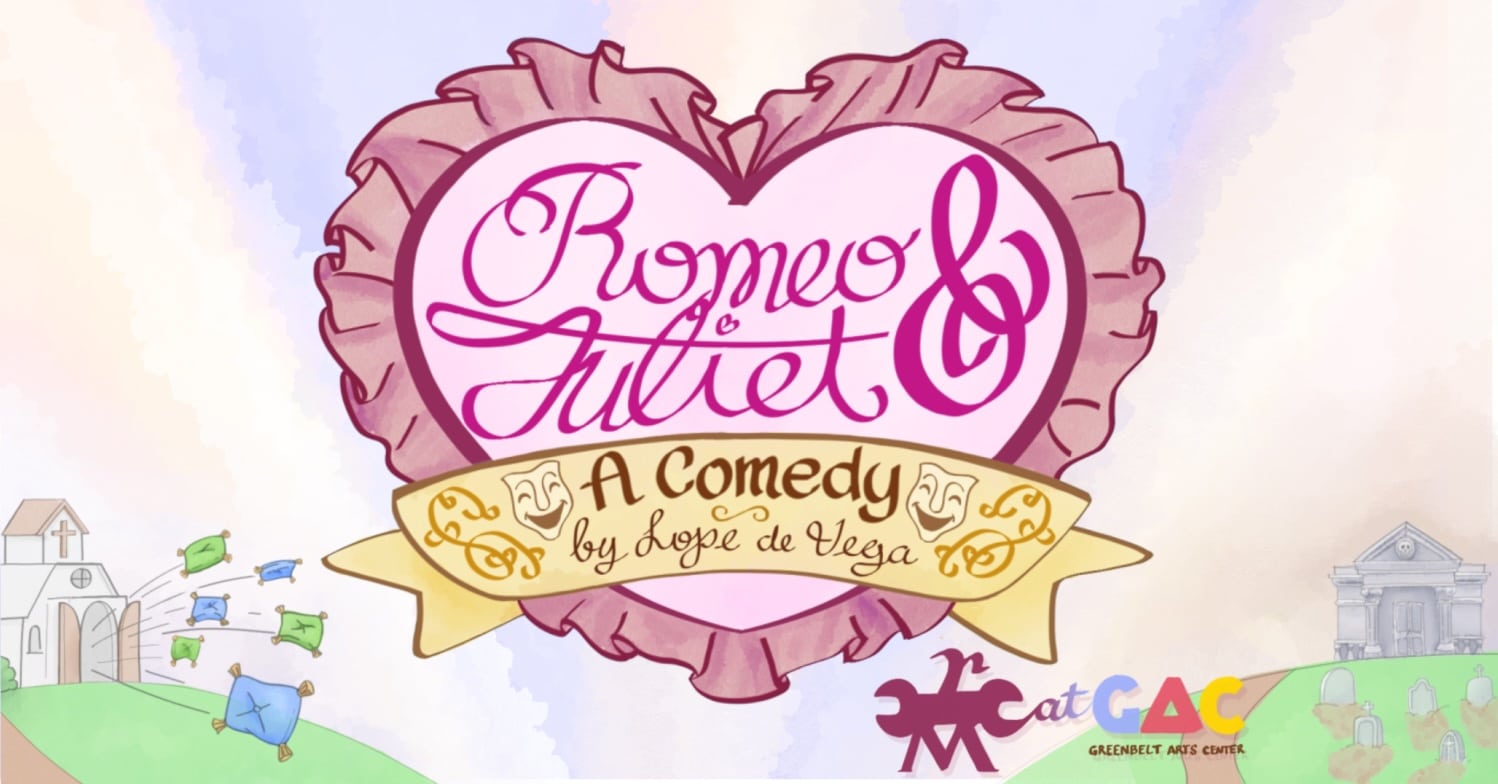
In Shakespeare’s tragedy, the feud is a blood-soaked generational conflict. In Lope de Vega’s world, “what if the conflict between the rival families escalated over seat cushions?” Olear teases. “Various aspects of the Romeo and Juliet story have become an integral part of our culture. The characters’ excitement as they share their news with each other and with us reminded me that once upon a time, it wasn’t a cliche, it was edge-of-your-seat suspense.” The variation and slight restructuring of who finds out what and when offer today’s audiences a novel experience with this classic material.
Marianne Virnelson, who plays Roselo (the Romeo equivalent), notes that the humor is baked into the structure of the Spanish comedy. “In the beginning [of Shakespeare’s Romeo & Juliet], it’s formulaic to what a Shakespearean comedy usually is. It’s fun, it’s flirty, it’s fast-paced. And then somebody gets killed, and then everybody else starts to die, and it gets really sad,” Virnelson says. “[Vega’s Romeo and Juliet (A Comedy)] gets the happy ending that you’ve always kinda wanted. It’s funny the whole way through.”
Dabbling in Translation
For Olear, a bilingual director who “dabbles in translation,” the road to the stage was a scholarly scavenger hunt. Dissatisfied with modern translations that felt too “ordinary” and Victorian versions that felt too stiff, she embarked on creating her own master script.
“I found a poetic translation that felt grand and elevated, but realized it omitted a particularly memorable dirty joke, and I thought, ‘Wait, wait! What else is missing?’ So I got my hands on several more translations,” Olear says. Assisted by Susan de Guardiola, a professional historian and a native Spanish speaker, she compared multiple versions against the original text to ensure the 17th-century wit landed for a 2026 audience.
The result is a script that feels Shakespearean in its meter but is far less dense. “It’s not Shakespeare, so the language isn’t sacred,” she says. The master script became a work in progress as the director and actors worked together with assorted translations to find the best way to deliver the story. “We’re concentrating on human universals,” Olear says. “We still laugh at cowardly braggarts who get scared, liars who fool nobody, or overconfident know-it-alls who miss the point.”
“This one goes off the rails instantly…”
One of the most striking departures from the traditional tale is the agency of the leads. While Shakespeare’s Juliet is often portrayed as a victim of circumstance, Lope de Vega’s Julia is clever and proactive. “When [Julia] contrives how to achieve her happy ending, it’s an earned one,” Olear says.
The world-building also introduces a host of new faces. Instead of the fiery Tybalt, the audience meets a suitor with a crush on Julia, forcing her to flirt with Roselo right under his nose. Both leads are equipped with “funny mirror” sidekicks who amplify the comedy. Melvin Smith, who plays Anselmo (Roselo’s best friend), acts as the “straight man” attempting to keep his smitten friend grounded. When Smith wandered into the audition space, he had no interest in doing a classic Shakespearean tragedy, and was won over by the fresh take. Says Smith: “I saw what they were doing and thought, ‘This is different.’”
Rather than a derivative work, this production highlights a fascinating case of literary parallel evolution. Both Shakespeare and Lope de Vega drew from the same source novella, but they emerged with vastly different scripts. While Olear acknowledges that Shakespeare was “more faithful to the source material,” she found herself drawn to the road less traveled. “I fell in love with [Vega’s] version of the characters.”
The production leans heavily into physical comedy and double-entendres, where high-stakes romance is often complicated by absurdities like the aforementioned seat cushion rivalry or a friar’s potion that definitely “didn’t come with instructions.” Rebecca Korn, who plays Julia, says the shift in tone is apparent from the first scene. “This is Romeo and Juliet as you have never thought of it before,” says Korn. “This one goes off the rails instantly.”
At GAC, where the electrifying chaos of a community theater in full swing fills every hallway, the Rude Mechanicals are proving that even the oldest stories can find a new, hilarious life. As Olear puts it: “The fun the playwright had with the material will be worth the investment.”
Romeo and Juliet (A Comedy) plays from January 30 through February 7, 2026, presented by The Rude Mechanicals performing at Greenbelt Arts Center, 123 Centerway, Greenbelt, MD. Purchase tickets ($24 general admission, $22 senior/military, $12 students/children) online. For more information, phone the box office at 301-441-8770 or email boxgac@greenbeltartscenter.org.
The cast and crew credits are here.