For a play about an English politician who lived almost five centuries ago, A Man for All Seasons is all too relevant today. It concerns Sir Thomas More, lawyer, counselor, but also a man of principle, trying to keep his head (in all senses of the word) in the service of King Henry VIII — a narcissistic, vain, womanizing, mercurial monarch, who alternates between pseudo-friendship and threats, and can turn on his subordinates at the merest hint of disloyalty.
Although Robert Bolt must have thought of his play as historical when he penned it in 1960, the current production (at the Arts Barn in partnership with Kentlands Community Players) proves that it might also have been prophecy. It depicts one man attempting to keep himself and his family safe from the machinations of a corrupt court, while also holding on to his convictions, while everyone around him sucks up to the tyrannical ruler, declaring anything he says to be truth, no matter how outrageous. As director Andrew Harasty says in his program note, “When I made the submission, it was mid 2024, and I had no idea how relevant it would become.”
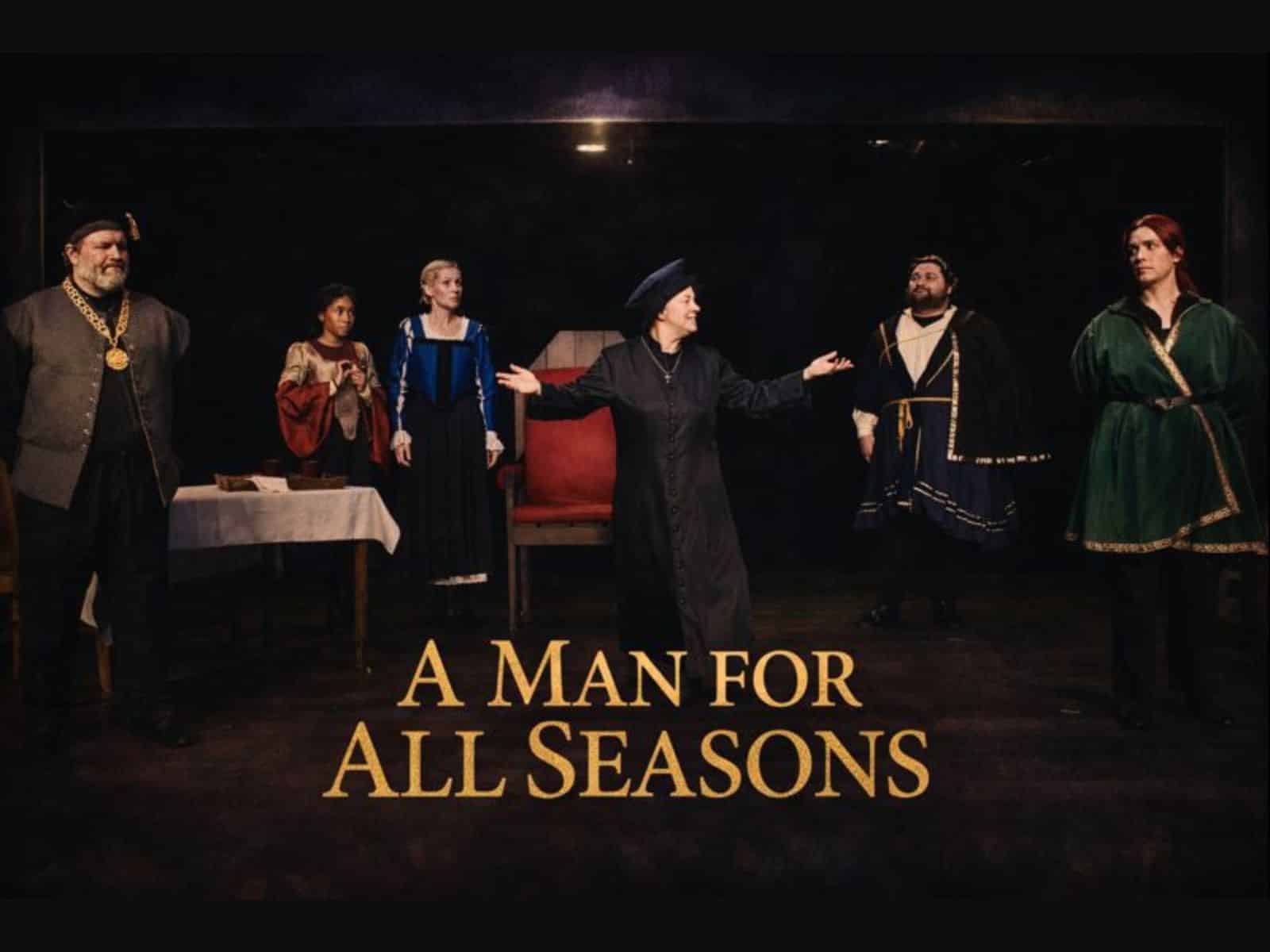
Harasty, in his directorial debut, acknowledges that the play is a period piece, but does not clutter it up with details. The pre-curtain music (sound by Bruce Hirsch) is appropriate, and McKenna G. Kelly’s set dressing and props are sparse but evocative. (There is some nice work with faux candles being “snuffed out” and “lit” with excellent timing.) It is in Elizabeth A. Weiss’s costumes that historicity is most accurately maintained. The male-presenting actors wear plain black from the waist down, and then indicate their positions and the change in their fortunes by the various doublets, impressive clerical robes, and chains of office they wear on top. The two noble female-presenting characters wear period-correct gowns, necessary because in the script More compliments them on them several times. And Weiss even manages a symbolic color palette, with More and his family in sincere blues, while his political enemies at the end are almost all in snake-like green. Overall, the technical aspects of the show are appropriate without being distracting, as either overdoing the period frills or going for a complete modernistic anachronism would be.
Harasty’s direction is equally straightforward and effective. His biggest coup is casting supremely talented actors and then letting them do what they do best. He even let them decide whether to do English accents or not, and the only one who went that route consistently was Jay Tipnis as Oliver Cromwell. With a lesser cast, it could have been distracting to have only one or two actors doing accents. Here, however, it gives Tipnis’s Cromwell the air of a villain in a superhero movie, with his supercilious intelligence and posh pronunciations. Tipnis’s slimy, sneering demeanor and facial expressions seal the deal.
Another character Harasty makes excellent use of is Jacqueline Youm’s The Common Man. The compelling and chameleonlike Youm starts off giving the “no phones” speech at the top of the show, and then, with the ringing of a bell, morphs immediately into the representative of not only the age but the audience, saying, “The sixteenth century was the century of the Common Man — like all the other centuries.” The character is both narrator and framing device, changing personas with costume pieces out of a crate on the stage, and becoming steward, boatman, jury, jailer, and more, each with a distinct and appropriate accent and demeanor to match. Youm interprets the story for the audience when the politics become too convoluted, at one supremely ironic point, listing the dire fates of many of the politicians currently at the top of the greasy pole.
Other characters are similarly effective. Kimmel Garner, as More’s daughter Margaret, is dutiful but smart, with a stubborn streak. John Rocco, as her husband William Roper, shows a young man’s over-enthusiasm well and provides comic relief in a show that often needs it. Nancy Somers as More’s wife, Alice, gives a prickly but moving performance as a wife who is furious at her husband for what he has allowed to happen to himself and his family — precisely because she loves him so much. Jennifer Robinson is bracing as the Duke of Norfolk, a man of action who can’t comprehend why his friend More is being so stubborn about mere principle and conscience, when both practicality and solidarity suggest he should just blow with the prevailing winds like everyone else. Robinson clearly shows Norfolk’s pain and bewilderment at having to preside over the trial and condemnation of his friend. Paul Brewster is suitably eminent as Cardinals Wolsey and Cranmer, and Aetna Thompson effectively embodies the very different characters of smarmy Ambassador Chapuys and the Woman who tried to bribe the incorruptible More.
As More, Nathan Chadwick carries the entire story. He has the difficult task of portraying a rare character — a truly good man — without making him a boring saint. His scenes with his family are tinged with warmth and humor, and later with pathos as he cannot betray his principles even for them. His pain at parting with them is deeper than the pain of his looming death. Thomas More, interestingly, is both a man of conscience and a lawyer; in fact, he places great faith in the law, despite the fact that, in the end, it cannot save him. His practicality in his own defense is refreshing — when a new oath comes out, he runs to find out whether there is anything in the wording that will both legally and morally allow him to swear it. But he is not what in the era was known as an equivocator — someone who will say anything plausible to get himself out of trouble. As a Catholic, he cannot be true to himself and acknowledge King Henry as the head of the Church, yet he remains loyal to the King, so he solves his dilemma by refusing to speak his mind, thereby denying his enemies grounds to condemn him for treason. Unfortunately, in the face of blatant lies and perjury, his faith in the letter of the law fails him, because in the end, King Henry is the law.
And as Henry VIII, that presence that looms over the entire play even though he appears in only one scene, Alden Michels is a force of nature. Manic, fickle, conceited, self-absorbed, tyrannical, alternately chummy and threatening, he is utterly terrifying in the totality of his power and the childish ways he uses it.
The Kentland Players’ A Man for All Seasons is a timely story about a man with a moral compass who tries to swim against the tide of corruption surrounding him. But if it feels too close to home, go see it just for the actors. Their performances alone make it worth it.
Running Time: Two and a half hours, with one intermission.
A Man for All Seasons plays through January 25, 2026 (Friday and Saturday at 8 pm; Sunday at 2:00 pm), presented by the Gaithersburg Arts Barn in partnership with Kentlands Community Players at the Arts Barn, 311 Kent Square Road, Gaithersburg, MD. Purchase tickets ($25 for adults; $23 for students 15— 21; $16 for youth 14 and under) at the door or online. Online ticket sales end two hours prior to the performance. Tickets may also be purchased in person at the Arts Barn box office or by calling 301-258-6394.
Recommended for ages 12+
A Man for All Seasons
By Robert Bolt
Directed by Andrew Harasty