
Some movies that get turned into musicals feel forced in their adaptation: rest assured that School of Rock (2003) is absolutely not one of them. The Little Theatre of Alexandria, known for its big productions of beloved shows, including Guess Who’s Coming to Dinner and The Drowsy Chaperone this season, has put on a production of the Andrew Lloyd Webber—scored stage adaptation of the beloved Jack Black—led film.
In 2015, School of Rock debuted on Broadway and closed in 2019 after a run of 1,309 performances. Despite this, it has not necessarily ascended to the echelons of popularity within the musical theater community one might expect, outside of a viral Good Morning America featurette that this reviewer watches monthly.
Perhaps a reason why School of Rock may not be as well-known a musical theater property, despite its Lord Andy name-zing, is how truly massive an undertaking any production of it is. For one, the lead actor is pressured to live up to the cherished Jack Black performance that helped make the film a household name. Two, of course, there are 10-plus child actors on the cast list. Three, these children must perform complex rock music, or at least convincingly appear to perform it if the orchestra is supplying some of the sound.
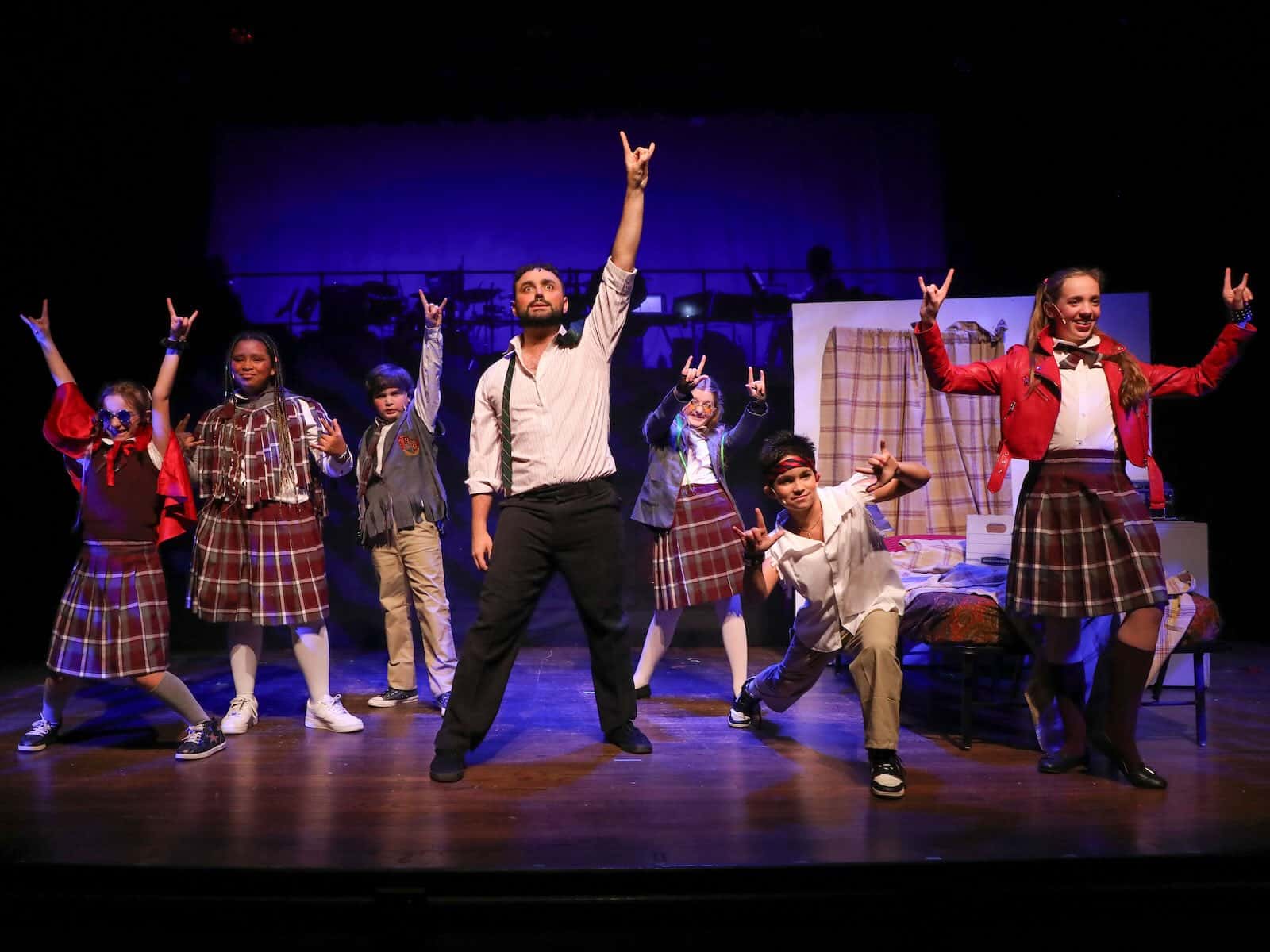
In the case of this production, music director Aimee Faulkner worked with the cast’s child actors to teach them to play all of those instruments, and to deliver all those vocals — and to boot, leads the pit every single night. Again — this show is an enormous undertaking.
Jarod Glou leads the Little Theatre cast as Dewey Finn, the out-of-work rocker who gets kicked out of his own band at the top of the show. In a bid to make his rent, he impersonates his roommate to get a gig as a substitute teacher at an elite prep school. (Every Lloyd Webber show has the “uptight” group of ensemble characters sing a staccato-heavy, pseudo-classical number about how uptight they are, and this show is no exception.) In the process, Dewey gets the elite prep school kids and their parents to see the value in being open about one’s feelings through music. In an era when musical adaptations of movies are so often shot-for-shot redos of the movie, the stage adaptation of School of Rock takes extra time on the relationships between the kids and their parents, making those relationships’ tension and eventual blossoming the show’s ultimate focus.
As director (as well as choreographer, stage combat coordinator, and intimacy coordinator), Kristina Friedgen says so well in her Director’s Notes, “at its core, School of Rock is a story about listening — to ourselves, to one another and to the voices we often dismiss.” Friedgen says of her specific production, “[it] is an invitation — to adults, educators, parents, and young people alike. It asks adults in particular to examine how adultism shows up in our daily lives: whose ideas are dismissed as ‘too young,’ whose choices are overruled ‘for their own good’ and whose voices are included only after decisions have already been made.”
And the thing that must be said first in a review of this production is how wildly impressive these child performers are. Each and every one is giving their all — their passion is clear, as is the creative team’s in the fact that the child roles are double-cast during this production’s run. And while I want to be grouchy about Dewey Finn being a static character, despite his personal issues kicking off the show, his character’s specific storyline is not what we are supposed to pay attention to. We see through this story how we can learn where we may have made grave mistakes in thinking through artists whose ways baffle us, and the innocence of children, and their pleas for unconditional love. And, spoiler alert, the show’s conclusion shows us how what we thought was most important often must be shed in favor of a needed shift in perspective.

Jarod Glou is a formidable Dewey Finn, bringing a truly astounding energy to the role. It’s staggering that he will have done what I saw him do 15-plus times in the span of the show’s three-week run. Glou is a truly frenetic, effervescent Dewey, focusing his performance on the character’s bubbliness and kineticism rather than the “desperate couch potato” angle, which adds to the character’s appeal.
There is something major missing from the book of this stage adaptation that brings certain necessities to light about Dewey’s portrayal. One highly memorable part of the original film is a scene that has been cut from the stage musical — when the student Tomika has a heart-to-heart with Dewey about how she believes her weight will make her a target of mockery on stage. Dewey comforts this student beautifully, by not denying that she is overweight and putting her and plus-size people down in the process, but instead saying how being overweight has zero correlation with skill potential in music. He says, “You’ve heard of Aretha Franklin, right? Okay, she’s a big lady. But when she starts singin’, she blows people’s minds. Everybody wants to party with Aretha!”
Man, it’s good.
This moment transforms Dewey, showing us that even though he is using the kids for his own means, he really does want them to blossom. There’s a mutual benefit for both Dewey and the kids in getting into the Battle of the Bands and simply being a great band — it’s not just for him. This scene in the film brings to a head other moments where Dewey has shown authentic care for others, but it is the most memorable. It’s much harder to pinpoint evidence of this care Dewey has for the kids in School of Rock’s stage adaptation. So without this moment having been included in the book, performing Dewey with a consistent freneticism — particularly when the driving force of his actions that we see is that he has to pay the rent and prove himself to his former band — may prevent us from seeing the full extent of Dewey’s depth and his compassion for these kids who are struggling in their ability to express themselves right alongside him.
And this isn’t about being more or less like Jack Black. Finding more moments when Dewey can be a quiet shoulder to lean on — bringing a Po-the-panda sensibility where his slacker-with-intensity characterization gives him a wacky lens into a solution but not the solution itself — in Dewey’s performance can bring exponential heart to the show. Perhaps cutting the majority of frenziedness in the scene where Dewey and Principal Mullins connect at the roadhouse would be the most actionable way to imbue Dewey’s performance, and the show, with the benefits of Dewey being more of an explicitly empathetic force.
But let’s be clear — for someone to be this magnetic and immersive as Dewey is truly a feat of performance and casting. Applause to Jarod Glou.
Jilliann Law as Principal Rosalie Mullins is also perfectly cast — she slides into both the character’s “before” and “after” so well, even bringing a tear to the eye during the song “Where Did the Rock Go,” a completely out-of-nowhere theatrical knockout. As the students, all the young superstars — especially Adrianna Weir as Summer Hathaway, Joey Pond as Billy Sandford, Isaiah Salley as James, Brooks Moretti as Zack Mooneyham, and Nesu Chizengeni as Tomika Williams-Spencer — bring joy, humor, passion, and light to this wonderful production.
Mia Glatter-Droll’s costume designs are excellent, especially in the show’s final scenes at the Battle of the Bands, where the students’ and Dewey’s school outfits have been altered into absolutely phenomenal rock costumes, glitter, leather, and all.
Set designer Vincent Worthington, set decorator Myke Taister, co-master carpenters Jim Hutzler and Jeff Nesmeyer, set painter Diedra Nicholson-Lamb, and rigger Russell M. Wyland have taken on a monumental task — this show has so many moving setpieces, and they all do move smoothly. Dewey’s classroom is particularly impressive — the texture and realistic appearances of the bricks in the wall add a professional sparkle to the scene. The set’s engineering, which helps conceal the drumset when needed, is particularly impressive.
When a scene takes place inside a house — particularly Dewey’s house, Dewey’s room, and the students’ individual houses — there is something of a lack of texture and decoration on the plain white walls. What decorations there are are frequently on the walls, kitschy pieces of art that would work in context if they seemed more intentionally so. While the crew’s ability to move the set pieces so agilely is a compliment to both their strength and the excellence of the set design and carpentry, many of the sets look empty, and meagerly or oddly decorated. Some of the texture that makes Dewey’s classroom bricks look so excellent would have been helpful here — given that all or most of the walls of these interiors are white, different wallpapers would have helped too.
This is an outstanding production with profound love put into it by all parties, with huge effort and love from the child cast as well. I wish I had the chance to see both casts of children perform. If you’re able to get a ticket, given the remainder of its run is sold out, go see this labor of love from some of DC’s best.
Running Time: Two hours with a 15-minute intermission.
School of Rock plays through February 28, 2026, at Little Theatre of Alexandria, 600 Wolfe Street, Alexandria, VA. To purchase tickets ($36, reserved seating), go online or contact the Box Office via phone (703-683-0496) or email (boxoffice@thelittletheatre.com). (The show is currently sold out, but there is a waitlist.)
The program is online here.
School of Rock
Based on the Paramount movie by Mike White
Book by Julian Fellowes
Lyrics by Glenn Slater
New music by Andrew Lloyd Webber
Produced by Christine Tankersley and Bethany Weinstein
Directed by Kristina Friedgen