Few people know that before Marcel Marceau (1923-2007) became internationally renowned as the world’s greatest mime, he was a young Jewish man (née Marcel Mangel) in Nazi-occupied France, who joined the resistance to help rescue Jewish children from the Holocaust (in which his father, Charles Mangel, originally from Będzin, Poland, was captured by the Gestapo in 1944 and deported to Auschwitz concentration camp, where he was killed). Marceau’s courageous backstory is now being told in Marcel on the Train, presented by special arrangement with Mix and Match Productions for a limited world-premiere engagement Off-Broadway at Classic Stage Company.
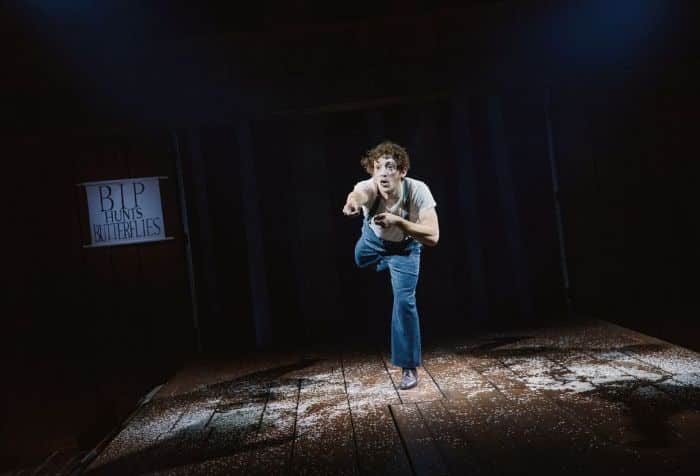
Co-written by Marshall Pailet, who also directs, and Tony Award nominee Ethan Slater, who stars as Marcel, the real-life events are presented with imagined details and conversations through an inventive and highly entertaining incorporation of Marceau-inspired pantomime into the emotionally engaging narrative (with Lorenzo Pisoni serving as movement consultant). Slater’s stellar performance manifests both his outstanding talent at empathetic characterization and enactment, and his impressive expertise at miming and physical comedy from the moment he takes the stage, with the silent sequences delivering the affecting story as clearly as the spoken-word scenes (the hand-mimed drooping flower and fluttering butterflies, with the supporting cast joining him, are especially uplifting metaphors). It’s an award-worthy performance that elicits laughter and tears, and leaves us knowing, respecting, and caring much more deeply about the man he honors.
Set on (and off) the eponymous train in 1943 France, the segments move back and forth in time and place, from the protagonists’ railway journey and mountain hike to escape across the border into Switzerland, to memories of how the rescue mission began, to visions of the future grown-up lives of the children who survived. The twenty-year-old Marcel does everything he can to keep his four twelve-year-old charges amused and quiet in the train compartment by miming, making silly jokes, urging them to pretend they’re sleeping, and reassuring them that they’ll be safe, so as not to have them panic, to attract attention, or to have their true identities discovered (though two are girls, they’re all ostensibly traveling to the Alps as a group of boy scouts for a weekend of camping, under false non-Jewish names with forged IDs – as is his).
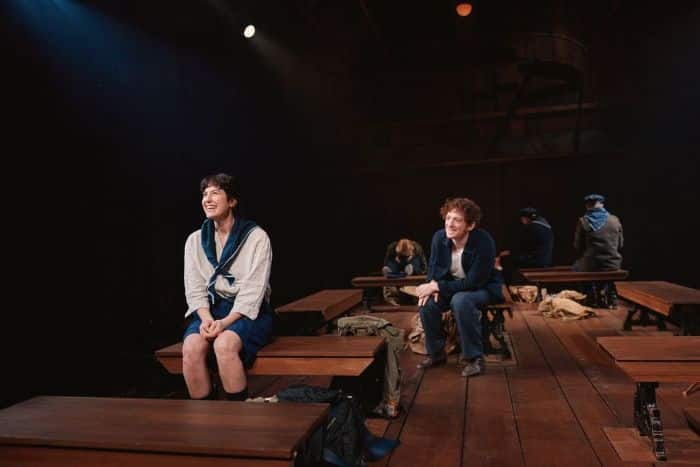
The children are portrayed by adult actors (apropos of the play’s conclusion, depicting what became of them in post-war decades), each with a distinctive personality and demeanor. Alex Wyse is Henri, who boldly believes he can outsmart the Nazis; Max Gordon Moore plays Adolphe, a realist who confronts him; Maddie Corman portrays Etiennette, who remains timid and silent, is inspired by Marceau’s miming, and creates a significant drawing with a smart detail on the wall of their compartment; and Tedra Millan embodies Berthe, who is plagued by bad dreams, dark thoughts, negativity about life and the future, and frequent urination due to a bad kidney (but the bathroom is two cars down and she doesn’t want to be spotted, so they have to come up with another solution), and insults Marcel and his humor (which she doesn’t find the least bit funny until he finally brings her some comfort and a smile).
Rounding out the featured cast is Aaron Serotsky masterfully appearing in multiple roles as Marcel’s father Charles, who is asked to escape with them but chooses not to flee again; his cousin Georges, who enlists him to take the children on the train and plans to meet him halfway, with another group of kids, and to take over the mission of getting them safely to the Swiss Alps (but where is he?); a French-born Nazi guard who enters their compartment, interrogates them extensively, searches all their bags, and examines their papers for a lengthy period, but doesn’t fully open or eat their mayonnaise sandwiches (with good cause); and a private who will serve with Adolphe during the war in Vietnam.
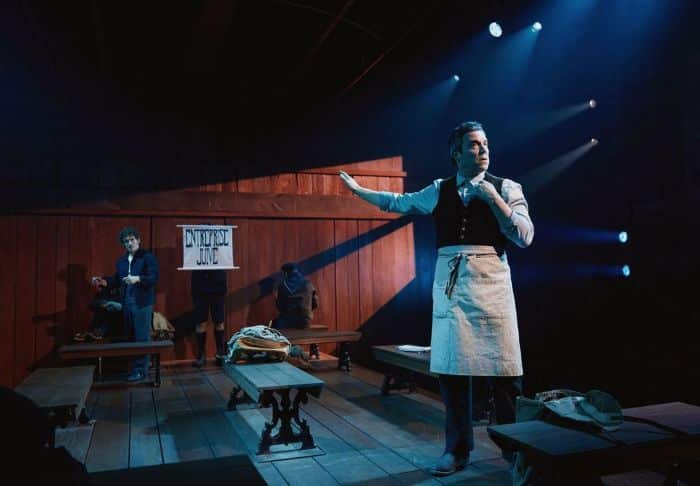
A transportive set by Scott Davis, with props supervision by Caitlyn Murphy, shifts easily on the runway stage from the wooden train car, with bench seats, an arched metal ceiling, and pendant lights, to the Alpine forest and the other locales, with handwritten signboards hung by members of the cast on the back wall to identify the change in scenes. Dramatic lighting and ominous looming shadows (lighting by Studio Luna), and the noise of the moving train and the threatening voiceovers of the Nazis (sound by Jill BC DuBoff), accentuate the moments of terror and tension and contrast with the lightened mood of the miming and the delightful shadows it casts – all in keeping with Pailet’s compelling direction, which skillfully balances fear with joy. And costumes (by Sarah Laux), with make-up (by Charlotte Bravin Lee), identify the characters and the era, including our final cleverly devised view of the future international master of pantomime.
Marcel on the Train is everything great theater should be: a profound human story with powerful emotions brought to life by an outstanding cast, director, and design team, which draws you in and keeps you invested, while shining a spotlight on how much the heroic Marceau contributed to life beyond his famed career as a mime. Don’t miss it.
Running Time: Approximately 95 minutes, without intermission.

Marcel on the Train plays through Sunday, March 22, 2026, at Classic Stage Company, 136 East 13th Street, NYC. For tickets (priced at $66-136, including fees), go online, or find discount tickets at TodayTix.