By Richard Tarbox
“You’ve got to admit that watching most theater companies’ productions of Hamlet is like sitting in the middle seat on a really, really, really long flight.” —Women Playing Hamlet
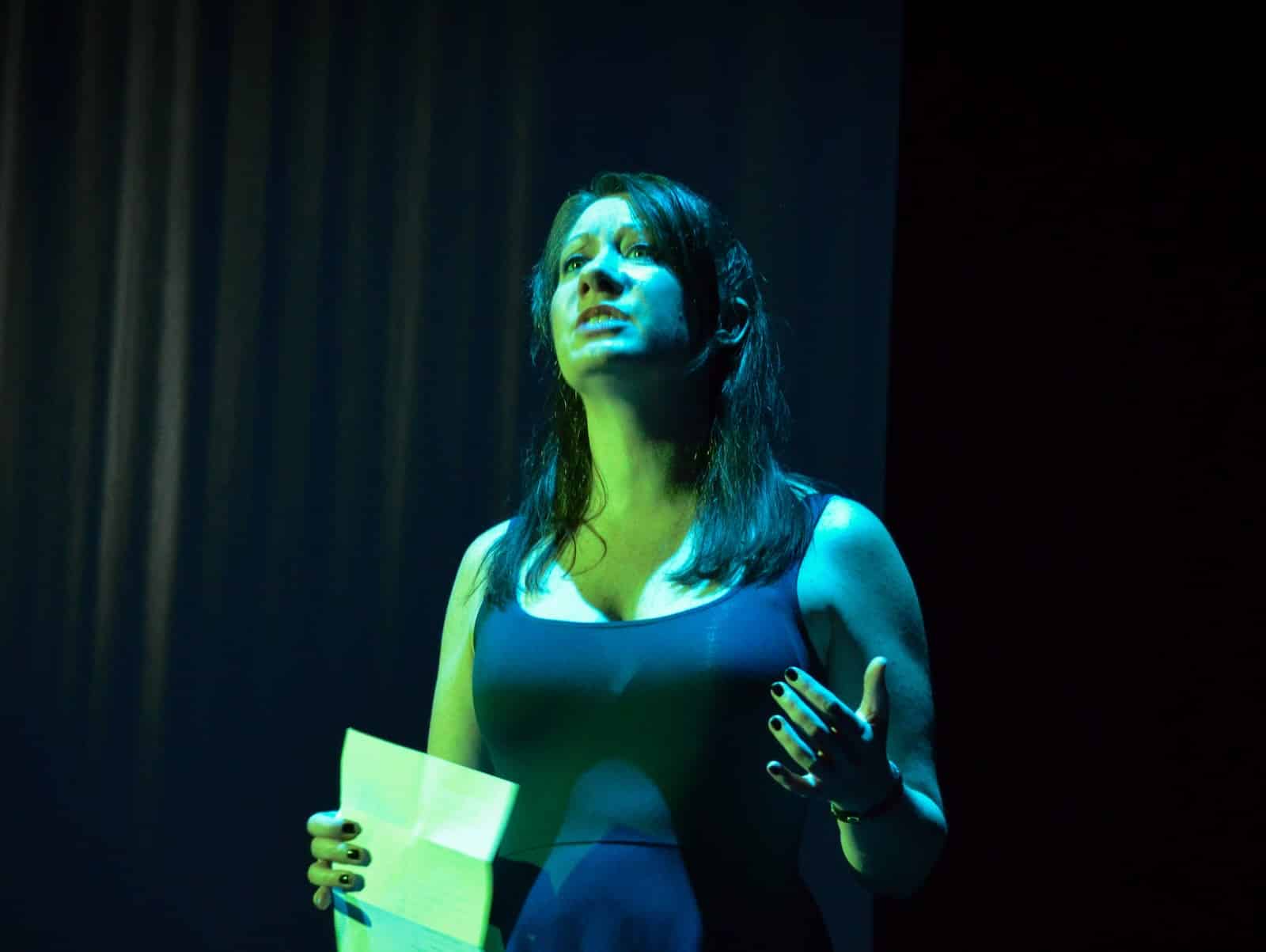
In Women Playing Hamlet, Jessica, an actor best known for a bit part on a soap opera, has been cast in the title role of a stage production of Hamlet. To Jessica, this is an existential crisis, motivated by not only her own anxieties, but also by the “expert” advisors (an acting tutor, a literary scholar, a professor, a priest, a psychiatrist, a bartender, a gravedigger, and even a bike messenger) who all tell her “you’re too young to play Hamlet.” And they should know. They each have MFAs in acting.
Oh, and she’s recently drawn the ire of Sir Patrick Stewart (but don’t worry, her Gen Z niece has been texting Sir Patrick to straighten things out).
Playwright William Missouri Downs teases the idea of gender-swapping Shakespeare’s moody prince as if the audience would assume it transgressive (Women? Playing Hamlet?!?), but quickly establishes that the role has a long history of being played by women — Nance O’Neil (1924), Sarah Bernhardt (1900), Anna Dickinson (1882), Charlotte Cushman (1861), Fanny Furnival (1741) — just to name a few. In the DC area, with theater companies like Taffety Punk, women playing Hamlet feels like a mainstream concept.
Downs’ script goes further and suggests Shakespeare intentionally imbued Hamlet with a “womanly” temperament: “It is obvious that Shakespeare intended Hamlet to be played by a woman,” one character tells Jessica during her quest for advice on the role. “Note that lacking masculine virility, Hamlet uses qualities that are associated with the female of the species. Qualities such as compassion, diplomacy, and the ability to talk for long periods, even when it’s obvious that absolutely no one is listening … what’s more feminine than this?” While this is presented humorously, it comes across as a sincere assertion and more than a little chauvinistic as it paints Hamlet’s indecisiveness as an inherently female quality. By contrast, the characters present a satirical play-within-the-play, Hamlet for Boys, in which the protagonist seeks revenge with violent immediacy.
As Jessica navigates professional insecurities and her life-imitating-art existence (her father has just died and her mother has married her uncle; thankfully, there is no Ophelia proxy), she comes to understand the character of Hamlet better, why he seems to delay taking decisive action through much of the play, and what Shakespeare might have been trying to say about all of this.
Bowie Community Theatre’s production is performed by 11 women. The script allows casts as small as four and as large as 19, but insists that all parts be played by women, a nod to the Elizabethan tradition of Shakespeare’s relatively few female roles being played by men. (With its large female cast, Women Playing Hamlet should be of interest to university theater departments resigned to yet another production of The Wolves). Director Fred Nelson has cast female performers who effectively portray characters covering a convincing range of ages, genders, and levels of status and authority, assisted by creative costume designs (a team effort by Jennifer Georgia and Linda Swann). Priestly frocks, glamorous dresses, and twill suits are augmented by comically fake beards and mustaches, allowing the cast to ham it up in their archetypal roles, with some doubling up on parts.
Per the script, the play is presented on a Brechtian bare stage, referencing (but not consistently employing) another Shakespearean tradition, “verbal scene painting,” in which an actor describes the setting we do not literally see. On the back wall of the set, a floor-to-ceiling projection screen is used for PowerPoint slides that provide contextual information (scripted, but designed by the director) when the characters directly address the audience, TED Talk–style. The screen is sometimes used to portray locations, to lesser effect. Most scenic projections were either generic to the point of being unnecessary or even anachronistic, such as the “Shakes Beer” pub, supposedly in NYC, but with parked cars out front sporting European license plates. Sound effects and music (also designed by the director) are used to punctuate comedic moments and transitions. The play starts and ends with a recording of Leo Delibes’ “Flower Duet” from the 19th-century French opera Lakmé, which makes as much sense as a Danish King named Claudius.
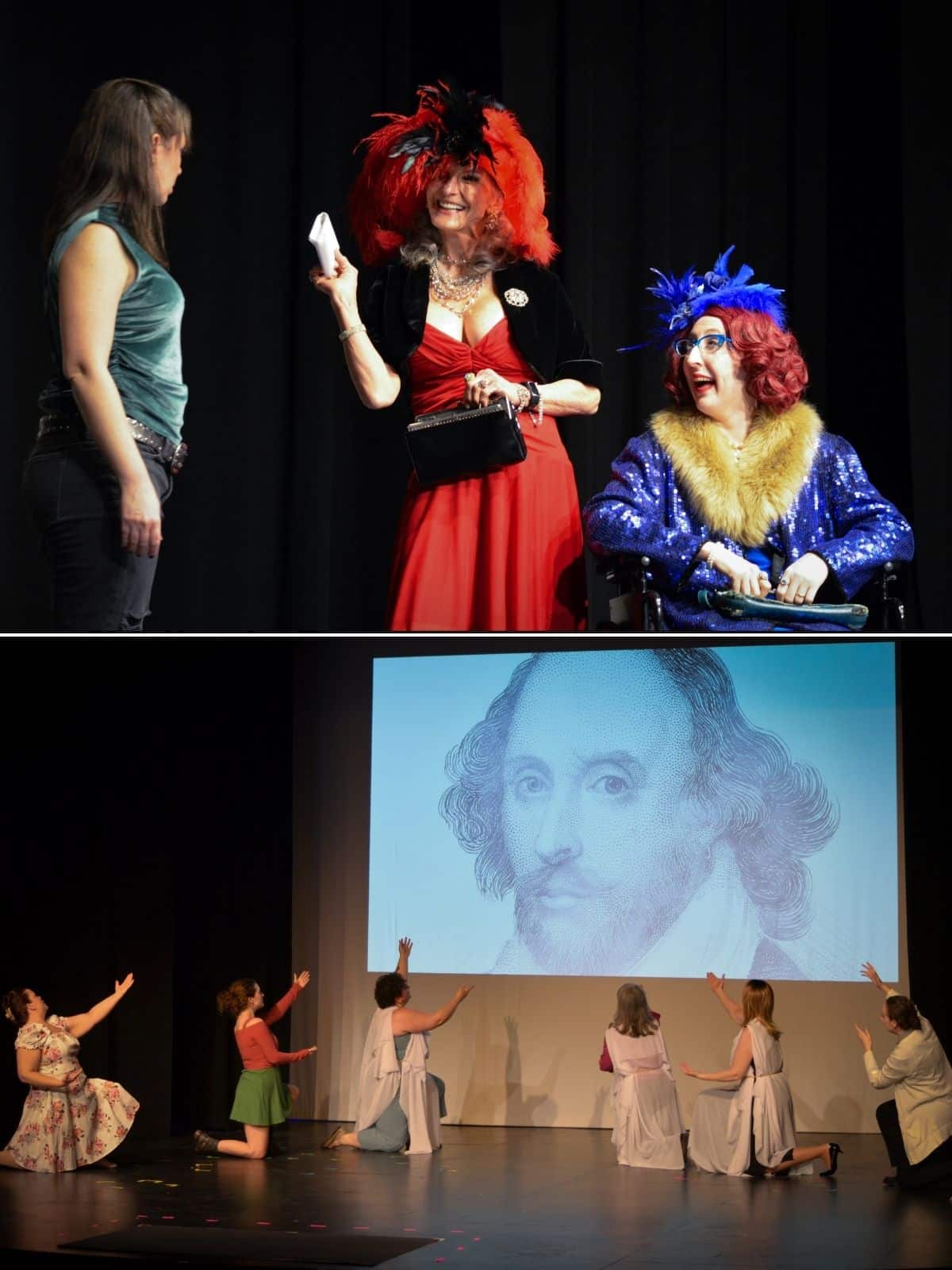
As Jessica, Dana Fleischer carries the play, rarely leaving the stage. Fleischer effectively portrays excitement and insecurity (bringing to mind the role of George in Christopher Durang’s The Actor’s Nightmare as she breaks the fourth wall and seeks guidance on her task). Other standout performances include Amy Heller as Jessica’s wise and brutally honest acting tutor and Shannon Monroe as Jessica’s low-key but plucky niece (and Sir Patrick’s online BFF). Rosalie Daelemans and Laurie Simonds delight with borscht belt–meets–Grey Gardens portrayals of Jessica’s former soap opera star pals, Rosie and Gilda (get it?). Holly Gibbs is hilarious in both the roles of Jessica’s Minnesota-don’tcha-know mother and as a second-act gravedigger with a cockney accent so broad it makes Dick Van Dyke’s Mary Poppins chimney sweep sound like Sir David Attenborough by comparison.
With so many talented women on stage, it does beg the question: Why is this production not directed by a woman (or, for that matter, written by a woman)? From director Fred Nelson’s self-aware program notes: “Why the heck is a man directing this show?” He continues that as a member of BCT’s reading committee, he fell in love with the script, had to be a part of it, and therefore is directing it. This feels like a well-intentioned failure to see an opportunity to uplift.
The cast and production team at Bowie Community Theatre have done a fun and enjoyable job of presenting a script that asks interesting questions yet does not provide wholly satisfactory answers. Did Shakespeare intend the character of Hamlet to have a “womanly” sense of agency? The play seems to say yes, but does so in a way that also undermines this idea as outdated patriarchal bluster. Is the idea of a woman playing Hamlet transgressive? Well, no, as the play says right away, many already have, to great acclaim. Can a young person gather the lived experience to effectively understand and play Hamlet? To paraphrase Laurence Olivier, “Why don’t you try acting, my dear boy? It’s so much easier.”Women Playing Hamlet has its issues, but it is a lot of fun and will give you plenty to argue about on the ride home.
Running Time: One hour and 45 minutes, including one 15-minute intermission.
Women Playing Hamlet plays through March 22, 2026 (Fridays and Saturdays at 7:30 PM and Sunday matinees at 2 PM), presented by Bowie Community Theatre performing at Bowie Playhouse, 16500 White Marsh Park Dr., Bowie, MD. Purchase tickets ($25, general; $20, seniors and students) online, by phone at the BCT Hotline at 301-805-0219, or by email (boxoffice@bctheatre.com) prior to the performance date.
Women Playing Hamlet
Written by William Missouri Downs
Directed by Fred Nelson
Featuring Dana Fleischer, Amy Heller, Shannon Monroe, Holly Gibbs, Betsy Schugar, Sue Ann Staake, Pilar Bruyere, Rosalie Daelemans, Laurie Simonds, Sarah Schauffler, and Maria Mitiurlev
Costumes and hair by Jennifer Georgia and Linda Swann, with additional costumes by Lauren Barnes, Shannon Monroe, Sascha Nelson, Sue Ann Staake, Maureen Dawson, and Sarah Schauffler
Lights by Pete Dursin and Collin Greiese
Sound and video by Fred Nelson
Properties by Penni Barnett and Sascha Nelson
Stage managed by Maureen Dawson.