An authoritarian government kidnaps anyone deemed a threat to the state. It tortures and kills them. There are no records of where they are or what has become of them. They have been “disappeared,” and their families are left bereft, fearing but not knowing their fate. This was the “dirty war,” waged by the late 1970s Argentine military dictatorship against its own people.
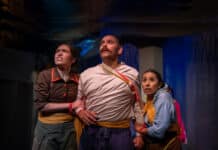
Marisela Treviño Orta’s Ghost Limb, presented by Avant Bard Theatre, traces a family’s experience of this war. The play begins in a narrative mode. Javier Alfaro (Bryon Escobar) is an idealistic art student, fascinated by the late, very dark work of Spanish painter Francisco Goya. His demanding father, Eugenio (Wilmer Xuárez), wanting Javier to intern at his architecture firm, burns Javier’s paintings. His mother, Consuelo (Nancy Flores), who has a very affectionate relationship with her son, tries to mediate.
So far, the makings of a domestic drama. Then the regime intervenes. At first, Eugenio says, they can stay safe just by keeping their heads down. Then the government closes Javier’s university. Javier retrieves his paints, which he uses to render a Goya painting on local buildings, “Saturn Devouring His Son,” depicting a tyrannical Roman titan, fearful of losing power, eating his own child. The mythological analogy to his country’s political situation brings Javier to the attention of the authorities.
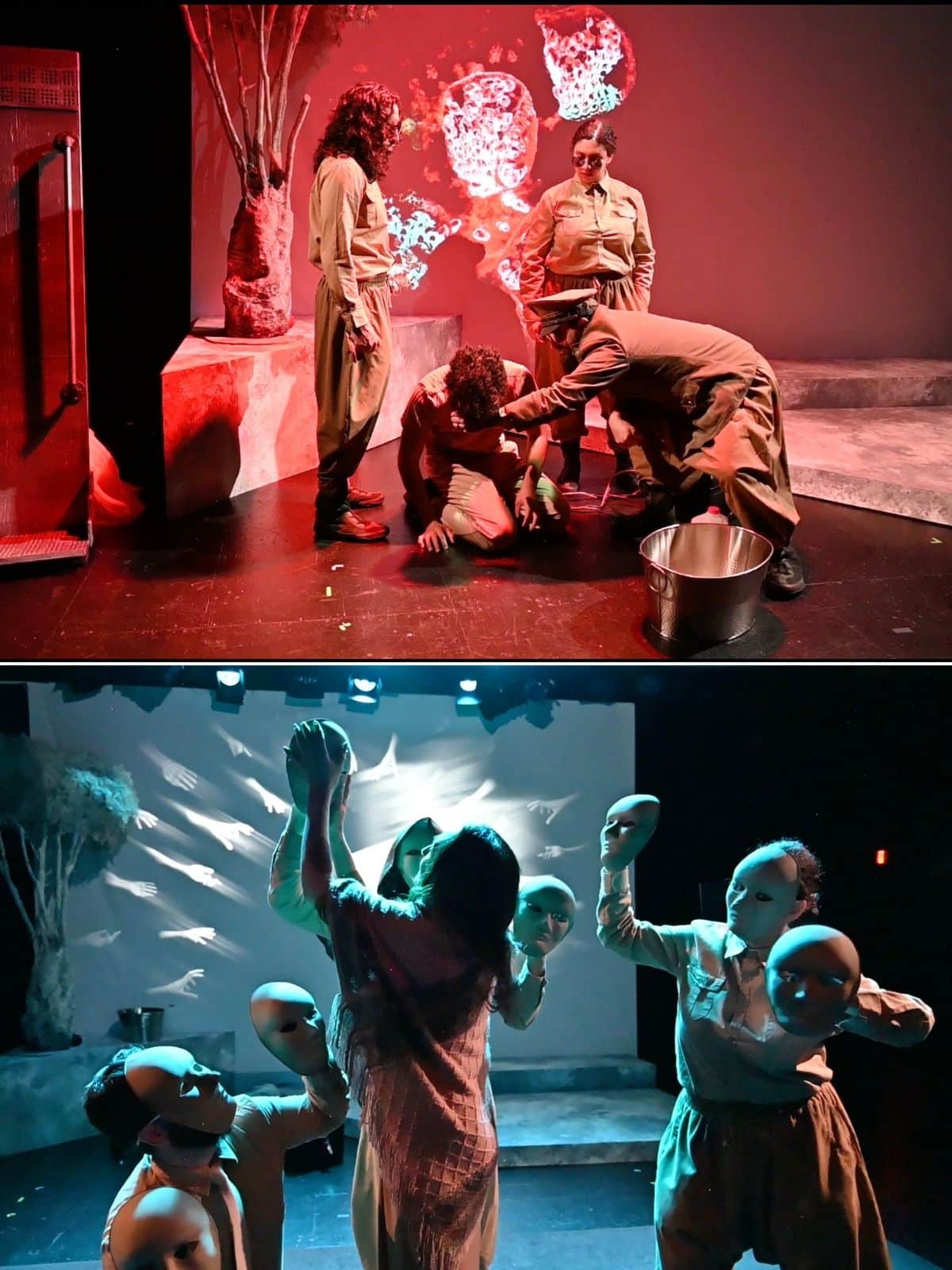
In the most striking scene of the production, the military break down the door of the Alfaros’ house to arrest Javier. In Liv Jin’s dramatic lighting design, the lights revert to a harsh white. The soldiers, in a relatively slow-motion movement sequence powerfully designed by director/choreographer Elena Velasco, beat Javier and his parents before taking Javier away.
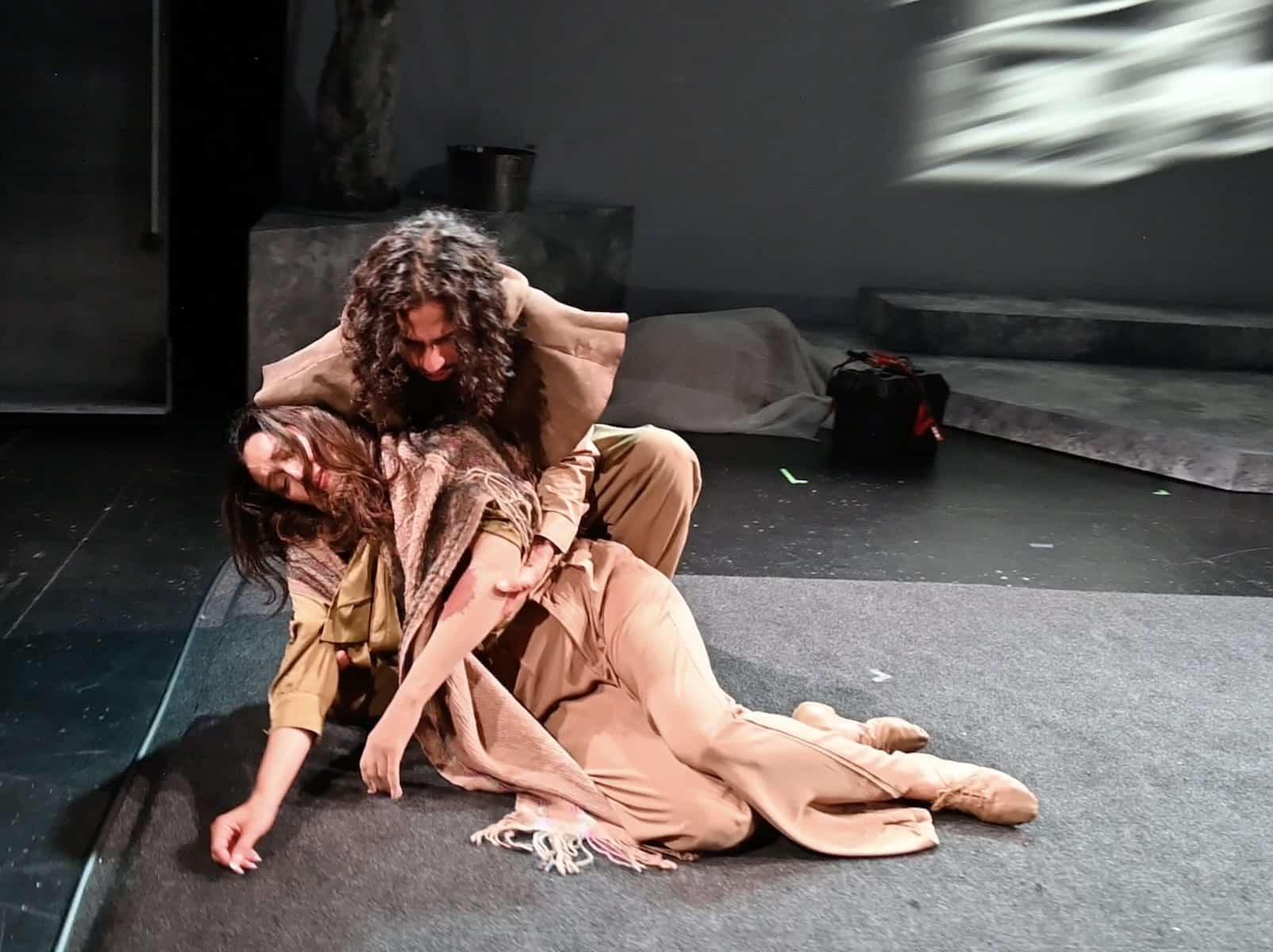
This is the pivotal moment of the play. A story that had been focused on Javier then becomes one of Consuelo’s unending search for her son. Consuelo’s arm, injured by the soldiers, becomes infected. She won’t accept medical treatment for it, as the injury is her connection to her son. When he is tortured, she feels it in her arm, the ghost limb of the title — excruciating, but a sign that he is still alive. In Julian Kelly’s projections — superb throughout the production — the screen displays moving amorphous red and black shapes as Consuelo shares Javier’s suffering. In these moments, Javier and his torturer are in dim light upstage, in the shadow world of the regime, while Consuelo feels his presence downstage in the everyday world, in fuller light.
Playwright Orta frames the mother’s search for her son through the Greek myth of Demeter, the goddess of harvest and fertility, and her daughter, Persephone, who is abducted to the underworld by Hades. Demeter searches everywhere for her daughter, as in her grief, the land begins to wither. In the production, projections of snowfall, even in summer, create a strong visual of a world gone wrong as the result of loss amid tyranny.
The mythical framing of Consuelo’s plight ultimately becomes a problem for the play. Consuelo’s character arc essentially stops, as she becomes less an individual and more an embodiment of the myth. In centering the universality of mothers’ wild grief for lost children in this myth, the play loses something of the particularity of 1970s Argentina.
Consuelo has a choice for a different path. Midway through the play, she meets another woman (Diana Gonzalez Ramirez) whose child was also disappeared. The woman has joined the long-term demonstration by the Mothers of Plaza de Mayo in Buenos Aires, demanding information about their children and challenging their erasure. Grieve for your dead child, she urges Consuelo, and take action. Consuelo — perhaps because of the mythic straitjacket into which Orta has put her — does not join. Flores is left to depict Consuelo’s anguish, and little else.
Escobar sensitively portrays Javier as a young man who does not realize the peril he faces. After his arrest, he has only a physical presence on stage, as he undergoes repeated torture. As his father, Eugenio, Xuárez often delivers his lines in a rigid fashion. After Javier is disappeared, Eugenio goes mad. Costume designer Anya Peregrino’s concept for him in these scenes is a voluminous greatcoat made of sheets of paper attached to each other. It was eye-catching and well-constructed, but more than was needed to make the point that he was mentally broken as the result of what had happened to his son.
Robert Schumacher effectively played two villains: a sinister doctor and a general who tortures Javier. Particularly in the latter capacity, he does a good job of showing that for functionaries of an authoritarian regime, the cruelty is the point.
Schumacher, Ramirez, and Oscar Salvador Jr. performed well as a movement ensemble in several choreographed scenes. In one notable instance, they worked with three kitchen chairs, moving them, one by one, to gradually form a circle as Consuelo danced atop them. Velasco’s choreography was well designed and executed, especially by Flores, but aside from the arrest scene, these sequences did little to advance the storytelling. Koki Lortkipanidze’s pervasive electronic music-based sound design bathed the audience in an ominous atmosphere of anxiety and dread.
Disappearing people is a common trait among authoritarian regimes. I thought of Lara in Boris Pasternak’s Dr. Zhivago, who ends in the Soviet Gulag as “a nameless number on a list that was later misplaced.” The resonance between the disappearances central to Ghost Limb and current U.S. deportation policy — not the same, not yet as broadly homicidal — is hard to miss, in ways that can feel personal. About eight miles from my home in Western Maryland, a large truck warehouse is planned to be repurposed as a detention camp for an estimated 1,500 people. And that’s no myth.
Running Time: 90 minutes, with no intermission.
Ghost Limb plays through May 23, 2026, presented by Avant Bard Theatre performing in Theater Two of the Gunston Arts Center, 2700 South Lang Street, Arlington VA. Tickets, priced at $45 (with a half-price discount for seniors, veterans, and students), are available online.
The Ghost Limb program is online here.
Ghost Limb
By Marisela Treviño Orta
CAST
Consuelo: Nancy Flores
Javier: Byron Escobar
Eugenio: Wilmer Xuárez
Madre/Soldier 1/Orderly: Diana Gonzalez Ramirez
Priest/Soldier/Orderly 2: Oscar Salvador, Jr.
General/Doctor/Newsie: Robert Schumacher
PRODUCTION TEAM
Director and Choreographer: Elena Velasco
Stage Manager: Rachel Heney
Technical Director: Matty Griffith
Set Designer: Nadia Kuffar
Projections Designer: Julian Kelley
Lighting Designer: Liv Jin
Prop Designer: Rachel Heney
Master Electrician: Max Abromovitz
Sound Designer: Konstantine “Koki” Lortkipanidze
Costume Designer: Anya Peregrino
Photography: Naya Chopra
Producer – Producing Artistic Director: Sara Barker^
Producer – Managing Associate: Josie Palmarini^
Producer – Production Manager: Kathleen Akerley^
Producer – Communications: Alyssa Sanders^
^ Avant Bard Theatre Producing Partner