Inspired by her real-life experience in a diverse father-daughter YMCA bonding program that first began in the 1950s, the semi-autobiographical satire Indian Princesses by playwright Eliana Theologides Rodriguez raises a wealth of important sociological and personal issues with an eye on the laugh-out-loud humor and the profound emotional impact on five young girls of color, the three white fathers participating with them in the titular initiative (a term that has been criticized for being an offensive epithet), and the grandfather who runs the camp-like activities. Now playing a limited world-premiere engagement at Off-Broadway’s Linda Gross Theater, the co-production of Atlantic Theater Company and Rattlestick Theater, under the direction of Miranda Cornell, is both funny and thought-provoking in its examination of assimilation, untold histories, and cultural appropriation, all of which wreak havoc on the program’s intended mission.
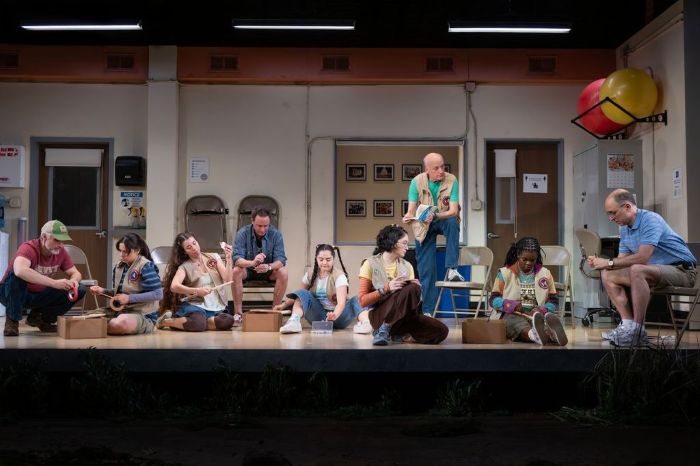
Set in the American Midwest in the summer of 2008, an expressive cast of nine embodies the distinctive personalities that come together (some hesitantly) in the program’s “Spirit Squirrel Tribe,” contrast and clash, waiver between fun and trauma, expose secrets about one another, raise questions about their backgrounds, relationships, and what their futures hold, and get to know a little more about each other and themselves, in a coming-of-age story that brings the laughs and the tears, along with some significant realizations. It all comes to a head when the competing groups in the program put on a play competition, where the Spirit Squirrels’ presentation, “America the Beautiful the Play,” goes way off-script and hard truths emerge.
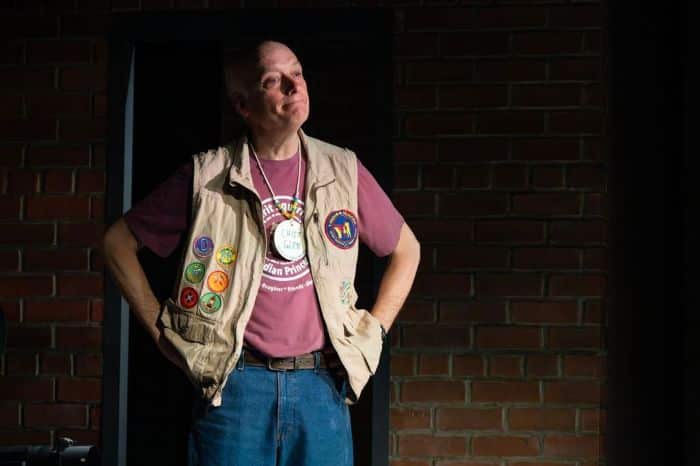
Leading the bonding initiative is the religious Bible-quoting Glen, or the tribe’s “Chief Glen” (grandfather of the half-white/half-Japanese Samantha), played with laughably controlled determination and smiles by Frank Wood, who passes the cheap imitation of an indigenous storytelling stick to each member of the group to grant them their turn to speak, then condenses their responses to his questions to a few words, though the point of the session is to share with the others and to find out why they’ve chosen to be there.
In the case of Pete Simpson’s dour working-class Mac (father of the half white/half Mexican Andi) – who, along with his Mexican wife, was condemned by their families for falling in love and getting married, and believes that men don’t need to talk or to show their feelings – he would prefer not to be there, but is stopped from leaving by Glen, if only to maintain the minimum number of participants required for the program to be funded (to get through it, Mac then brings in a carton of beer to share with the other dads). In the role of Chris (stepfather to biological sisters Lily and Hazel, of Yaqui and Tewa descent), Greg Keller insists on politically correct language and corrects their play’s whitewashed vision of America to the point of disrupting the performance, and Ben Beckley as Wayne (adoptive father of the African-American Maisey) has just become unemployed during the economic crisis of the time and is under a great deal of stress as a result, as seen in his emotional tear-filled monologue (each of the men has one, following their girls’ anger at them, generated by the play fiasco and the program in general, which causes each of them to leave their home to head to the clearing where they meet again).
The sweet, funny, and sensitive nine-to-twelve-year-old girls – all well-portrayed by adults with adorably youthful behavior, voices, movements, and attitudes (vocal and text coaching by Gigi Buffington) – represent the non-white diversity intended by the “Indian Princesses” program, as well as the humanity of the different individuals who are much more than mere tokens. Samantha, portrayed by Haley Wong, is concerned about the thoughts she has, which, she fears, in keeping with the beliefs of her religious grandfather, might be sinful, so is prone to pounding her chest in atonement. Rebecca Jimenez as Andi is shy and, like her father Mac, hesitant to speak and to express herself. Anissa Marie Griego and Serenity Mariana appear as the biological siblings Lily, an enthusiastic young triple-threat who loves Hairspray and aspires to a career on Broadway, and Hazel, who unintentionally reveals confidential information about her big sister to the other girls. It’s a disclosure that creates a fracture between them, leading Lily to rehearse with members of another group in the play competition, who lambaste her desire to be Penny, a white girl, in her favorite musical, which brings her back to the Spirit Squirrels, where they accept, support, and relate to her. And Lark White as Maisey, who’s been told nothing about her Black background or the history of slavery in America by Wayne, invents her own mystical story, identifies as a seer who possesses magical powers, and leaves us wondering if, in fact, she does (or at least the sharp vision to see things clearly after their cathartic summer experiences).
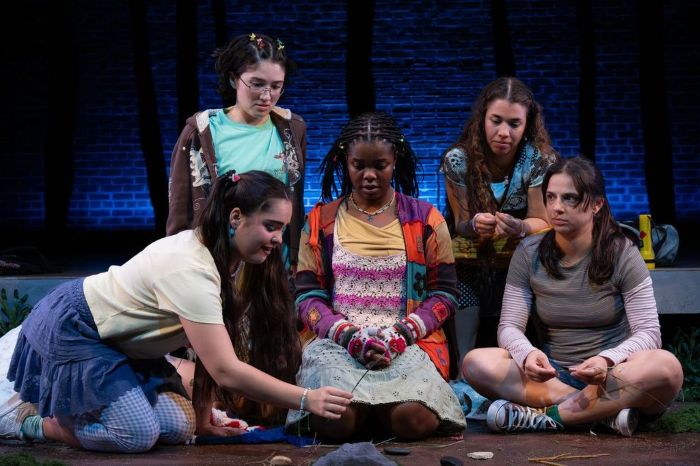
Costumes (by Sarafina Bush), including the signature vests and nametags they wear at the bonding program and the handmade accessories they don for their parts in the play, capture the casual dress of the era, and define the ages, demeanors, and roles of the characters. The set (by Emmie Finckel) transitions easily from the interior activities room with metal folding chairs, to the outdoor clearing of dirt, plants, and stones, the cars in which the men drive the girls home, and the camp’s makeshift stage, where the explosive play competition takes place. Shifts in lighting (by Mextly Couzin) signal the changing time, from day to night, with spotlights that give focus to the central characters, a rock that glows with Maisey’s vision, and sound (by Salvador Zamora) that accentuates the scenes and moods.
Indian Princesses is a funny and insightful show that will keep you laughing and make you think about the importance of understanding one’s cultural heritage while still being able to bond with others of different races, tribes, and ethnicities. Here, it’s the innocent children who do it best, coming together with others who’ve experienced the uncertainty of their true descent and history, and the pain of being seen as an outsider – even though their fathers tried what they thought best to make them feel loved and accepted in their own dominant white-male world.
Running Time: Approximately one hour and 45 minutes, without intermission.

Indian Princesses plays through Sunday, June 7, 2026, at Atlantic Theater Company and Rattlestick Theater, performing at the Linda Gross Theater, 336 West 20th Street, NYC. For tickets (priced at $25-131.50, including fees), go online, or find discount tickets at TodayTix.