While not all parts of Meredith Willson’s 1957 musical The Music Man have aged well, there’s something to be said for the comfort of simple narrative and predictably happy endings. There’s a warmth to small-town life and small love stories, a warmth that feels timeless. That is why this show has maintained popularity for decades. Despite this musical often verging on off-putting levels of chipper cheeriness, the beloved jaunty tunes, elaborate set design/projections, and mesmerizing choreography elevated this touring production of The Music Man, playing through May 31 at the Capital One Hall, directed by Matt Lenz, conducted by Thomas Fosnocht, and choreographed by Joshua Bergasse.
Set in 1912, The Music Man follows Harold Hill (Elliott Andrews), a con artist flitting from town to town, running scams on gullible locals. He makes his way to the small town of River City, Iowa, where he poses as a music professor intent on organizing and leading a boys’ marching band. He enlists the eager young denizens of River City and convinces their families to spend a lot of money on expensive instruments, uniforms, etc. Harold Hill, however, doesn’t know a gosh darn thing about music and plans to take off with the money he’s collected at the first chance. Ultimately, his heart prevents him from completing this scam when he falls for local librarian and music teacher, Marian Paroo (Elizabeth D’Aiuto). Although she sees through his scam, she also sees the hope and joy he has brought to town, particularly to her younger brother, Winthrop (Dylan Patterson), who struggles with his confidence because of a lisp. The Music Man shows how hope can often be more important than truth. We don’t always need the truth, but we can’t survive without hope.
Not all messages from this show are as enduring, however. Although they’ve cleaned up some of the offensive material from the original show, there’s still a good deal of casual misogyny that unfortunately comes with the time when it was written, even in the case of Marian, a character who’s supposedly educated, independent, and strong of conviction. She turns on a dime and transforms into a giddy schoolgirl once she decides to feed her crush on Harold Hill (a man who stalked, stole, and lied to her). Then, there’s the “slut shaming” lyrics of “Shipoopi.” I can’t say I’m a fan of that particular message, but Bergasse’s captivating choreography during that number (as well as several others, namely, “Seventy-Six Trombones” and “Marian the Librarian”) with each number layering various elements to create engaging chapters in a grand jazz-infused ballet had me hooked every time and, ultimately, left me appreciating the delightful embrace of unbridled positivity.
Andrews as Hill exhibited the foxlike physicality expected of the con-man character — sly, charming, malleable. His fast footwork and long legs enabled Harold Hill to magically maneuver from one spot to the next with a seamless stride, allowing him to manipulate multiple people simultaneously. We got a taste of this during “Trouble,” a classic tune of subtle persuasion, as well as the more niche number, “Marian the Librarian.” Both songs showcase Hill successfully manipulating minds with ease — dancing a dance he’s danced a thousand times. Andrews matched his movements in these moments with a charming smile that possessed just the slightest hint of deviousness. However, Andrews was also perhaps the only performer to successfully hold down the grounded, emotional moments of the show, which, admittedly, were few and far between.
The production really leaned heavily on the classic elements of broader comedy. So much so that I often felt like I was watching a mid-afternoon sitcom, complete with a laugh track. Classic sitcom tropes were central to each performance throughout the show. We even had the bumbling, bickering married-couple trope with Mayor Shinn (Patrick Blashill) and his wife, Eulalie Mackecknie Shinn (Emmanuelle Zeesman). As I’m not a fan of that genre, many of the comedic deliveries had me cringing. But that’s just proof that the performers were committed to the tone the show decided to explore. Most of the audience, in fact, was laughing right on cue, as though we were at a live taping of a sitcom and a crew member had just held up a flashing neon sign that said: “Laugh.”
Elizabeth D’Aiuto, as Marian Paroo, maintained the most consistent vocal performance of the night. Her strong soprano vibrato was perfectly apt for the style of this show. D’Aiuto’s voice had a way of making scooped dynamics feel proper. She had several songs in which she displayed her prominent voice, such as “My White Knight” and “Will I Ever Tell You,” and I was very pleased to hear her do justice to the show’s penultimate number, “Till There Was You,” a hauntingly beautiful love song.
This show had several successful numbers, and others that left me wanting, such as the show’s opening number, “Rock Island,” a fun, staccato tune that requires deceptively difficult levels of breath control and enunciation. Halfway through the song, the men seemed already out of breath, understandably, of course, but this also meant that our important exposition faded away when it should have been spat in our faces with a sharp landing.
However, the number still opened the show with a bang, thanks to the engaging set design and projections by Ann Beyersdorfer and video/projection designer Lisa Renkel. The show opens with an early 20th-century train tunneling toward the audience as though it were going to drive right off the screen, and as it passes seemingly over us, the curtain is raised to reveal several interior train cars. Two men to each car jostled about in a bouncy beat, bringing to life both the song’s rhythm and the reality of a moving train.
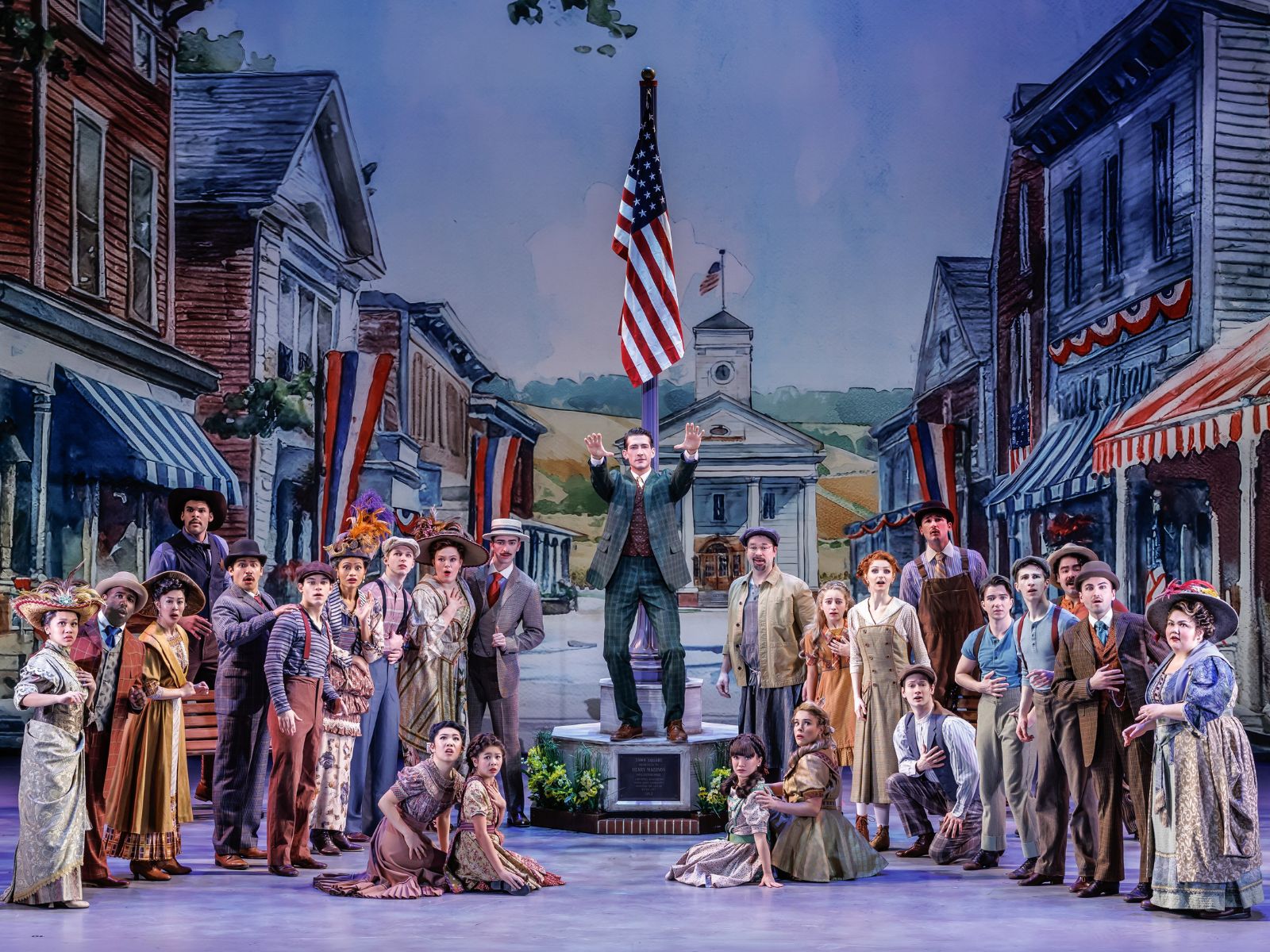
Renkel’s projections did much more to elevate the show. A triad of vertically stacked panels bookended either side of the stage. The projected images would change throughout the show, expanding world-building by depicting stores in town and streetlamps in the Paroo neighborhood, or by advancing the plot with images such as toxic waste symbols when Harold Hill first comes to town and attempts to draw the townspeople under his spell. Toward the end of the show, when the townspeople are looking to confront Hill about his deceitful actions, two large screens are rolled in, displaying projected images of sped-up greenery as though we were really running long distances.
Renkel, presumably in tandem with Beyersdorfer and the rest of the design and construction team, created incredible watercolor-painted backdrops that faded in and out across multiple screens to show the town, the neighborhood, the field, the meeting house, and the enchantingly romantic footbridge. The same footbridge where Marian serenaded Harold with “Till There Was You,” during which the two sway in each other’s arms, dressed in elegant shades of whites. Costume designer Santo Loquasto, with the help of costume coordinator Robin L. McGee, managed dozens of costume changes. Marian alone wore at least four dresses, if not more; I lost count. The entire cast sported convincingly authentic garments in pastel colors that spoke to the innocence of the people in the town and the lighthearted nature of the show.It’s that “light nature” that’s at the heart of this show. The Music Man is a story about finding the beauty in simplicity. It’s a reminder to find the good in others, to maintain hope at all costs, and not to take life too seriously.
Running Time: Two hours and 30 minutes, including a 15-minute intermission.
Meredith Willson’s The Music Man plays through May 31, 2026, in the Broadway in Tysons series at Capital One Hall, 7750 Capital One Tower Road, Tysons, VA. Tickets are available starting at $78.10 and can be purchased online.
The program for The Music Man is online here. The cast and creatives are also on the national tour website here.
For future Broadway in Tysons shows at Capital One Hall, click here.