Urgency is built into Eugene Ionesco’s allegorical farce Rhinoceros. Too bad that in Live Garra Theatre’s current production, it took so long to get to the end.
The Romanian-born playwright, who died in 1994, primarily lived in Paris and wrote in French. His 1959 work, named for the horned behemoth, has become an example of Theater of the Absurd for its very premise: people turning into rhinoceroses. The goal? To shock, challenge, even push audiences to take responsibility and change, rather than face the ennui of the status quo or, worse, radical regime change.
Penned not even 15 years after World War II, when Nazism and fascism overtook Europe and changed the world into one that willfully or soullessly accepted the banality of evil in its midst, Rhinoceros was Ionesco’s response to the scourge of insidious and blatant mass indoctrination that allowed fascism to take hold. In a sense, theater of the absurd pointedly directs its focus to the audience: Are we guilty, complicit? Live Gara’s production, which clocks in at three and a half hours, takes that notion to heart, distributing paper rhino heads stuck on a tongue depressor. We are directed to hold them in front of our faces when the rhinoceros’s grunts and stampedes are heard. And some watchers do.
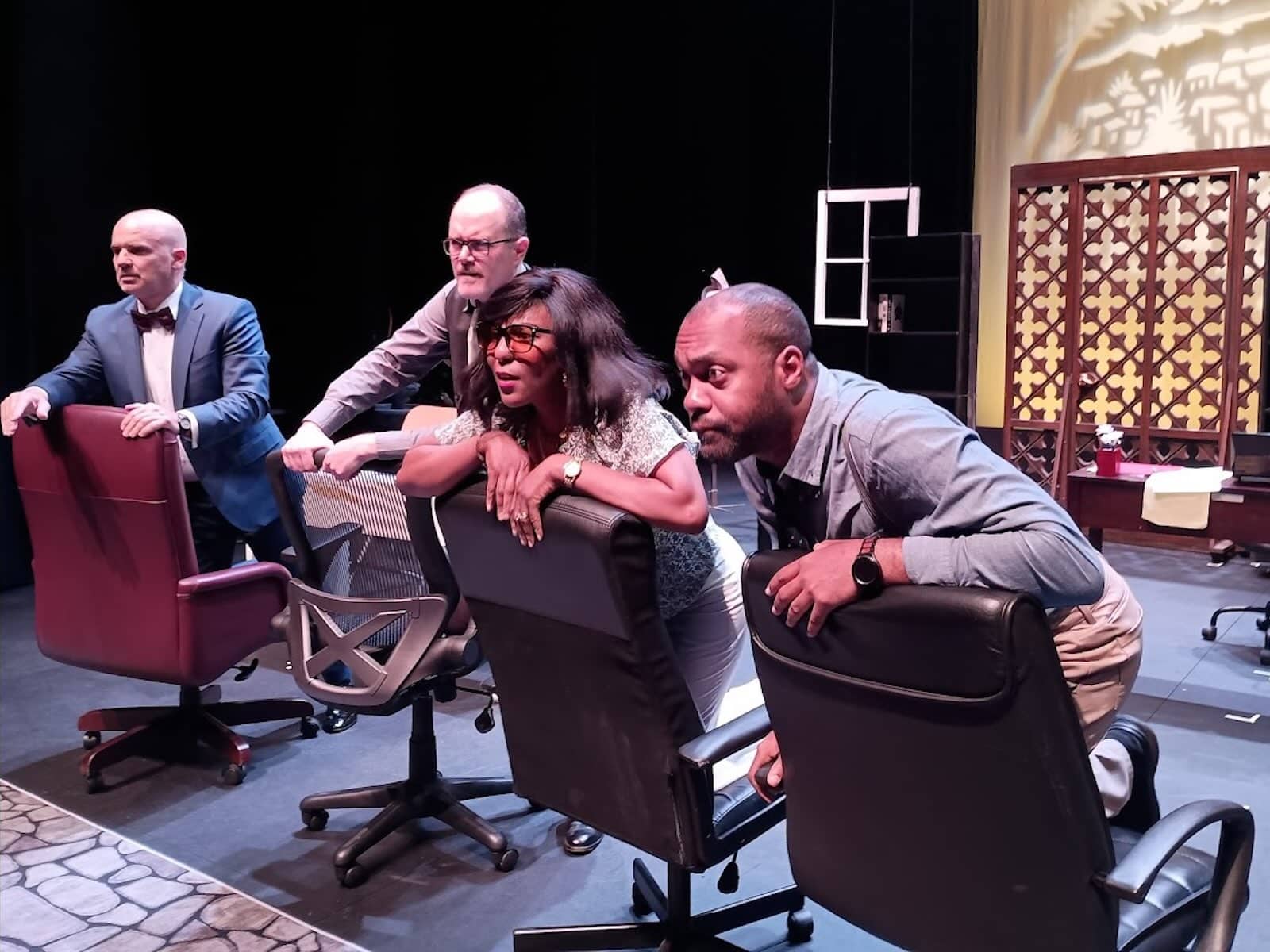
For those who didn’t read Ionesco’s play in college, it features a collection of disparate characters in a nameless town. Said town here exists in what seems to be an innocuous period in the late 1980s or so, before smart cell phones and social media made us even more senseless and disconnected from human conversation. Berenger (Pierre Walters, in the strongest performance of the evening, playing his Everyman character like a straightlaced Eddie Murphy, leaning into his individualistic choices amid groupthink) and Jean are friends, but not warm ones. Punctilious Jean (who is played with stolidity but less comic timing by straight-laced Todd Leatherbury) nitpicks, criticizing his friend for his casual dress, his lateness, even though he’s minutes early, and his fondness for brandy for breakfast.
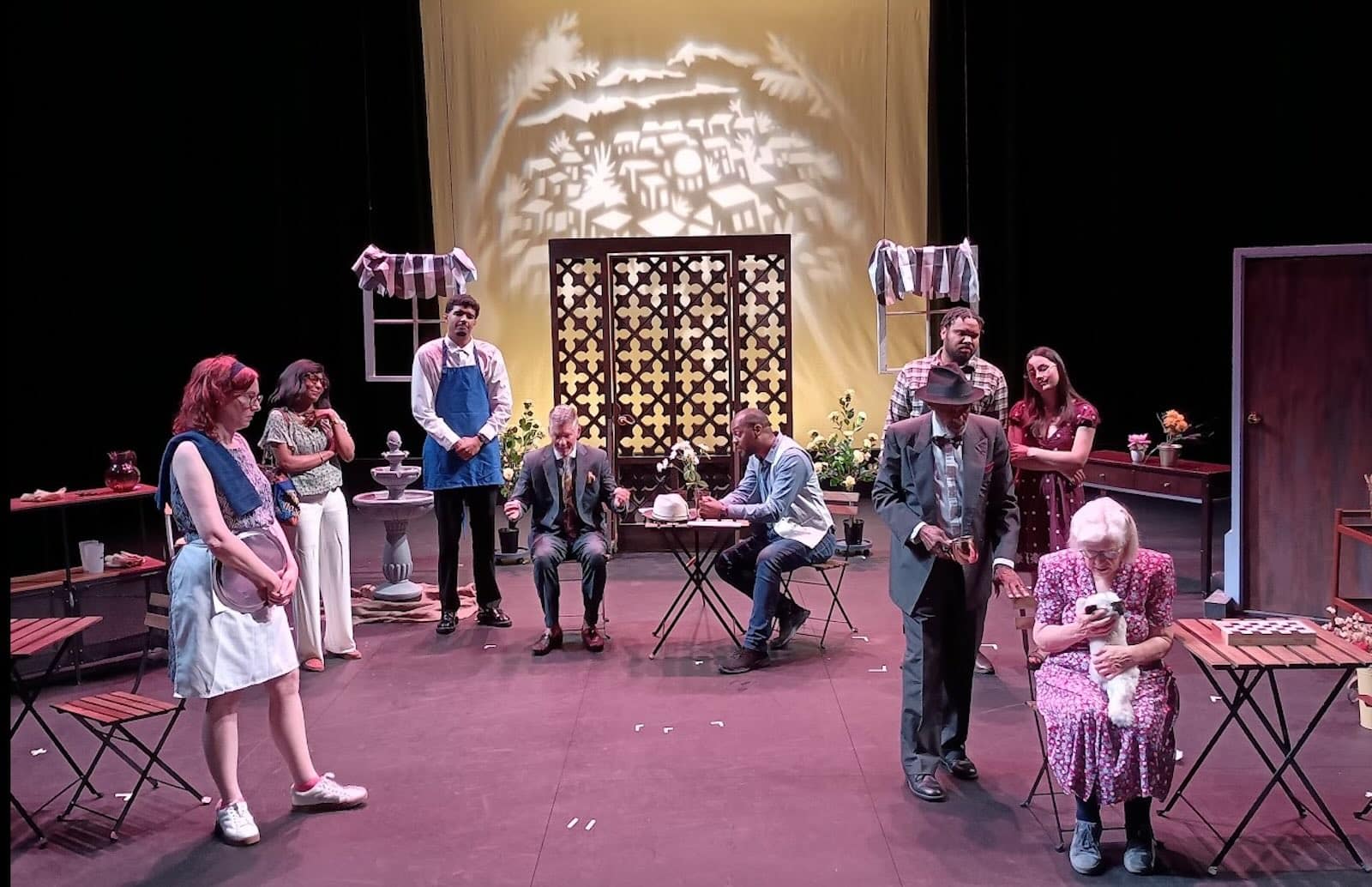
The large 15-member cast includes a bevy of characters orbiting around Berenger as foils, intellectual, silly, a pretty love interest, and more. Among them are co-workers and bosses from a nameless and soulless office job, waiters and patrons of a nameless, bland café, and a nameless stuffed pussycat, the first to suffer the ignoble fate of being trampled by a rhinoceros.
The dialogue early on is both mundane and vaguely, if you’re paying close attention, farcical; sometimes repetitive phrases serve as Ionesco’s tic to lean into language and emphasize meaning or nothingness. It starts as a rumor of a rhino running about town — termed “ridiculous” by pedantic Jean. Throughout the early part of the play, parallel conversations introduce both Ionesco’s characters and his ideas. Berenger remarks that he feels solitude oppresses him but remains frightened of other people — a nod to fellow French playwright Jean-Paul Sartre’s existential philosophy: hell is other people. Even a few inside theater jokes get tossed in: “Do you know anything about avant garde theater?” someone asks.
In the 1974 film version of Rhinoceros, featuring Zero Mostel and Gene Wilder, the take was to lean into slapstick comedy and farce with no visible rhinos in sight; we only heard them spoken about, watched characters watching them and saw the aftereffects of this rhinoceros takeover.
Director and Live Garra Theatre founder Wanda Whiteside has chosen to depict the rhinos in playful ways, first through some smeared green paint on one character’s skin, later as a blow-up rhino doll, then a horned mask, and, of course, with the mini placards the audience wields. With the extended lead-up, the rhino takeover never feels insidious, just loooooonnnng.
Ionesco intended to provoke viewers into considering how they so easily become seduced into mass collective ideas through societal and coercive political pressures. It’s not a far step to meander from the ridiculous rhinoceros herd mentality of the play to the hyper conformity that captured a nation’s critical faculties to buy into an antisemitic regime, which ultimately led to the horrific extermination of six million Jewish citizens of Europe and the now-disputed (as too few) five million murdered non-Jews, including Christian Poles and Slavs, Roma, Jehovah’s Witnesses, physically and mentally disabled persons, and political dissidents, among others.
The smartest of Whiteside’s directorial choices includes the conceptualization that as onlookers, the audience — the herd — plays a role being responsible for societal catastrophe of unimaginable proportions. We are the rhinos, the fascists, the Nazis, even if our faces are hidden by masks, our complicity makes us guilty.
Alas, this production clocks in at an O’Neillian length of three hours and 32 minutes with one intermission and two interminable set changes. The uncredited set featured an abundance of furniture and props that made scene shifts overly long. Then to see the stage managers and artistic director place and replace minor props like a pillow or basket, felt redundant. As well, an odd choreographed sequence in the midst of scenes 1 and 2 clumps the 15 actors together for a rendition of the “Electric Slide,” alas, not with the standard party music. Sure, it’s a metaphor — dancing in unison as blind allegiance — but really?
Unquestionably, amid these trying times when societal divides and fascistic governmental actions have begun to feel like one more mundane salvo in days of overwhelming news cycles, Rhinoceros is the right play for this moment. If only this production could have lived up to its promise.
Running Time: Approximately three hours and 30 minutes, including a 10-minute intermission.
Rhinoceros plays through July 5, 2026, presented by Live Garra Theatre performing at the Silver Spring Black Box Theatre, 8641 Colesville Road, Silver Spring, MD. Purchase tickets ($35–$20 student/senior) online.