
In Aurin Squire’s My Favorite Sociopath, the Contemporary American Theater Festival (CATF) in Shepherdstown, West Virginia, takes a sharp, witty, cynical look at how sketchy ethics and the lure of the sensational lead to the demise of journalism and the rise of fake news. The show is laugh-out-loud funny in the bargain.
Squire gives us three bright, verbal, competitive journalism students seeking success at their college newspaper in the 1990s: Miles (Nick Saxton), Gina (Brooke Turner), and Evan (Kennedy Kanagawa). Their backgrounds are varied, and they are not reliable narrators of their own lives.
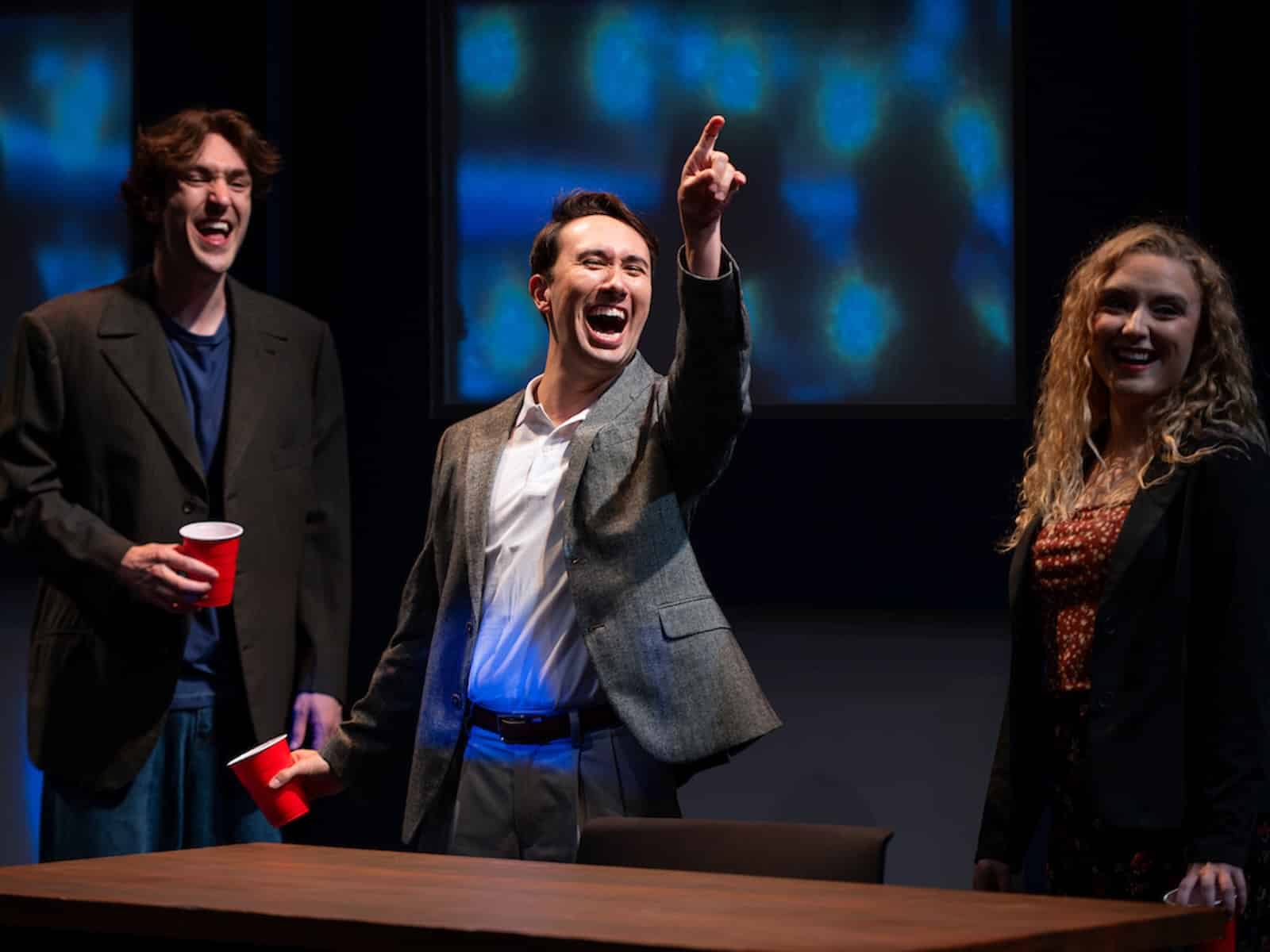
Gina, who portrays herself as a small Mississippi town girl of humble origins, insists on strong journalistic ethics throughout most of the play. Evan, an apparently gay man who claims to be from a wealthy family with ties to the Spanish royal family, seeks to dominate the newsroom by being the first to publish a noteworthy story. But it is Miles, son of a minor Miami criminal, who first finds a story that hits the paper’s front page.
The three are friends, sort of. Evan makes a point of calling the others “friend,” even as he seeks advantage over them. Gina and Miles have an on-again off-again relationship in which desire, journalistic considerations, and ambition are often at odds.
In sparkling performances by all the actors, the vulnerabilities of each character become apparent not only to the audience but also to one another. Each character has a good reporter’s nose for finding these vulnerabilities and using them to their own advantage. In the newspaper’s office politics, each eventually finds ways to undermine, betray, or blackmail the others.
Squire’s script establishes a highly permeable fourth wall. The characters, particularly Miles, often speak directly to the audience, commenting on what is happening in their world, the state of journalism, and where the play’s action is leading.
In Céline Rosenthal’s direction, the characters’ lines to each other and to the audience flow seamlessly, with the rapid-fire delivery and quick uptakes that are part of great journalism stories from the film The Front Page onward. Her direction creates stage pictures that not only use the playing area fully and effectively but also foster credible spatial relationships among the characters as they interact.
The action of the play coincides with the Bill Clinton/Monica Lewinsky scandal, for Squire an inflection point in the evolution of journalism away from its traditionally respectful, ethical, carefully edited role. (I wondered if Squire recalled the yellow journalism wars in the days of Pulitzer and Hearst.)
As the 1990s media engage in the politics of personal destruction at the national level, Miles — despite Gina’s ethical qualms — achieves success through a similarly ethically marginal exposé of a hapless private school principal. Seeking an attention-grabbing “hook” for the story, Miles focuses not on potentially interesting questions about the treatment of students at the school but on the principal’s ignorance of racist and antisemitic threads in the voluminous writings of a late-19th, early-20th-century Austrian writer whose philosophy informed the school’s pedagogy.
For all the characters, there is a temptation toward a style of storytelling that Squire calls “literary journalism — using literary structure and fictional techniques to tell a greater truth, a truth that cannot be accessed just by laying out the facts.” Or as the Cervantes/Quixote character says in Man of La Mancha, “facts are the enemy of truth.” But as Evan’s creation of a false narrative about a pregnancy club among Black teenagers shows, that can be a slippery slope, one that is increasingly easy to slide down as technology alters the ways news stories are told.
As the play’s title suggests, the word “sociopath” gets frequent use in the play. The characters use it casually, loosely related to its meaning in psychology (as explained in CATF’s excellent dramaturgical material for the show). Who is the sociopath here? All the characters use the term as an epithet directed at each other.
Squire has something broader in mind, which he discussed in the playwright interview in CATF’s online program:
The system is a sociopath. Media is a sociopath. The concept … is less a psychological diagnosis … and more a psychological virus that is transmissible through our media and our interactions, and it can infect people … It just lies dormant, waiting for the right situation to trigger it. All it takes to unlock it is the right series of combinations from a politician or the media. At the end, it is the system and then the audience with their smartphones … feeding that virus and making sure that it sticks around.
The final major light cue in Anshuman Bhatia’s lively lighting design — the quick pace of the lighting pairs nicely with the pace of the show — drives Squire’s point home, in a stunningly effective example of using lighting to not just illuminate the stage but tell an important part of the story.
Afsaneh Aayani’s set features a wall of translucent panels that can function as screens in some scenes, as well as a curved set of panels above and around the wall. Together with Kelly Colburn’s projections, it portrays visually the change from the centrality of print to more visual journalistic storytelling in the 24-hour news cycle and ultimately the social media age.
In a world, Squire comments, in which some people “want to consume fear and rage, then serve it to others,” an artist’s job is “possibly to vaccinate rather than to just wait until [the sociopathic virus] bubbles up again….” My Favorite Sociopath carries out the serious work of vaccination in a delightfully entertaining way.
Running Time: Two hours and 10 minutes, including one intermission.
My Favorite Sociopath plays through August 2, 2026, presented by the Contemporary American Theater Festival, performing at the Marinoff Theater on the campus of Shepherd University, 62 West Campus Drive, Shepherdstown, WV, in repertory with four other plays. Tickets, priced at $75 ($67 for seniors and $65 for students), are available online. Times, dates, and ticketing information for the full festival may be found on the CATF website or by calling the CATF box office at 681-240-2283.
SEE ALSO:
Contemporary American Theater Festival announces casts and creative teams for 2026 mainstage season (news story, June 20, 2026)