Have a drink? Beware, it may be your last in Bowie Community Theatre’s And Then There Were None. An opulent mansion on Soldier Island, off England’s Devon coast, promises its visitors a luxurious retreat. Instead, they find themselves trapped in a murder mystery.
Directed by Tatum Moss, Agatha Christie’s story gathers ten people with distinct personalities and carefully guarded pasts in August 1939. A secretary, a stern socialite, and an anxious physician are among those whose invitation becomes an indictment of past wrongs. The production’s striking design and strongest performances make this gathering worth watching, though its suspense does not always match its atmosphere.
Set designer Dan Lavanga, working from Moss’ concept, and props designer and set dresser Roy Hammond create one of the most beautifully detailed interiors I have encountered in a theater production. Patterned sofas, polished wood, framed artwork, and a well-appointed bar convey opulence. Open terrace doors reveal a luminous sky glowing in reds and oranges. Costume designer Jeano Binney’s choices feel more contemporary than distinctly late-1930s, but they complement the production’s tone and elegant aesthetic.
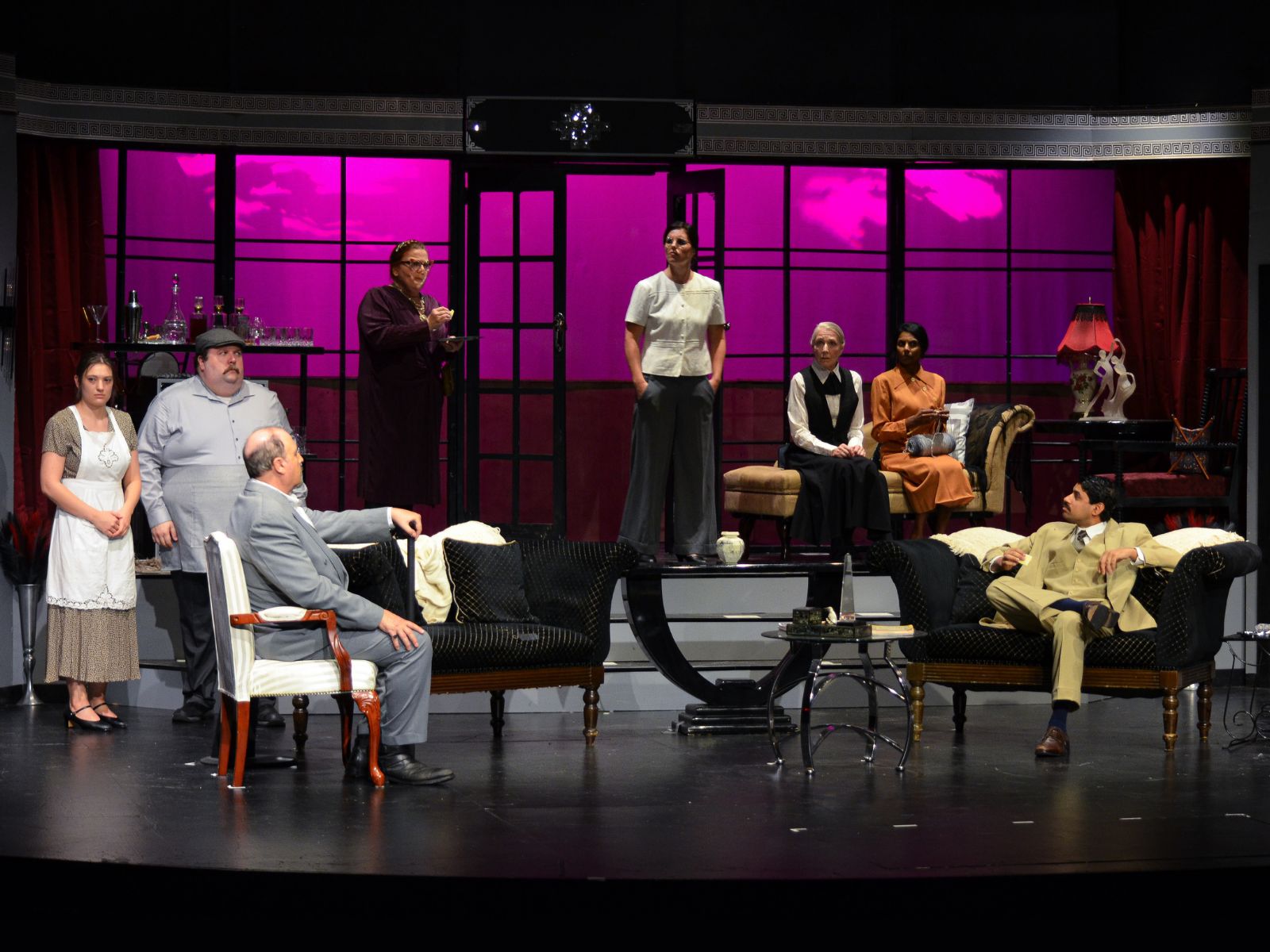
Once the doors close, the welcoming room begins to feel like a trap. Lighting designers Moss and the Bowie Playhouse staff shift the sky’s colors as time passes. Ceramic soldier figurines arranged beneath a framed nursery rhyme above the fireplace turn decoration into warning. The set rewards close attention, making even its simplest comforts feel suspect.
Moss’ blocking reinforces that unease. Standing characters circle and confront one another; seated exchanges invite uncomfortable confessions. Lowering oneself into a chair can also mean lowering one’s defenses. As sound designer, Moss heightens the danger with bells, forceful gunshots, and the ominous gramophone voice of Ryan Squires.
The tension between outward composure and concealed thoughts finds its strongest expression in Jeanne Louise’s Justice Lenore Wargrave. Returning to the play for a third time, and in a different role than before, Louise makes her familiarity with the material count. Her calculated silences and attentive listening quietly command the room. What Wargrave withholds becomes as intriguing as what she says.
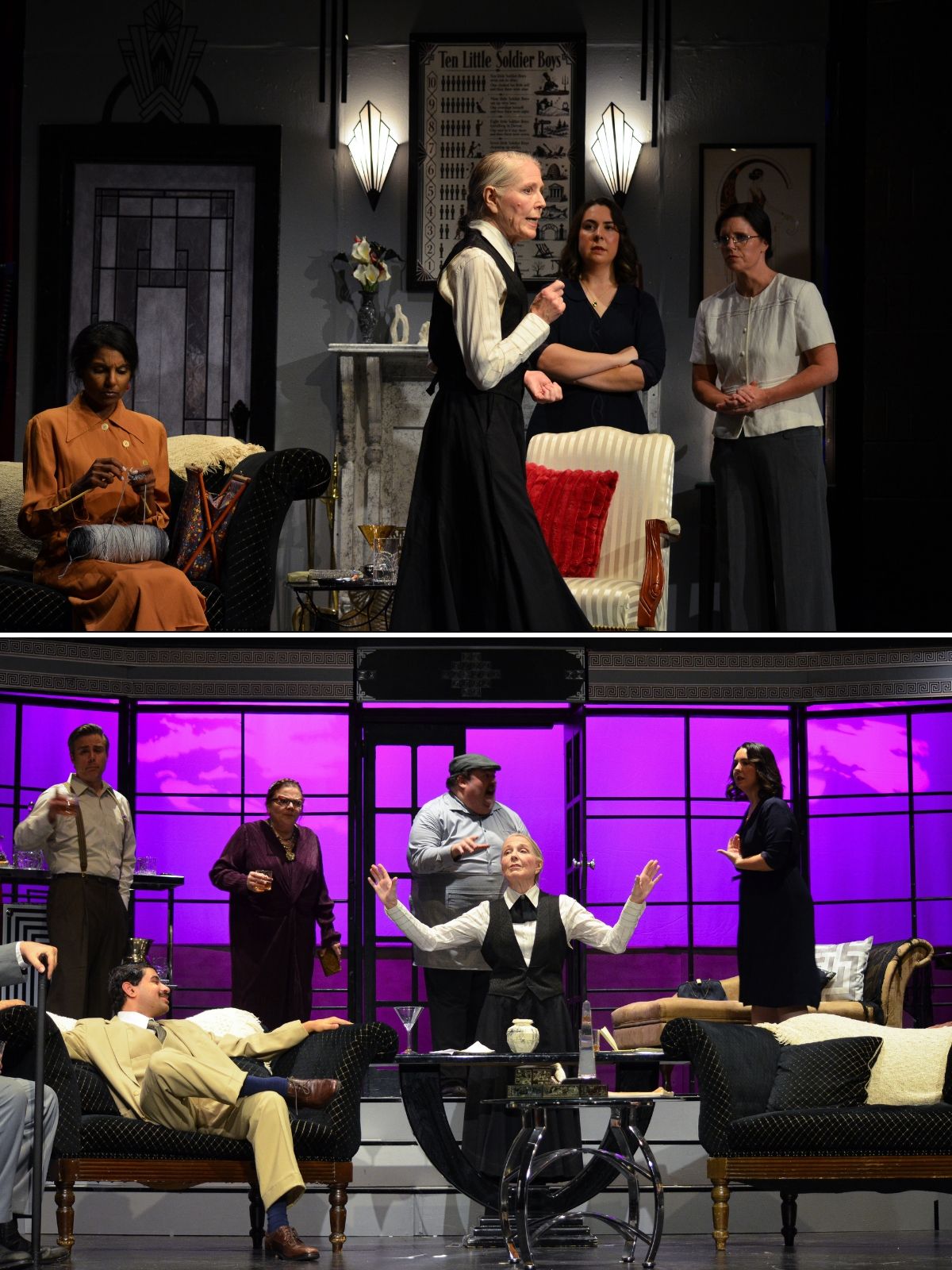
Where Louise draws attention through restraint, Brendan Cuddihee’s Captain Philip Lombard claims it with unapologetic bravado. His magnetic presence and clear delivery give confrontations momentum. Jenny Ephrussi provides a firm counterpoint as Dr. Evelyn Armstrong, whose unraveling composure reveals an increasingly urgent determination to survive.
Lombard also brings out a subtler side of Selah Holland’s Vera Claythorne. Her fleeting looks toward him suggest attraction and possibly deeper feelings without allowing either to dominate her performance. Bob Singer, meanwhile, gives General Mackenzie’s attention to Vera an unsettling edge.
Humor briefly loosens the tension. Aparna Sri finds sharp comedy in Emily Brent’s severity, especially when certainty gives way to genuine alarm. Vijay Dev brings warmth and comic buoyancy to Anthony Marston, while Gavin Shown turns Thomas Rogers’ disappointment over an anticipated tip from Inspector Blore into an amusing glimpse of resentment between the haves and the have-nots. Amy Heller’s Blore supplies early comic relief, while Sara Worley makes Ethel Rogers’ desire to leave palpable.
These engaging moments would carry greater weight with more consistent emotional detail. Vera’s nervousness begins so intensely that later distress has little room to grow. Brent’s repeated knitting sometimes feels like an assigned task rather than a natural habit. Blore’s brisk delivery and occasionally hard-to-follow accent obscure important exchanges. More varied reactions, clearer diction, and pauses after revelations would help the audience feel the consequences of each new clue.
At two hours and 45 minutes, including intermission, the evening feels lengthy even as individual exchanges rush. The challenge is to sustain momentum while giving fear, suspicion, and revelation time to register. Too often, keeping track of the mystery takes precedence over becoming invested in its people.
Yet a fleeting glance, Wargrave’s watchful silence, or Brent’s sudden alarm can bring the human stakes sharply into focus. These moments show how much more this impressive atmosphere can hold. We do not have to like these guests to care about their fates. But as the room empties, we should feel that we are losing people, not simply eliminating suspects.
Running Time: Two hours and 45 minutes, including one 15-minute intermission.
And Then There Were None plays through November 22, 2026 (Fridays and Saturdays at 7:30 p.m., Sundays at 2 p.m.), presented by Bowie Community Theatre at the Bowie Playhouse in White Marsh Park, 16500 White Marsh Park Dr., Bowie, MD. Purchase tickets ($25 for adults and $20 for students and seniors ages 62 and older, including transaction fees) online, by phone at the BCT Hotline at 301-805-0219, or by email (boxoffice@bctheatre.com) prior to the performance date.
Content Advisory: Murder, violence, gunshot sound effects, and discussions of death.