Following its Off-Broadway premiere at Playwrights Horizons in 2015, and its film adaptation, written and directed by Michael Almereyda, of 2017, Pulitzer Prize finalist Jordan Harrison’s 2014 sci-fi family drama Marjorie Prime is now making its, and his, Broadway debut in a limited engagement at the Hayes Theater. Considering the confluence of humanity, memory, and technology, the prescient four-hander offers a thought-provoking, funny, and unsettling solution to the pain of aging and loss through artificial intelligence, while also questioning the accuracy and ethics of digitally recreated lives.
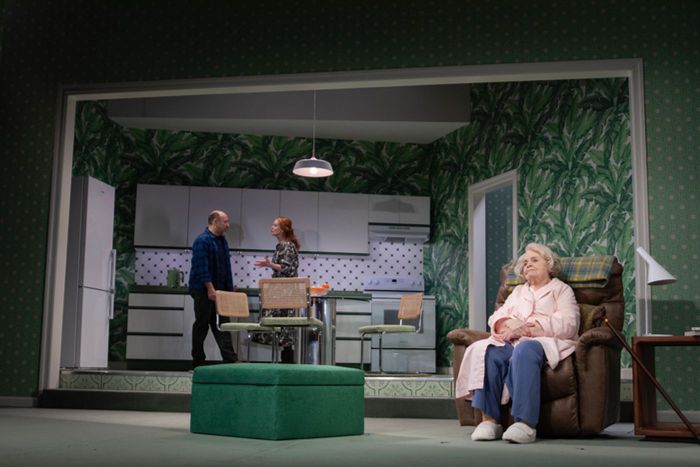
When the elderly widow Marjorie is impacted by Alzheimer’s and facing the onset of death, her son-in-law Jon, with her approval, but lacking the total acceptance of her daughter Tess, enlists the aid of “super-computer” Walter Prime, an AI-generated younger version of her late husband, to help her recall their loving past. At first encouraging and useful, it soon becomes apparent that the new version of Walter is limited to the information he’s been fed, not the full extent of who the man was, what the couple experienced together, and the real emotions he felt. But do the recollections stimulated and the comfort provided by Prime compensate for its shortcomings? It’s a question that becomes increasingly pressing and omnipresent in our current tech-driven culture, as reflected in the incisive three-part play, set in the 2060s.
Masterfully directed by Anne Kauffman, the production presents a perfect synthesis of wry wit, affecting poignancy, and keen foreboding without ever becoming overly sentimental, stiffly robotic, or sanctimonious. And the stellar cast – June Squibb as Marjorie, Cynthia Nixon as Tess, Danny Burstein as Jon, and Christopher Lowell as Walter Prime – capture the distinctive personalities, underlying tension, and difficult decisions in award-worthy performances that deliver the theme with human relatability and technological disconnect.

As the characters converse and share information with the Primes (yes, spoiler alert, the number increases as the narrative progresses), we learn about their history and interactions with one another, the other members of their family, the dogs they adopted, the memorable events and people in their lives, and the devastating death of Damian (Marjorie’s son and Tess’s brother) at the age of thirteen, which had a traumatic impact on the mother and daughter. Through it all, Jon is largely calm, helpful, and empathetic, trying his best to understand, to assist, and to support the women in any way he can, until he finally sees the reality of the AI simulations. The well-named Tess is often testy, exhausted by the constant care she gives her mother, frustrated by the lifelong lack of communication between them, losing her temper with her husband, overwhelmed by her unhappy existence, and raising the question of the quality of life, then eventually becoming a more even-tempered and pleasant form of herself.
Walter Prime, conceived of in his thirties to stir the memories and slow the dementia of the 85-year-old Marjorie, is, by design, smooth and fluid in his movements, agreeable, positive, and encouraging in his demeanor, taking in the facts and feelings he’s given, and noting he doesn’t “have that information” when something arises that hasn’t been shared with him – one of the few tip-offs, along with the huge discrepancy in the couple’s ages, that he’s not the real Walter, reinforced with eerie shifts in lighting (by Ben Stanton) and sound and original music (by Daniel Kluger) that remove us from the natural realm.

And Squibb’s Marjorie, alternating between feistiness and contentment, is the consummate embodiment of aging, switching back and forth from moments of forgetfulness and cognitive decline to awareness of her situation and past, and random references to the pop culture of her youth, including ZZ Top, Julia Roberts, and Beyoncé’s “Single Ladies” (even singing a few lines of the hit song), all with compelling realism, humor, and believability that comes not only from her extraordinary talent but her decades of living (she’s now 96, and her spot-on performance is both remarkable and inspirational). The interior set design (by Lee Jellinek), where it all transpires, likewise combines a 20th-century look with some more futuristic elements (like merely tapping the wall to play music), and costumes (by Márion Talán de la Rosa, with hair by Amanda Miller and make-up by Sarah Cimino) are indicative of the ages and existences of the characters, with somewhat neater and more refined dress of the Primes than the humans.
Marjorie Prime is a smart and insightful consideration of the growing infringement of AI on our lives and our inherent humanity. It will leave you wondering what you would do if given the opportunity to keep a loved one with you, even in a digitally recreated form that lacks the fully rounded personality, experiences, and memories of a life lived. Considering the rapid advancement of technology in our time, it’s a decision we’ll most likely face in the not-too-distant future.
Running Time: Approximately 85 minutes, without intermission.

Marjorie Prime plays through Sunday, February 15, 2026, at Second Stage Theater, performing at the Hayes Theater, 240 W 44th Street, NYC. For tickets (priced at $102-234, including fees), go online or find discount tickets at TodayTix.