The year 1967 was pivotal in many ways. It contained the “Summer of Love” counterculture movement, along with several urban riots fueled by racial and civil unrest. And the Supreme Court of the United States unanimously declared state laws banning interracial marriage were unconstitutional in the landmark Loving v. Virginia case. The decision overturned the miscegenation convictions of Richard Loving and his wife, Mildred Jeter Loving, who had been married in Washington, DC, in 1958.
It was in this landscape and with the issue of interracial marriage that the classic motion picture Guess Who’s Coming to Dinner opened and brought these questions to the big screen with such stars as Sidney Poitier as the Black doctor who arrives at his white fiancée’s home in San Francisco to meet her progressive parents, played by Katherine Hepburn and Spencer Tracy. Written by William Rose and directed by Stanley Kramer, the film received numerous 1968 Academy Award nominations, including wins for Rose’s screenplay and Hepburn’s leading performance. (Sadly, Tracy was also nominated for an Oscar; critically ill during filming, he died 17 days after the production wrapped.)
The subject matter, performances, and success of the film were considered groundbreaking for the time.

All this context is prelude to the top-notch production of Guess Who’s Coming to Dinner, the stage adaptation now playing at the Little Theatre of Alexandria through April 18. This is a must-see show, with excellent performances that bring new life to the story and characters, raising some of the same questions as the original film.
The play was adapted by Todd Kriedler in 2012 and debuted in Atlanta, according to the director’s notes by Adam Konowe. Some theater-goers may recall Arena Stage’s production from its 2013/14 season, and it has since made the rounds regionally.
Director Konowe has assembled a cast that is more than up to the task of taking on the characters who find themselves conflicted about a successful Black doctor who comes home with his bride-to-be to meet her affluent, seemingly liberal father and mother — a successful newspaper publisher and a gallery owner, respectively — whose points of view and values are tested.
In the role played by the late Poitier, Justin Oratokhai strikes an equally dashing figure to his film counterpart and brings a depth of feeling that mingles passion with clinical precision. As the object of his affection, Joanna Drayton, Meghan Mohon shows the convictions of a young woman in love with her man, despite the color barrier that the rest of the world sees at the time.
Without any nods to the iconic film performances of Hepburn and Tracy, except for the dialogue and the story, the seasoned actors Rachael Hubbard: Hubbard and Bruce Alan Rauscher become Christina and Matt Drayton. Hubbard is a vision of 1960s elegance, sporting a period wardrobe designed by Michelle Harris. Christine’s undying love for her family and her strong, progressive values are portrayed with clarity, even when the initial shock of her daughter’s news rattles her.
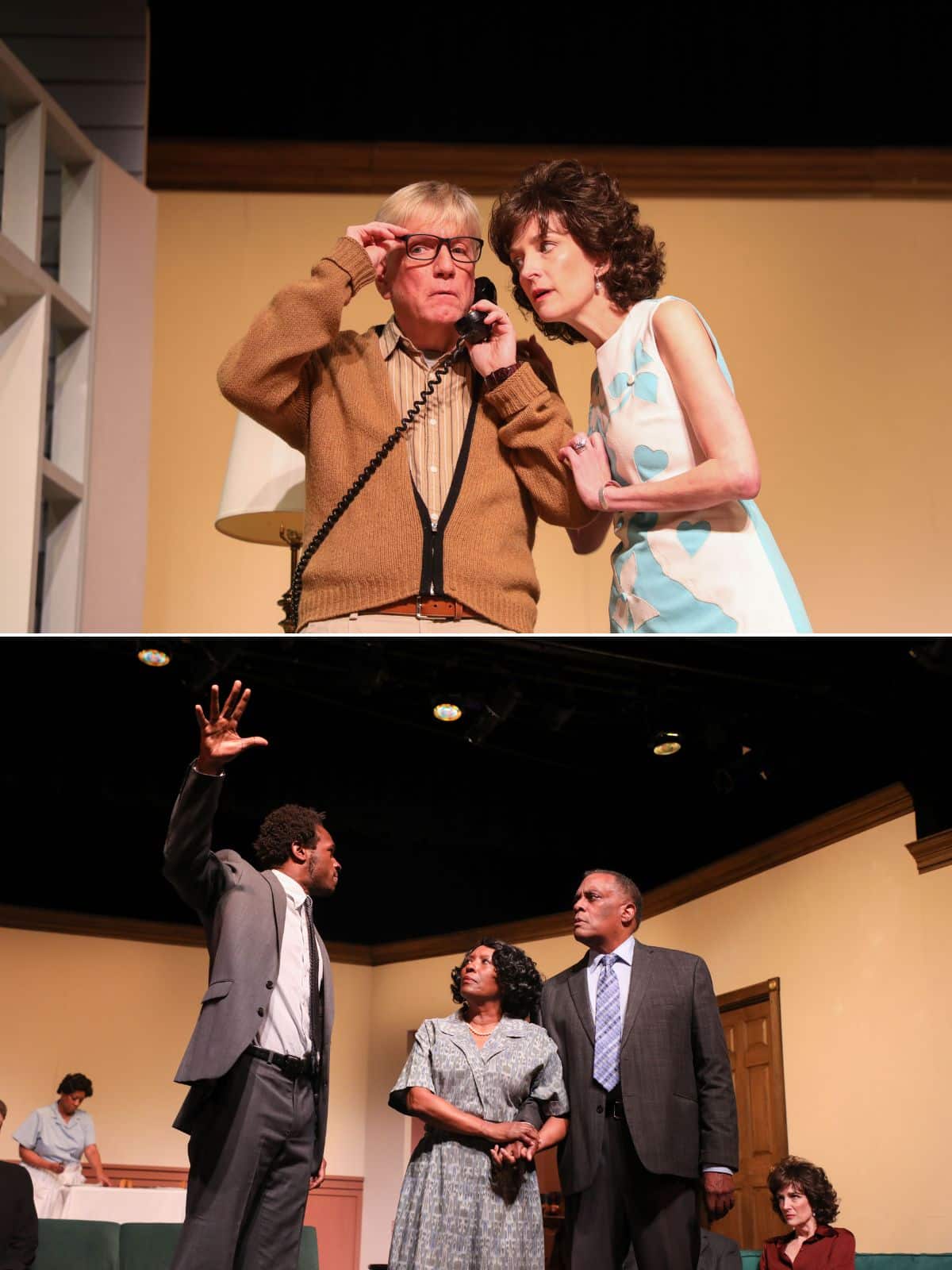
As liberal newspaperman Matt Drayton, Rauscher brings his considerable authority and charm to a role that has to show the most change among the characters, which the actors handled masterfully. Drayton’s entire career has been one of championing causes, we learn. But like many fathers of young women during that era (and frankly this one), he immediately wrestles with his own conscience, and the acceptance of a Black man as his daughter’s intended spouse. Rauscher makes this struggle real and sympathetic.
The central quartet of actors — Hubbard, Rauscher, Mohon, and Oratokhai — ground the production in the reality of the time period but they all seem as fresh as if it were a contemporary tale.
The cast is rounded out by a stellar group of supporting players who bring depth to their roles, even if their characters lean toward comic relief. As Mrs. Drayton’s gallery manager Hilary, Gayle Nichols-Grimes seems to have been transported directly from a different era, with her flawless Trans-Atlantic accent (re: the way old movie stars talked in “that” accent). The character also represents the quiet part out loud, which Nichols-Grimes does not portray shyly: the seemingly classy and sophisticated matron who harbors ugly, racist feelings just bubbling under the surface. Hubbard’s rebuff of her pig-headed assistant is worth the price of admission.
Floating in on charm and a lilting Irish accent, Marc Derks takes on the role of family friend and conscience Monsignor Ryan, a character worth cheering. Also deserving of cheers is Eleanore Tapscott as the Draytons’ loyal housekeeper and family cook, “Tillie” Binks. Devoted to her employers and fiercely protective of Joanna, whom she raised, Tillie, also a Black woman, brings a different perspective to the questions of race and acceptance. Tapscott captures the love and moral compass of a woman who has seen much in her life.
Rounding out the characters and providing their own strong performances, Kevin Sockwell and Gayle Carney play Dr. Prentice’s father and mother. Sockwell’s Mr. Prentice matches Rauscher’s intensity as he wrestles with his son’s perceived recklessness. The role of Mrs. Prentice may not have as much to say, but Carney’s reactions and brief sections of dialogue land every time.
Director Konowe’s collaborators, such as costume designer Michelle Harris, provide the artistic support the actors need to bring this important story to life with amazing detail. Hair and makeup designer Kadira Coley provided the actors with 1960s looks from head to toe. Tom O’Reilly’s set design immediately places the action within the elegant and stylish setting of a Mid-Century Modern home on a hill in San Francisco, complete with cactus-laden patio and a clean and simple living room/dining room space. O’Reilly was aided in the execution of his period design by an army of carpenters, painters, and set dressers.
Even for a play based on a 1967 film set in the same era, Guess Who’s Coming to Dinner shines a light on the questions of progressive values and race (and dare I mention “wokeness”?), which with nearly 60 years hindsight seem eerily prescient. This production is worthy of anyone’s time for just these reasons and many more.
Running Time: Approximately two hours and 30 minutes with one 15-minute intermission.
Guess Who’s Coming to Dinner plays through April 18, 2026, at Little Theatre of Alexandria, 600 Wolfe Street, Alexandria, VA. To purchase tickets ($28, reserved seating), go online, contact the Box Office via phone (703-683-0496), or email (BoxOffice@thelittletheatre.com).
The program for Guess Who’s Coming to Dinner is online here.