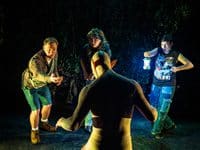
The inevitability of a play that included an element of artificial intelligence (AI) was foretold by Nostradamus and a storefront psychic. How a playwright incorporates AI into the story is, of course, the real question. In the hands of the prolific writer Lauren Gunderson, AI is actually not center stage in Anthropology but a wonderful spice in a very human story of grief and loss, regret, a search for the truth, and fraught family dynamics. In other words, like in the best dramatic texts, Anthropology holds a mirror up to life, with a side view of technology that permeates our lives, and the complications that real life and artificial intelligence hurl at us, sometimes with painful results.
Gunderson is one of the most-produced living American playwrights since 2015, topping the list four times, most recently for the 2025/26 season (American Theatre magazine). Her titles include Emilie: La Marquise Du Châtelet Defends Her Life Tonight, Silent Sky, I and You, and an adaptation of Peter Pan and Wendy, among many others. Anthropology had a London premiere in 2023 and has been produced in many theaters since.
On the well-appointed church basement stage where NOVA Nightsky performs their plays, a spartan apartment with a central computer station and sparse Mid-Century Modern furniture gives the actors plenty of space to enact this very human story where AI plays a pivotal role. Adam Ressa provided the scenic design.
As directed by Sarah Baczewski, the play unfolds in an unfussy manner, highlighted by naturalistic acting and shared intimacy thay is palpable and wholly believable. In order to incorporate the artificial intelligence within the script, Baczewski was skillfully and artfully aided by video effects brought to the stage by Alex Eagle, Nate Eagle, and Jeff Fitzgerald. (Fitzgerald also provided the video design.) Aside from the computer work desk, the AI was represented by both innovative video effects with glass orbs, and the actor who played the actual chatbot — more on this later. The effects were surprising and added a sci-fi aspect to the play simply and very effectively.
The précis of the play is simple even as complications ensue. Merril, a brilliant Silicon Valley coder, dealing with unconsolable grief since her younger sister’s disappearance, creates an active chatbot not only named after Angie, her sibling, but recreates the missing sister based on all the physical and online data Merril can feed it. When the chatbot is active, Merril slowly warms up to the artificial doppelganger until the chatbot-Angie begins to insinuate herself (itself?) into not only Merril’s life but the lives of others. The search for the real, missing Angie is also percolating in the background until the search comes to a climatic revelation. With elements of a thriller, laced with humor, and deep pathos, Gunderson’s script is masterfully handled by the entire company and directed by Baczewski.
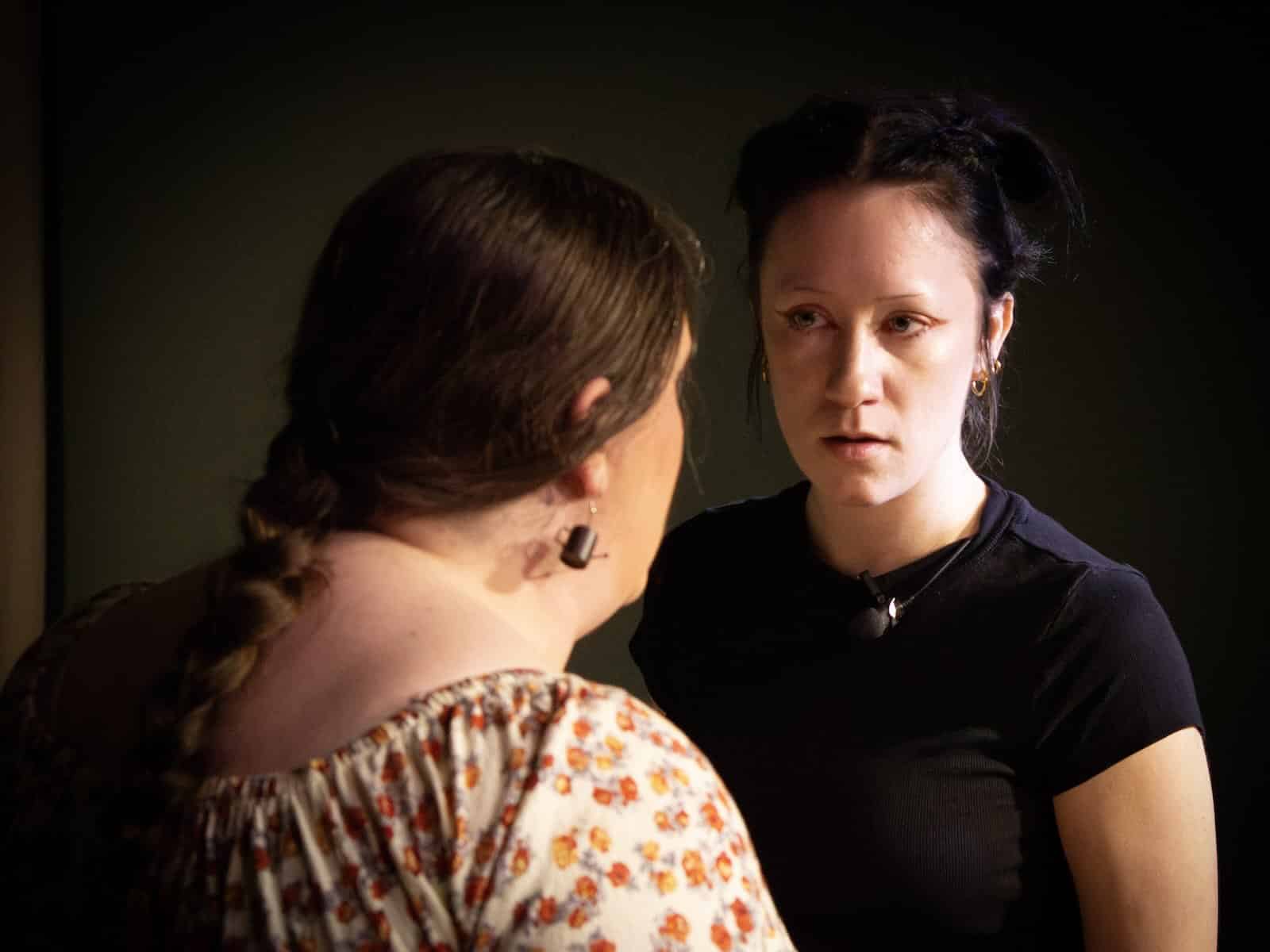
But the human element is the true highlight of the play, superbly cast by Baczewski, and brought to life by the actors. Elyse R. Smith was Merril, the central character who effortlessly carries the play from start to finish. Carrying her grief like a heavy blanket, the character’s sharp mind is contrasted with her wounded soul, both clearly visible throughout her performance. As both the chatbot version of Angie (and eventually her human counterpart), Fosse Thornton brings both cold calculation and an insinuating presence to the surprising dual role of Angie and Angie the AI recreation. The ongoing scenes with Smith and Thornton ratchet up the tension and suspense throughout the play, until the shocking reveal (not to be spoiled here).
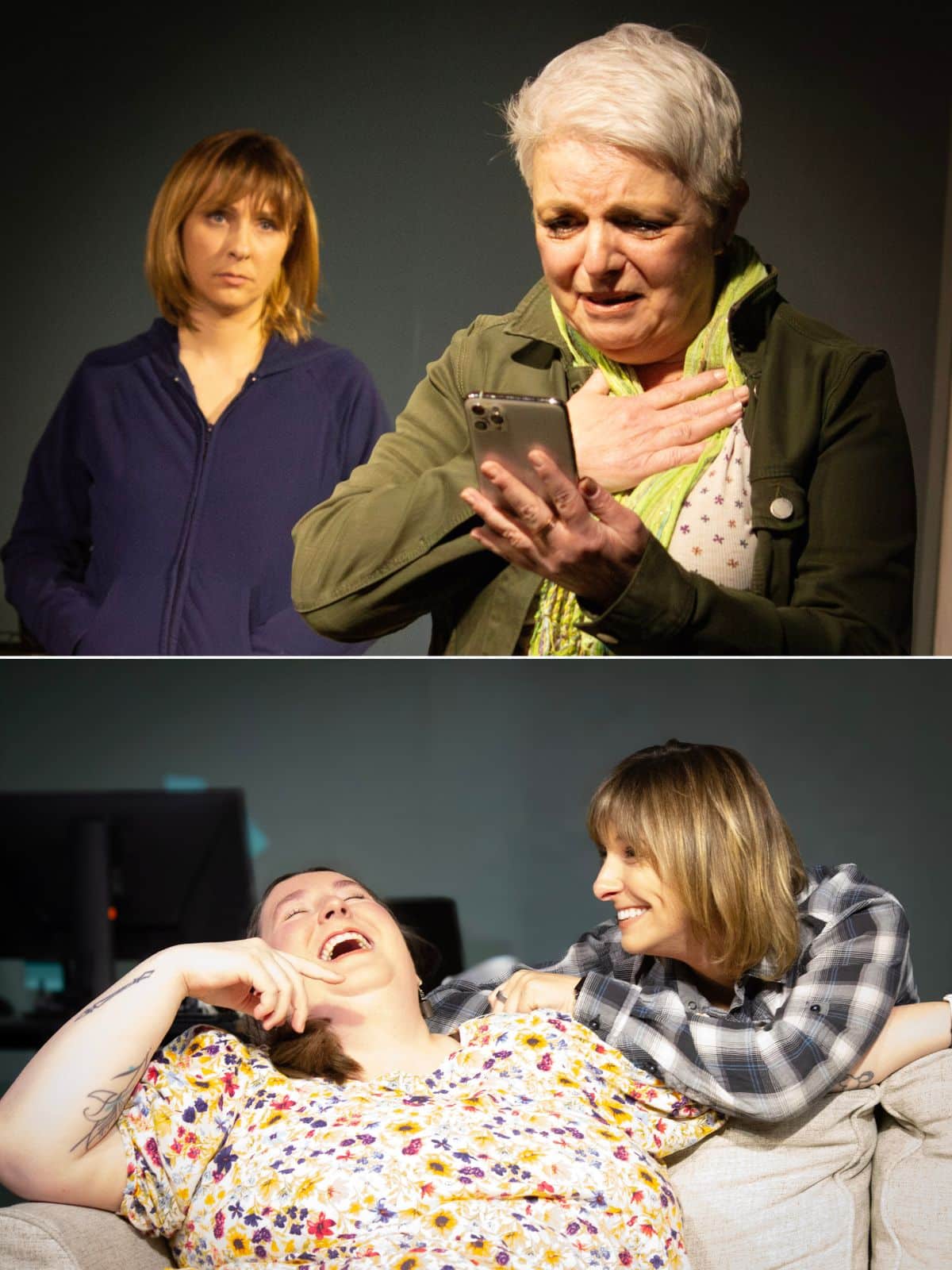
Playing smaller, yet pivotal roles, which still interact with the wily chatbot, Hannah Ruth Blackwell is Racquel, Merril’s recently former girlfriend who is suspicious of the substitute sister. As Merril and Angie’s troubled and emotional wreck of a mother, Mattie Cohan makes the most of her few scenes, bringing additional drama and tension to all involved.
As presented without intermission, the scenes build on each other seamlessly, with a 90-minute running time that keeps the action tight and the arc of the story just long enough to be satisfying. And the questions of how useful artificial intelligence is in our lives and whether AI could break barriers and learn enough about our language and habits to truly mess with us are anyone’s guess. As portrayed in Anthropology, AI can be both a comfort and a danger; contemplating such results may keep some of us awake for long after the play has finished.
Running Time: Approximately 90 minutes with no intermission.
Anthropology played April 16 to 25, 2026, presented by NOVA Nightsky Theater Company, performing at Memorial Hall at Falls Church Presbyterian Church, 225 E Broad St, Falls Church, VA.
The program for Anthropology is online here.Anthropology has closed, but the season continues. Coming up next for NOVA Nightsky Theater Company: Big Love by Charles L. Mee, adapted by Jaclyn Robertson, directed by Robertson and Adam Ressa. The NOVA Nightsky production runs June 12 to 27, 2026. Patrons may purchase tickets online in advance. Big Love, according to the playwright’s website, “is an amalgamation of Aeschylus’ The Suppliants and a myriad of Mee’s own personal ingenuity, borrowed text, and other ideas from a number of authors, playwrights, theorists, with much of the play borrowing much from Aeschylus’ 470 BC drama.”