Rockville Little Theater strives for immersion in their production of The Curious Incident of the Dog in the Night-Time and achieves something much more visceral: a relentless portrait of sensory overwhelm and broken trust. It is a well-staged, expertly acted production, but it is intentionally and effectively not easy to watch. The story follows autistic teenager Christopher Boone, a mathematically gifted individual who becomes fixated on investigating the death of his neighbor’s dog, but the mystery is merely the scaffolding for a much deeper exploration of neurodivergent reality.
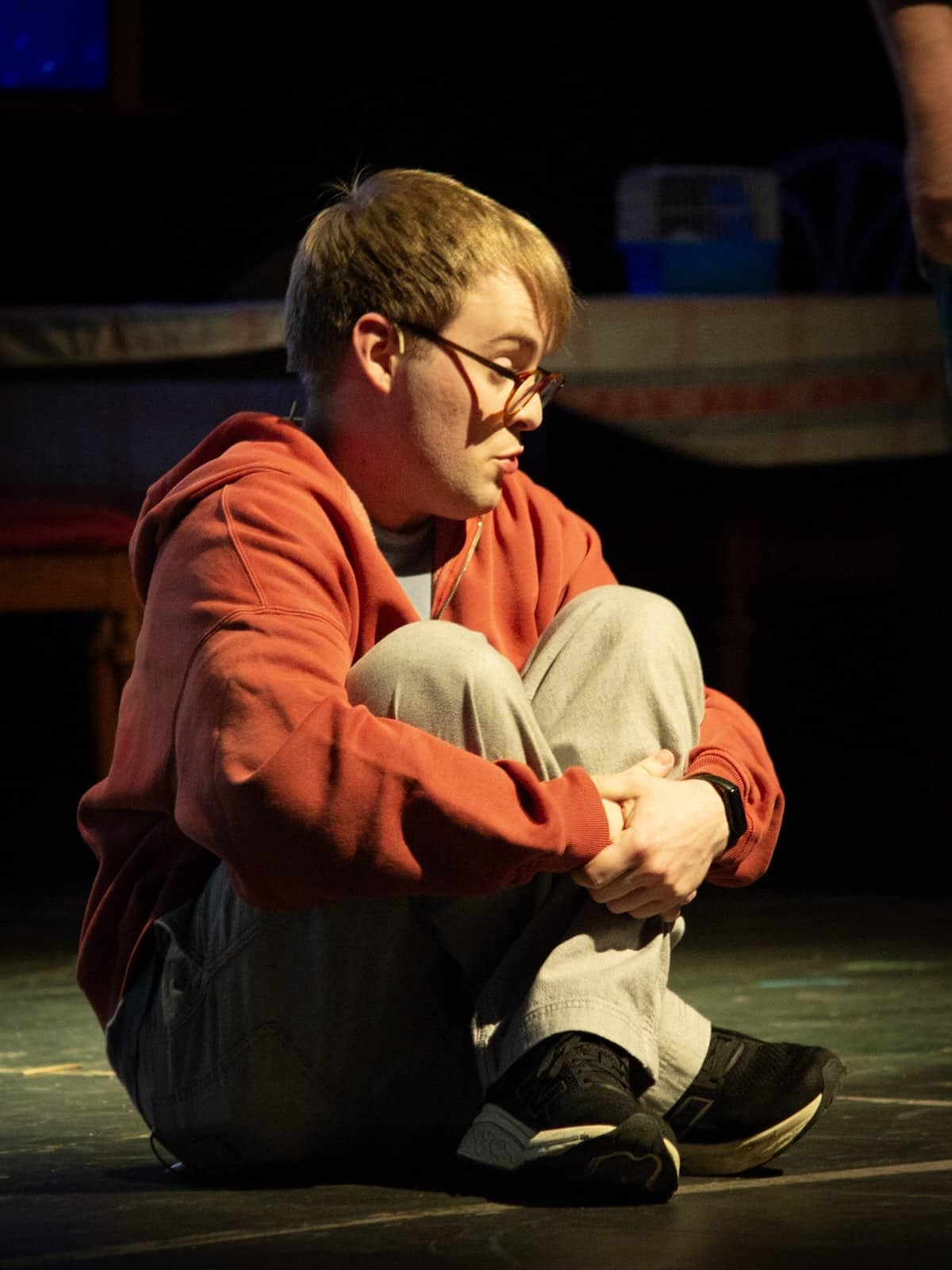
As Christopher, Henry Jeanneret delivers a standout performance that anchors the show’s emotional gravity. Christopher spends the entire play in a state of high stress punctuated by frequent meltdowns. Jeanneret adopts physical mannerisms and maintains stims throughout his performance, expertly managing the intensity of his movement with such incredible dynamic range that the tension never leaves the stage. While the show provides some one-liners that offer moments of levity to break the tension, for me, it was an experience of sustained, calculated overwhelm.
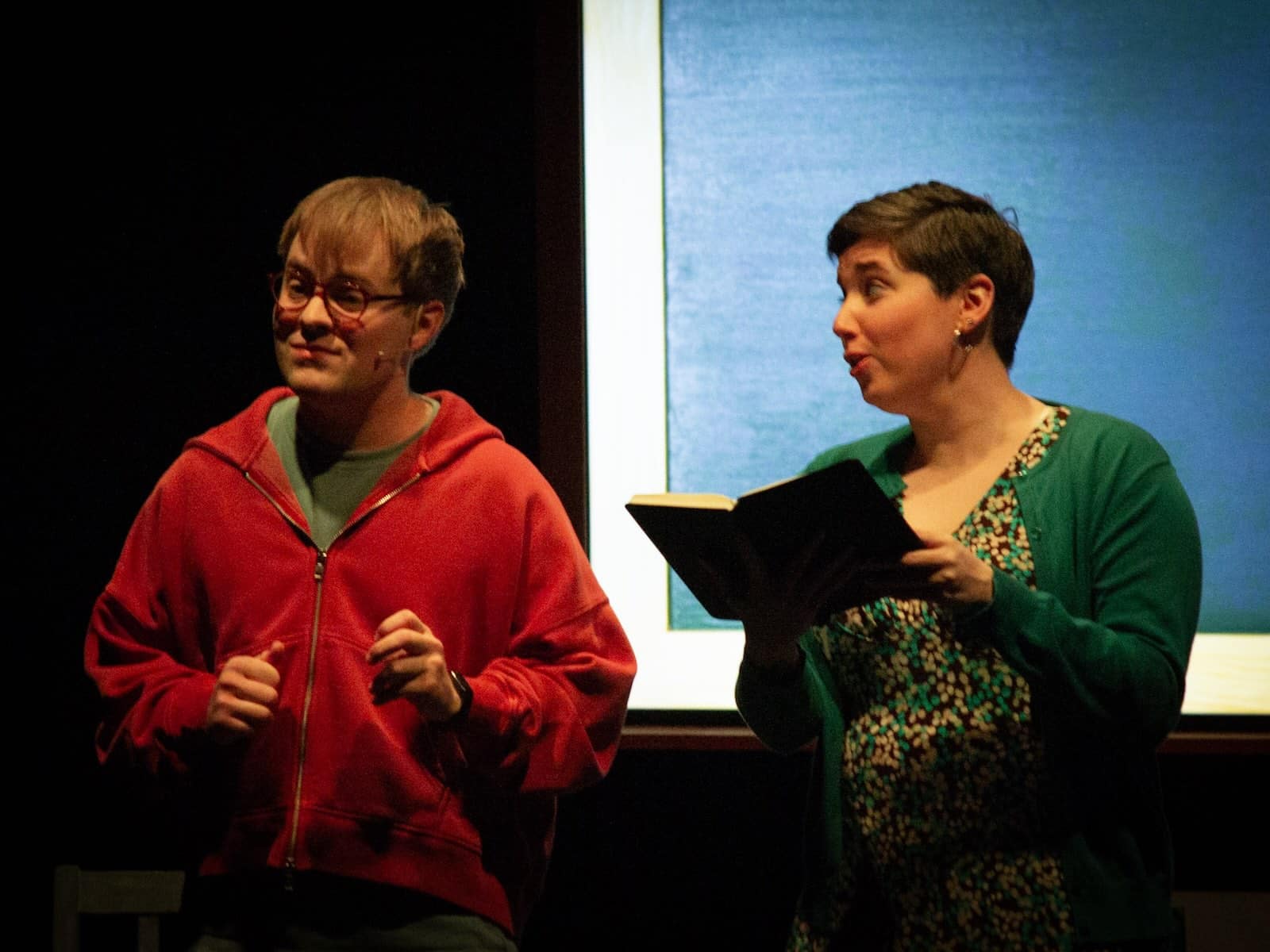
The production’s greatest technical success is its ability to manifest Christopher’s internal logic, emotions, and the chaos of overstimulation. The minimalist set designed by Maggie Modig relies on three large background screens and a primary projection, allowing the world to shape around Christopher in real time. The video design and projection by Brad Tehaan, depicting his inner logic, was innovative, carrying the weight of sensory overload and specially curated to bring the audience into the moment.
However, that chaos is the show’s primary language. From the classroom scenes filled with a constant murmur of movement to the train station’s simulated advertisement overload, Roger Stone’s sound design creates a relentless soundscape. Coupled with focused pools of light and Catherine Oh’s frenetic choreography, the production creates a state of claustrophobia that is both impressive and exhausting. The cast performances were equally sharp. Dave Wright and Amanda Jones as Christopher’s parents captured the grueling, messy reality of their struggle with heartbreaking clarity. But even feeling their struggle, I felt I was crying for their understanding, because even in private, they did not accommodate their son.
The show highlights a heartbreaking empathy gap between the audience and the protagonist. While the audience laughed at Christopher’s literalism, such as his plea for people to stop using metaphors (which he views as lies), these weren’t jokes to me. They were legitimate requests for clarity and accommodation, met with an eyeroll and the social lie of humor. This tension is most evident in the hand-touch between Christopher and his parents. While often viewed as a heartwarming substitute for a hug, to me it felt more like a performance of masking — a forced obedience to a neurotypical need for connection rather than a calming technique for Christopher himself. It was a concession he made for his parents’ sake, and my heart broke a little every time he was forced to fulfill their want at the expense of his need.
The second act, while technically impressive and amazingly executed during the London train station sequence, suffers from a noticeable narrative stall. As the mystery of the dog and his mother’s disappearance is resolved, the story settles into a grueling portrait of burnout. Like Christopher, I was tired, yet the drama continued, leading to a heavy final blackout. There is no easy triumph here. Instead, the final moments feel like a betrayal from those Christopher was supposed to trust most. Sitting in the sudden silence after two hours of sensory bombardment, the weight of that broken trust is deafening.
A post-bow encore lifts the mood and provides a palate cleanser; however, the true power of this production lies in its refusal to sugarcoat the cost of Christopher’s journey. The production succeeds so well at portraying exhaustion that I left the theater feeling as depleted as the protagonist himself.
I think there will be a noticeable difference in how neurotypical and neurodivergent audiences receive the work. For some, the actor performances and immersive production will be a poignant taste of autistic life; for others, it is a lived experience of high stress in a world where people won’t talk plainly, say what they mean, or answer honest questions. Because the show so effectively mirrors Christopher’s reality, those who struggle with sensory input may find the standard performance more taxing than transformative. For those, RLT’s sensory-friendly performance (scheduled for May 8) is perhaps the most accessible way to engage with the heart of the story without the barrier of physical overwhelm. The Curious Incident of the Dog in the Night-Time is a profound and skillfully executed production that deserves to be seen, provided you are prepared for the weight it leaves behind.
Running Time: Approximately two hours and 20 minutes, including one 15-minute intermission.
The Curious Incident of the Dog in the Night-Time plays through May 10, 2026, presented by the Rockville Little Theatre, performing at the F. Scott Fitzgerald Theatre, Rockville Civic Center Park, 603 Edmonston Drive, Rockville, MD. Purchase tickets ($24; $22 for students and seniors) online, by calling the Box Office (240-314-8690), or by email (boxoffice@rockvillemd.gov).
Special sensory-friendly show on May 8.
The Curious Incident of the Dog in the Night-Time
Based on the novel by Mark Haddon
Adapted by Simon Stephens
Directed by Michael Kharfen
Produced by Laura Andruski & Nancy Somers
Stage Manager: Terri Carnahan
CAST
Christopher: Henry Jeanneret
Siobhan: Danielle Comer
Ed: Dave Wright
Judy: Amanda Jones
Actor One: Tricia Contreras
Actor Two: Tom McGrath
Actor Three: Dylan Hernandez
Actor Four: Will Townsend
Actor Five: Nadia Abouraya
Actor Six: Sue Holliday