By Mary Harney
A spin on the classic Sleeping Beauty fairytale, Sleeping Beauty: The Time Traveler, presented by Adventure Theatre MTC, isn’t a bad way for a young kid to spend an hour. The musical follows a boy named Rolly who, by pricking his finger on a spinning wheel, travels back in time to the age of Charlemagne, where he meets young princess Aurora. Aurora and Rolly become friends and connect over their desire to be independent from their controlling parents. Aurora dreams of becoming a knight, and she works with Rolly to avoid her destiny of being cursed to sleep for a thousand years.
The story, written by Janet Stanford (founding artistic director of Imagination Stage), provides Sleeping Beauty with much-needed agency in her own story. It turns out that Rolly, like all too many of his contemporaries, spends too much time gaming and got a D in social studies, so his frustrated parents take him on a history tour in France. (The show contains many references and parallels to the video game Legend of Zelda.)
There are times when the narrative gets a little unclear. The play starts with Aurora and Rolly at the end of their journey. They then act as narrators, introducing the audience to the beginning of the story, but in the midst of that scene, the King and Queen directly address Rolly, making it unclear whether our heroes were the narrators or actually in that time and place. In an ancient castle, Rolly pricks his finger, falls asleep, and wakes up centuries earlier to encounter Aurora. Then later on, he and Aurora prick their fingers, he for the second time. Rolly wakes up in the future while Aurora falls asleep for a thousand years. Does pricking their fingers transport them, or do they need to sleep until they awake in their final destination? And if so, how did sleeping get Rolly to the past?
The plot points did not really feel resolved by the end of the play. An Evil Fairy character (played by Jack Stibbe) did not receive his comeuppance, and we never get to see Aurora’s parents come to terms with her need to take charge of her own life. And though she speaks often of her dream of becoming a knight, we never see what happens to that aspiration. Aurora gets to experience the modern world and all of its technological wonders, but she becomes stuck in a time where she is unable to ride a horse and battle evil wizards with her sword. Achieving her dream meant becoming independent from her parents, so it would be a fitting end to her character journey if she defeated the curse and got knighted, leaving the castle to have adventures out in the world.
The songs, with music by Deborah Wicks La Puma and lyrics by Andrea Dodds, could have used a bit more variety, but the numbers were generally successful in moving the story along and providing some insight into the characters. The first song, “Am I Awake,” and the finale, “Wide Awake,” allow the story to come full circle. “Aurora’s Song” echoes the Disney princess “I want” songs with an uplifting melody. Stanford’s book was effective in highlighting the conflicted relationship between Aurora and her parents. Reminiscent of Mother Gothel’s villainous song in the Rapunzel movie, the strongest musical number was “Old Enough to Know.” It felt distinct from the other numbers in highlighting how the overprotective King attempts to frighten Aurora by magnifying the dangers in the world. “Pretty Dreams” contrasted that with the Queen comforting Aurora. “A Piece of Wood” expresses Aurora’s bubbling discontentment with her parents treating her like a little kid, and “What If” results in Aurora and Rolly making the decision to risk time travel again. “A D in Social Studies” did not seem as integral to the show as Rolly’s parents could have easily explained their frustration with their son’s preoccupation with video games in a few lines of dialogue.
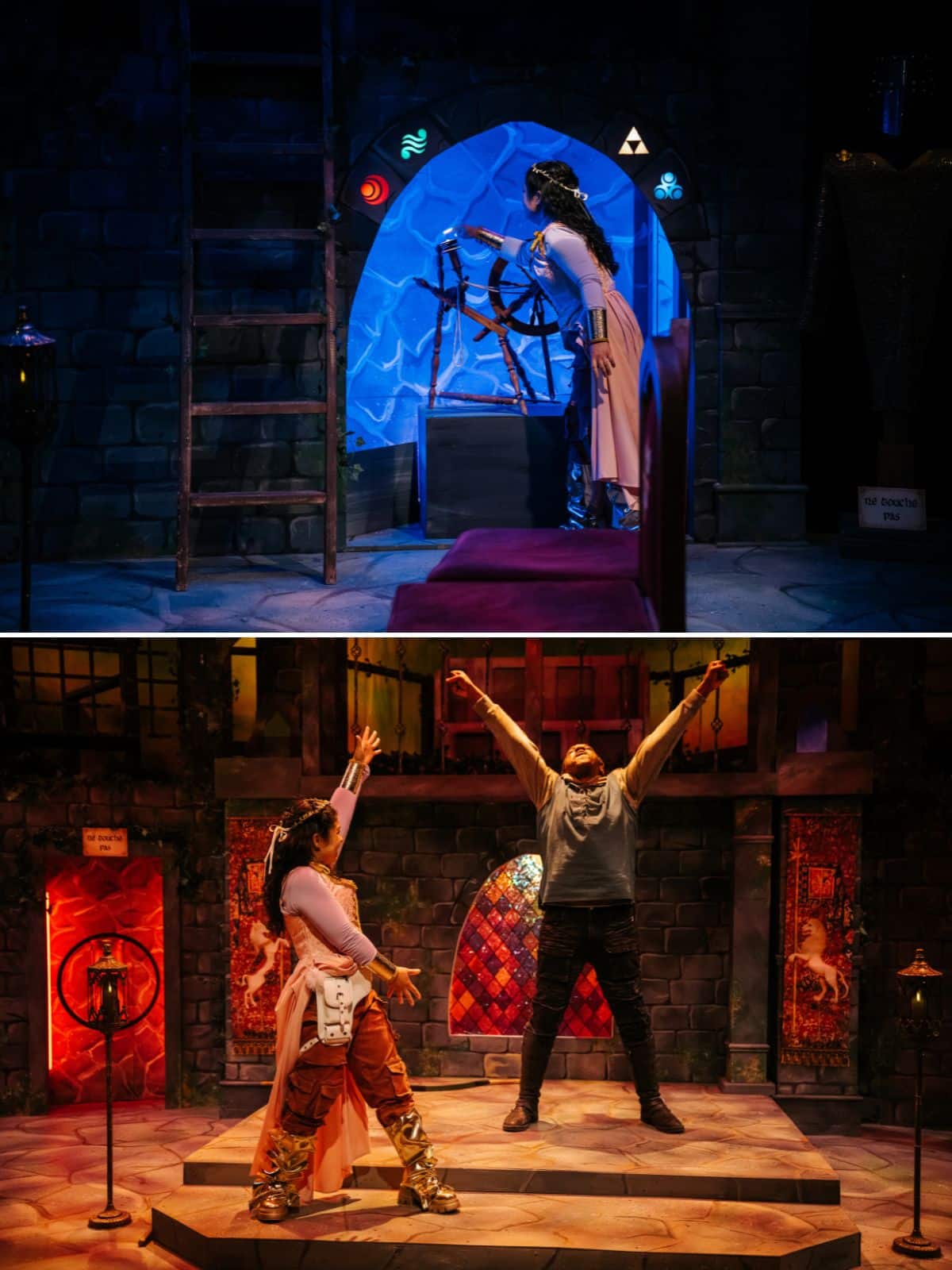
The acting was generally well done, and each performer sang quite well. Chelsea Majors plays a 12-year-old Aurora with an infectious optimism and yearning for a life of heroism. Carl L. Williams plays Rolly with a newfound wonder of history and a positive energy that accompanies Aurora’s optimism. Jake Stibbe and Sally Imbriano perform with a dramatic flair, whether they are playing parents or fairies. However, the characters were portrayed with a childishness that was a bit too exaggerated.
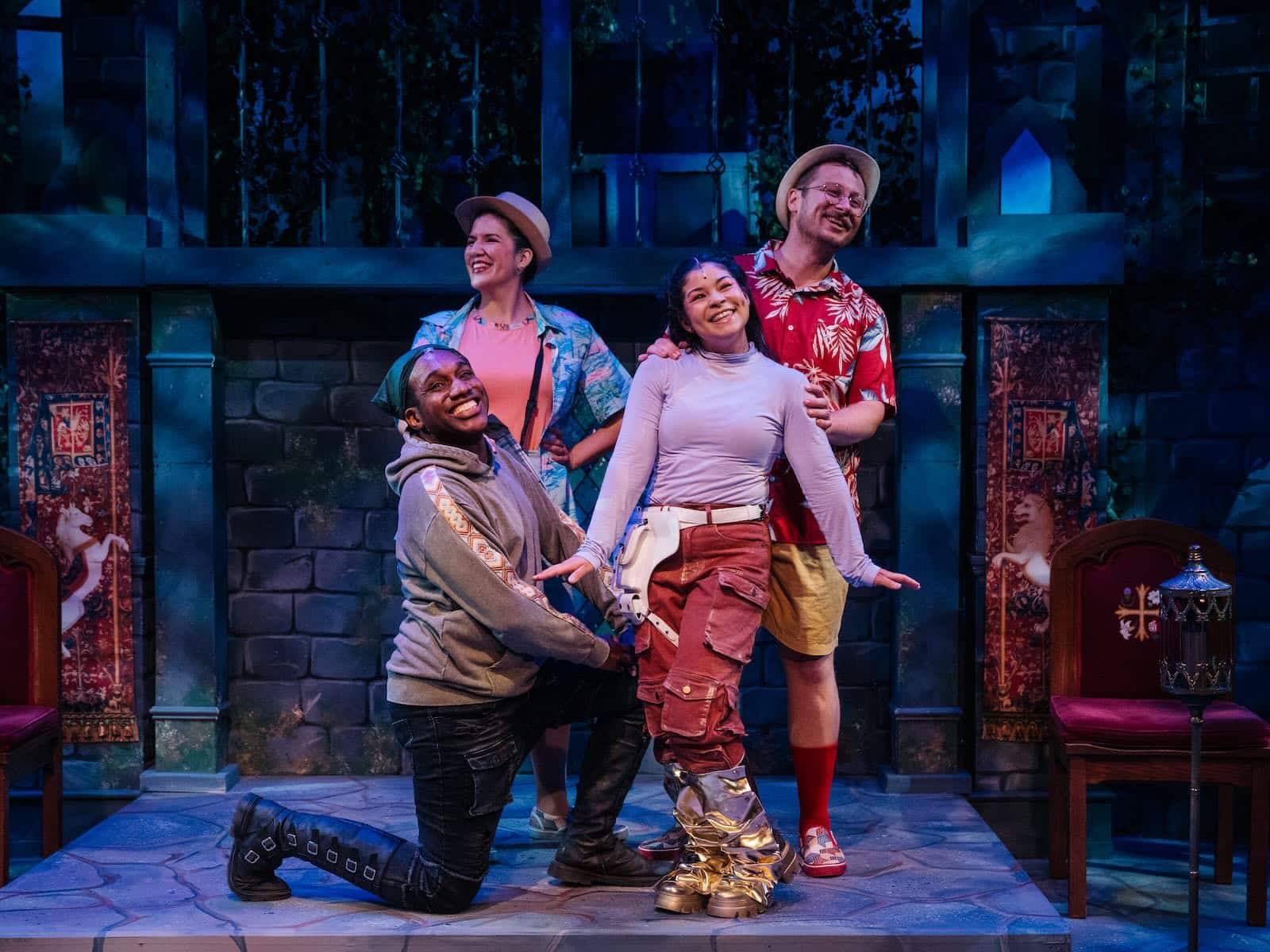
For the most part, Paris Francesca‘s costume design effectively differentiates between the modern age and Aurora’s time. Imbriano and Stibbe alternate between Rolly’s time in modern tourist clothing and Aurora’s time in royal capes and crowns. Aurora wears a crown and dress that look royal, but under that, you see orange cargo pants and golden boots that seem like something she would have borrowed from Marty McFly.
The lighting design by Lynn Joslin was especially effective in the flashback scene when the good fairy battles the evil fairy and the lights switch from red to blue in dramatic fashion. The set design by Dom Ocampo also worked well at immersing the audience in a fairy tale with the childlike wonder of the painted sets and the ivy.
While the play is meant for all ages, it’s more targeted toward very young children. Just as Aurora’s parents should learn to trust her more, the show could do well by not underestimating younger viewers. In other words, a story can lean into more complex themes and trust that both the younger and older members of the audience can take something away from the story. This play probably won’t appeal to older viewers, but it might be a nice watch for a young child while visiting Glen Echo Park.Running Time: 60 minutes with no intermission.
Running Time: 60 minutes with no intermission.
Sleeping Beauty: The Time Traveler plays through August 23, 2026, presented by Adventure Theatre MTC, performing at Adventure Theatre MTC, 7300 MacArthur Blvd, Glen Echo, MD (in historic Glen Echo Park). Purchase tickets ($28 for general admission; group, field trip, and birthday rates available; free for children under 1) online or call the box office at 301-634-2270.
Children under 1 are free. Recommended for all ages.
Sleeping Beauty: The Time Traveler
Book by Janet Stanford; Music by Deborah Wicks La Puma; Lyrics by Andrea Dodds; Directed by Janet Stanford; Choreographed by Kurt Boehm; Music Direction by Elisa Rosman; Set Design by Dom Ocampo; Costume Design by Paris Francesca; Lighting Design by Lynn Joslin; Resident Props Designer Andrea “Dre” Moore; Sound Design by Kenny Neal; Production Stage Manager Shannon Saulnier; Assistant Stage Manager Hayden Polsky; Production Manager & Scenic Charge Dom Ocampo; Interim Technical Director Megan Holden; Fight Choreography by Ryan Sellers; Lead Carpenter/Lead Electrician Andrew Wilkinson; Carpenters Jackson Elkins, Spencer Munshi, and Lily Ung; LX Electricians Patrick Carter and Hayden Polsky; Sound Electricians Kenny Neal and Griffin De Lisle; Scenic Painters Tyler Whitmore, Daniel Brody, and Bowie Colon.
Featuring Chelsea Majors as Aurora, Carl L. Williams as Rolly, Sally Imbriano as Queen/Mom, Jake Stibbe as King/Dad, Mallorie Stern as Aurora and Queen/Mom Understudy, and Daniel Brody as Rolly and King/Dad Understudy.

Mary Harney is a contributing writer for DC Theater Arts. She is studying fine arts and English at George Washington University, where she enjoys making art, and writing about art and literature. Mary lives in Washington, DC.