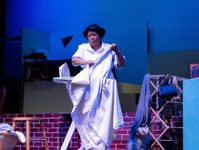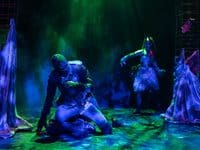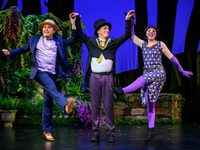
The work of William Shakespeare is pretty universal year-round — however, it is spooky season after all, so why not lean in? Director Danni Guy’s vision of Shakespeare’s classic comedy A Midsummer Night’s Dream tries to present the story through a horror lens set in eerie Appalachia. Although the attempt didn’t exactly stick the landing, the unique interpretation proved to be an entertaining evening of theater playing now at Dominion Stage.
Performed in traditional Shakespearean dialogue, the story closely followed the original, apart from a surprise twist ending. We open on the wedding day of the Duke of Athens, Theseus (Patrick M. Doneghy), to the Queen of the Amazons, Hippolyta (Brittany Washington). Conflict begins when Egeus (Corey Ahearn) declares his desire for his daughter, Hermia (Gwyneth Sholar), to marry Demetrius (Morgan DeHart). Hermia, however, is in love with another man, Lysander (John Paul Odle). Both men are in love with Hermia, yet Hermia’s best friend Helena (Angela Cirino) pines after Demetrius. Meanwhile, an enthusiastic, amateur acting troupe including the pompous Nick Bottom (Ali Cheraghpour) rehearses a play.

The four lovers and six performers end up in an enchanted forest inhabited by mischievous fairies whose meddling tricks lead to absolute mayhem. The fairy king, Oberon (Doneghy), and fairy queen, Titania (Washington), are in the midst of their own argument. Robin Goodfellow, or Puck (Anastasia Brunk), loyal servant to Oberon, is sent by his master to obtain a flower with the power to make anyone fall in love with the first person, animal, or creature they see. A series of misunderstandings leads to dark chaos as both Demitrius and Lysander fall for Helena, and Queen Titania finds herself enamored with Bottom — whom Puck, just for kicks and giggles, has transmogrified with the head of a donkey.
The attempt to bring this story to the Appalachian hills felt lost in translation. Although the characters spoke in Appalachian accents (for the most part, occasionally slipping in and out), the dialogue wasn’t updated to reflect those changes. For instance, the numerous references to Athenian garments, etc., could have easily been changed from “Athenian” to “Appalachian.” Several decisions about what to change, or not change, felt arbitrary. For instance, they changed the wardrobe to seemingly 20th-century styles but kept elements like ancient scrolls. Tending to these small details could have better calibrated the audience to our updated environment.
Moreover, multiple performances felt as though they didn’t quite understand the tonal context behind the words they were saying. One performer, however, delivered a truly convincing and enticing performance — Angela Cirino as Helena. Her performance was grounded in the text yet still came across with conversational effortlessness, all while invoking real, believable pathos. And, as a bonus, Cirino even serenaded the audience before the show began with a lovely folk version of The Animals’ famously dark song “House of the Rising Sun.”
Another notable performance came from Natalie Pendie as the sly, foxlike fairy, servant to Queen Titania. Pendie had very few actual lines, although she was almost always present on stage — an acting challenge that required her to create a character almost entirely through entertaining physicality and physiology. She embodied a comedically curious energy as she pranced across the stage, rummaged through humans’ belongings, and sat back wide-eyed, watching the chaos unfold as though it were an episode of reality television.

Pendie also stood out in her costume, designed by Merrick Shamblin, and in her hair and makeup, designed by Rebecca Harris. Pendie wore a multi-toned green dress and gloves that paired beautifully against the brown and red colors of the artistic, fairly realistic fox head she donned as a sort of mane. Each fairy wore a mask or headdress representative of a different Appalachian animal or creature, including an opossum, raccoon, spider, and more. The work that went into these pieces, as well as certain props designed by Katy Jones Powe (such as the gruesome, decaying donkey), was visually striking and could have really brought the horror elements of the show to life. Unfortunately, they were overpowered by the confusion in tone and didn’t quite have the effect they could have.
Puck’s (Brunk’s) costume/makeup was also notable with a grey wolf-like pelt worn as a sort of vest; a dark, spiked feather glove worn on a single arm; intricate braids wrapped in her hair; and fluorescent scale-patterned makeup painted across her forehead and down her cheekbones. At one point, lighting designer Peter Leresche shone a bright, warm purple overhead light that wove between the shadows and reflected off Brunk’s skin, combining with the metallic green paint and generating the magical texture of the world.
This unique version of Shakespeare’s A Midsummer Night’s Dream, while entertaining, felt confused in execution, especially during the twist ending. I won’t spoil it, but I understood what they were going for and respect the attempt; with a few tweaks, this interpretation could have definitely succeeded this spooky season.
Running Time: Approximately two hours, with a 15-minute intermission.
A Midsummer Night’s Dream plays through October 24, 2026 (Thursday, Friday, and Saturday at 7:30 pm; Sunday at 2:00 pm), presented by Dominion Stage, performing at Theatre on the Run, 3700 S Four Mile Run, Arlington, VA. Purchase tickets ($30 for general admission) at the door or online.
A Midsummer Night’s Dream
By William Shakespeare
Produced and directed by Danni Guy