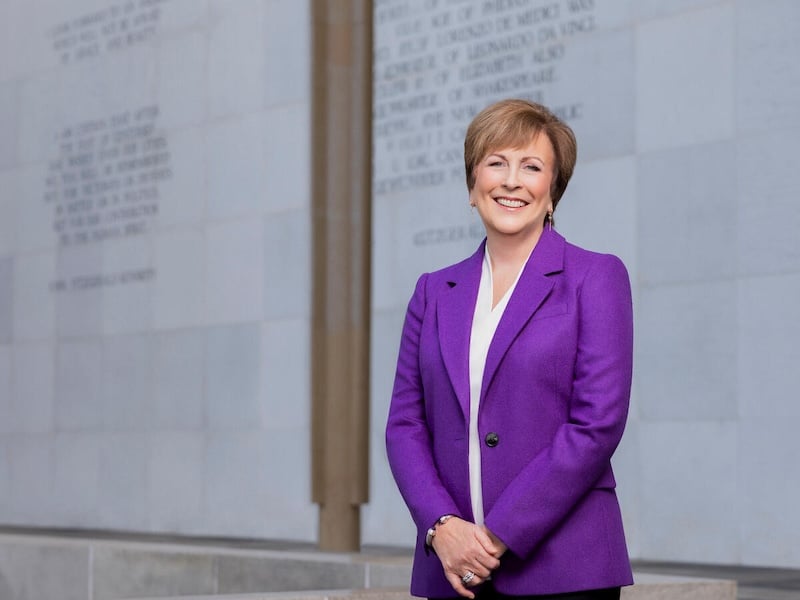
Deborah F. Rutter, who has served as President of the Kennedy Center since 2014, has announced her decision to step down at the end of this year. In November, the Center announced that chairman David M. Rubenstein would continue to lead the board through September 2026. The Center’s board of trustees has formed a search committee to identify Rutter’s successor. Executive search firm Spencer Stuart has been retained to assist with the search.
Rutter, an established arts industry leader before coming to Washington, DC a decade ago, leads one of the world’s largest and busiest performing arts institutions. The sprawling Kennedy Center presents theater, contemporary dance, ballet, vocal music, chamber music, hip hop, comedy, international arts, and jazz, and also serves as the home to the National Symphony Orchestra (NSO) and Washington National Opera (WNO). With over 2,000 diverse performances each year — and two major televised awards shows, Kennedy Center Honors and the Mark Twain Prize for American Humor — the Center attracts 1.5 million ticketholders and over 2 million visitors annually. Rutter also guides the Center’s global network of over 40 education initiatives — making it the nation’s largest provider of arts education — reaching more than 2.1 million individuals. Rutter is also credited with landing the prominent Italian conductor Gianandrea Noseda as the NSO’s Music Director in 2016, cited by the Washington Post as a “coup for the NSO.”
“After more than 10 extraordinary years in Washington, DC, collaborating with some of the most phenomenal artists, cultural leaders, diplomats, philanthropists, volunteers, and administrators, I have come to believe it is time to pass the torch,” said Rutter. “It has been a great honor to work with the best in the world. It is time now to hand this truly unique institution to a new leader who will take the power and majesty of the arts to the next level.”
She added, “When I arrived at the Center in 2014, I was curious how the many and varied artistic genres under one roof could combine into multi-disciplinary experiences; how the storytelling of every art form could be more powerful if we incorporate new technologies and new environments; and how art and arts education could be integrated into our daily existence. Through all of this, the goal has been to live up to our name as the national cultural center, expanding our reach and ensuring our work reflects America, and the world. The last decade of artistic growth at the Center has been thanks to our staff, our artists, and our audiences’ eagerness to explore new ground together — with trust, respect, and joy.”
“Deborah’s visionary leadership has transformed the Kennedy Center,” said Kennedy Center board chairman David M. Rubenstein. “Her legacy will be the Center’s increased relevance, visibility, and physical footprint. She also led the organization in welcoming new art forms and audiences, unprecedented fundraising, modernized our digital and television presence, strengthened our board governance and engagement, and elevated the Center to become a true destination. As a result, millions more people have participated in the arts in our country and around the world. Deborah has given the nation a stronger, better, more impactful arts organization. Fortunately, Deborah will serve as president for all of this year, providing extraordinary leadership as she has over the past decade. Filling Deborah’s shoes will be a daunting task for the board.”
Under Rutter’s leadership, the Kennedy Center has grown its operating budget (expenses) to $268 million. Earned revenues have likewise grown to $125 million, in addition to $95 million in contributed funds; $45 million in federal appropriations for the operation, maintenance, and improvement of the memorial; and a $4 million draw from the endowment in Fiscal Year 2024.
In her first year, Rutter broke ground on a transformative arts facility and first-ever campus expansion, the REACH, and spent the next two years with staff, artists, and architects redefining and shaping the purpose and function of the new spaces. After successfully delivering on a $250 million capital campaign raised entirely through private contributions, the REACH opened in September 2019 with a 16-day festival that drew over 60,000 attendees with 450+ events.
Kennedy’s words and legacy were increasingly visible throughout the memorial. As part of the Center’s 50th anniversary season, Rutter oversaw the yearslong development and September 2022 opening of Arts & Ideals: President John F. Kennedy, an immersive, permanent 7,500 square-foot exhibit exploring President Kennedy’s connection to arts and culture. Since its opening two years ago, the JFK exhibit has been enjoyed by nearly a million visitors.
Rutter also steered the organization through an 18-month closure during the pandemic, adapting arts experiences to digital platforms and serving audiences, donors, and the public with extraordinary resilience and innovation. Once the Center reopened, she worked with the board and staff to quickly rebuild audiences and stabilize the organization financially.
Throughout her tenure at the Kennedy Center, Rutter has expanded programming to represent the diversity of art in America, most notably, becoming the first major performing arts institution in the country to introduce Hip Hop Culture and Social Impact as two central areas of programming. The Center’s Social Impact work and programs focus on the power of art to build community, inspire action, and drive meaningful change.
A hallmark of Rutter’s vision and the Center’s mission are the intersections of the arts with other aspects of our daily lives. Programs that evolved under her leadership include Sound Health (Network), a collaboration with Artistic Advisor Renée Fleming exploring the neurological and health benefits of music on well-being and physical healing. This initiative at the Kennedy Center eventually led to the creation of a national partnership and millions in funded research with the National Institutes of Health, the NEA, and now UCSF. In 2024, the Center also introduced its new Arts & Wellbeing series featuring year-round programs reflecting the full spectrum of the arts and its impact on mind, body, and soul. This spring, the Kennedy Center will present Earth To Space: Arts Breaking the Sky in a three-week festival that brings an international lineup of artistic and scientific luminaries and special projects exploring humans’ ambitions to navigate space.
 ABOUT THE KENNEDY CENTER
The John F. Kennedy Center for the Performing Arts is America’s living memorial to President John F. Kennedy, attracting millions of visitors each year to more than 2,000 performances, events, and exhibits. With its artistic affiliates, the National Symphony Orchestra and Washington National Opera, the Center is one of the nation’s busiest performing arts centers dedicated to providing world-class art, powerful education, and outstanding memorial experiences to the broadest possible constituency. Across all its offerings, the Kennedy Center is committed to increasing accessible, inclusive opportunities for all people to participate in, and learn through the arts, including more than 400 free performances each year and a variety of Specially Priced Ticket programs for students, seniors, persons with disabilities, and others. On September 7, 2019, the Kennedy Center inaugurated the REACH, its first-ever major expansion. Designed by Steven Holl Associates, the REACH provides visitors with new opportunities to interact and engage with the Center as the nation’s premier nexus of arts, learning, and culture. On September 8, 2022, the Kennedy Center unveiled Art and Ideals: President John F. Kennedy, a new 7,500-square foot permanent exhibit exploring Kennedy’s presidency and his commitment to the arts.