Dead center of the Black Bottom neighborhood in 1949 Detroit is a local jazz club — The Paradise Club. The heart of a vibrant Black community, the Club soon becomes a battleground of clashing dreams as Blue, his musicians, best girl, and new-to-town tenant are caught up in a swirl of ambition, memory, love, and survival. Paradise Blue by Dominique Morisseau, under the direction of Raymond O. Caldwell at Studio Theatre, is a haunting and poetic jazz-infused drama that is a thrilling combination of bittersweet and melancholy, sharp and fast, strong and soft. In a world of music and longing, Paradise Blue explores the cost of holding on and letting go.
Having inherited the Paradise Club from his late father, owner and lead trumpet player Blue, played by Amari Cheatom, is a troubled man. Both being chased by the terrors of his past — the source of his sound — and chasing his music as a release to the suppressed pain he cannot articulate, Cheatom’s Blue was unsettlingly unsteady. What started as confidence soon dissolved into twitches, forced fleeting smiles, and haunted dark eyes; Cheatom unraveled with chilling erraticity. With a frighteningly desperate need for control and an escape from unresolved traumas, he set the audience perfectly at unease — lingering like the sharp unresolved chord at the end of a jazz set.
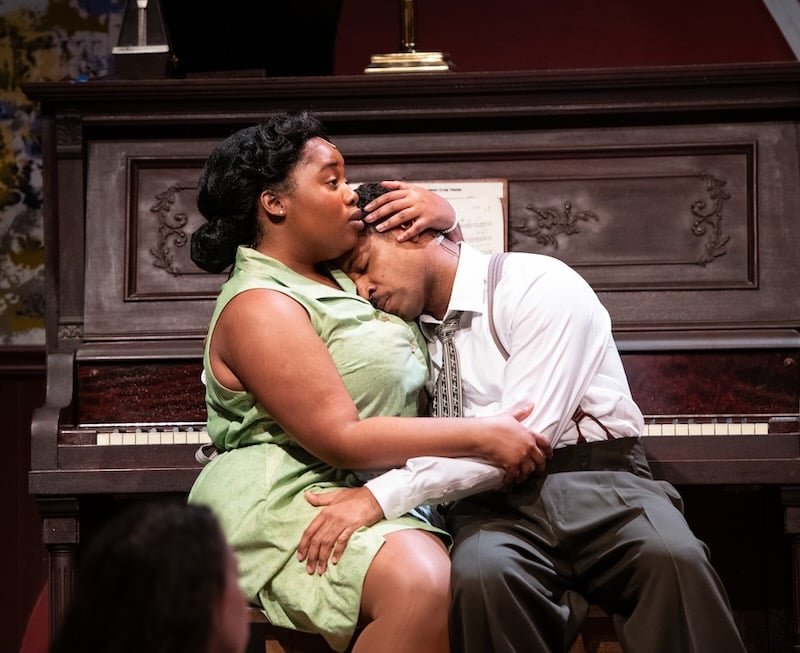
Soothing Blue’s erratic and knitted brow (as well as soothing everything else at the Club) was Pumpkin, played by Kalen Robinson. A soft, caring woman who finds solace in the music of poetry and in the family she’s built from the community of Paradise Valley, Robinson’s Pumpkin was the glue of the production. Robinson’s skillful nuancing of Pumpkin’s calming and nurturing energy allowed for her to be equal parts refuge and prison as she began to look inward into what she wants out of life and outward into what her life has become. Slowly finding value in herself more than in the service she provides to other people, her journey to self-worth and agency was thoughtfully crafted and beautifully executed.
Similarly playing the role of peacemaker was the Club’s pianist, Corn, played by Marty Austin Lamar. A towering figure built of soft shoulders, nimble hands, and a broad smile, Lamar’s Corn had a gravity to him that settled spirits and warmed souls. Whether working with Pumpkin on her voice or talking down the demons that only Blue could hear, the steady Corn was always good for an easygoing laugh and a sigh of relief when tensions or emotions ran high.
Often, the source of tension was the recently arrived, and the not-so-recently widowed, Silver, played by Anji White. A confident and tough woman-of-the-world who goes after what she wants and aggressively protects what is hers, White’s Silver was fire personified: beautiful, fast, and deadly. A powerful woman both out of necessity and inherent inner strength, White’s Silver was the production’s powerhouse as she refused to play by the old rules and, for me, the most mesmerizing in forcing hidden tensions to surface.

Equally emotionally charged were the highs and lows of the Club’s percussion man, P-Sam, played by Ro Boddie. Handsome, charming, and a passionate mixture of hotshot and hothead, Boddie skillfully infused Sam with the righteousness of youth. Viewing the Paradise Club as not just a gig or an artistic outlet, Boddie’s Sam clung to the brick walls and the resilient heritage it represented as a lifeline in a world rapidly changing and yet going nowhere fast.
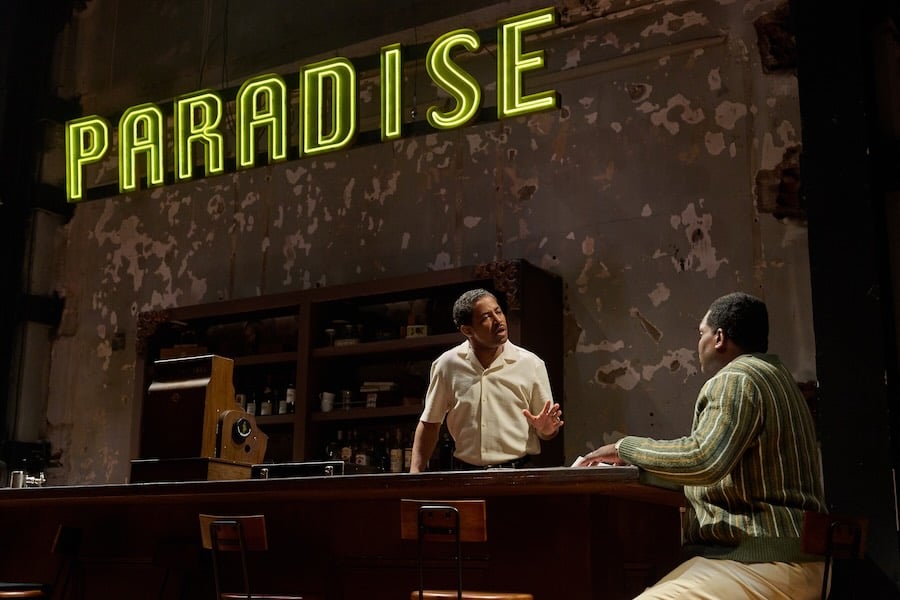
Key to creating the environment of this theater noir was the standout production team at Studio Theatre — literally transforming the Victor Shargai Theatre into the Paradise Club, with tables and chairs and a real bar. Direction by Raymond O. Caldwell orchestrated an enthrallingly frenetic current of energy, emotion, words, and action, electrically complemented by Intimacy Coordinator Sierra Young and Fight Choreographer Robb Hunter. The tactical and immediate set design by Lawrence E. Moten III allowed the audience to play both patron and ghost watching the tumultuous week unfold, and the lighting design by Keith Parham flickered and dimmed along with this production’s heart-stoppingly immersive staging. Musical direction by William Knowles and sound design by Matthew M. Nielson, along with musicians Michael A. Thomas (trumpet) and Mark Saltman (bass), wove together a soundtrack that caused your soul to relax and your pulse to race.
From the physical space where Studio Theatre sits at the historical epicenter of Black culture in DC to the narrative epicenter of Black Bottom in 1949 Detroit, Paradise Blue is impeccably aware of where it is in time, space, and message — the power of which feels more relevant with each passing day. Paradise Blue at Studio Theatre engulfs you in a raw urgency and mirrors back the hope for home, the refuge in music, the safety of agency, and the curse of legacy that drives its world. The sheer complexity of it doesn’t allow for easy answers or tidy resolutions. Instead, it immerses you in dissonant dreams, inviting each person who walks into the Club to witness, laugh, and shudder at the truths we confront and the choices we make — or fail to make.
Running Time: Two hours and 30 minutes with a 15-minute intermission.
EXTENDED: Paradise Blue plays through June 22, 2025, in the Victor Shargai Theatre at Studio Theatre, 1501 14th Street NW, Washington, DC. For tickets (starting at $55), go online, call the box office at 202-332-3300, or email boxoffice@studiotheatre.org. or visit TodayTix. Studio Theater offers discounts for first responders, military servicepeople, students, young people, educators, senior citizens, and others, as well as rush tickets. For discounts, contact the box office or visit here for more information.
The program for Paradise Blue is online here.
Warnings: This production of Paradise Blue includes the use of explicit language, herbal tobacco, haze, and gunshots.
COVID Safety: All performances are mask-recommended. Studio Theatre’s complete Health and Safety protocols are here.