Hope: it’s an interesting human phenomenon. Even if we know tragedy is inevitable, we still take up the journey, convincing ourselves, “Maybe this time will be different.” In a world ravaged by social and economic inequality, hope is often the best thing we have. Anaïs Mitchell’s eight-time 2019 Tony Award–winning musical, Hadestown, is a spiritual awakening — an invitation to consider what it means to sacrifice self for soul, and to move through the world with an idealistic vision of what could be rather than what is. It reminds us that the only way to change the world is to believe that we can.
The show was originally directed on Broadway by Rachel Chavkin with assistant direction by Keenan Tyler Oliphant, who has now taken on the role of director for the national tour, playing through November 23 at the National Theatre in DC. It’s a spectacular production that, in my opinion, bested the original Broadway recording. The raw emotion, masterful musicality, and palpable commitment of each distinct performer — including the ensemble cast — brought the entire audience to the absolute edge at every turn. It’s a hell of a show that should not be missed!
Although the central subplot of Hadestown, the Greek myth love story of Orpheus and Eurydice, has been told for thousands of years, this show is stunningly unique and groundbreaking. In Mitchell’s version of the classic myth, we find ourselves in a Depression-era New Orleans–style town, sprinkled with edgy steampunk elements. Eurydice (Megan Colton) is a poor, starving girl who has witnessed firsthand the extent of darkness that this world can produce. Her realist sensibility is challenged when, despite herself, she falls in love with Orpheus (Jose Contreras), the starry-eyed, silver-tongued optimist whose song can literally bring light and life back to the world.
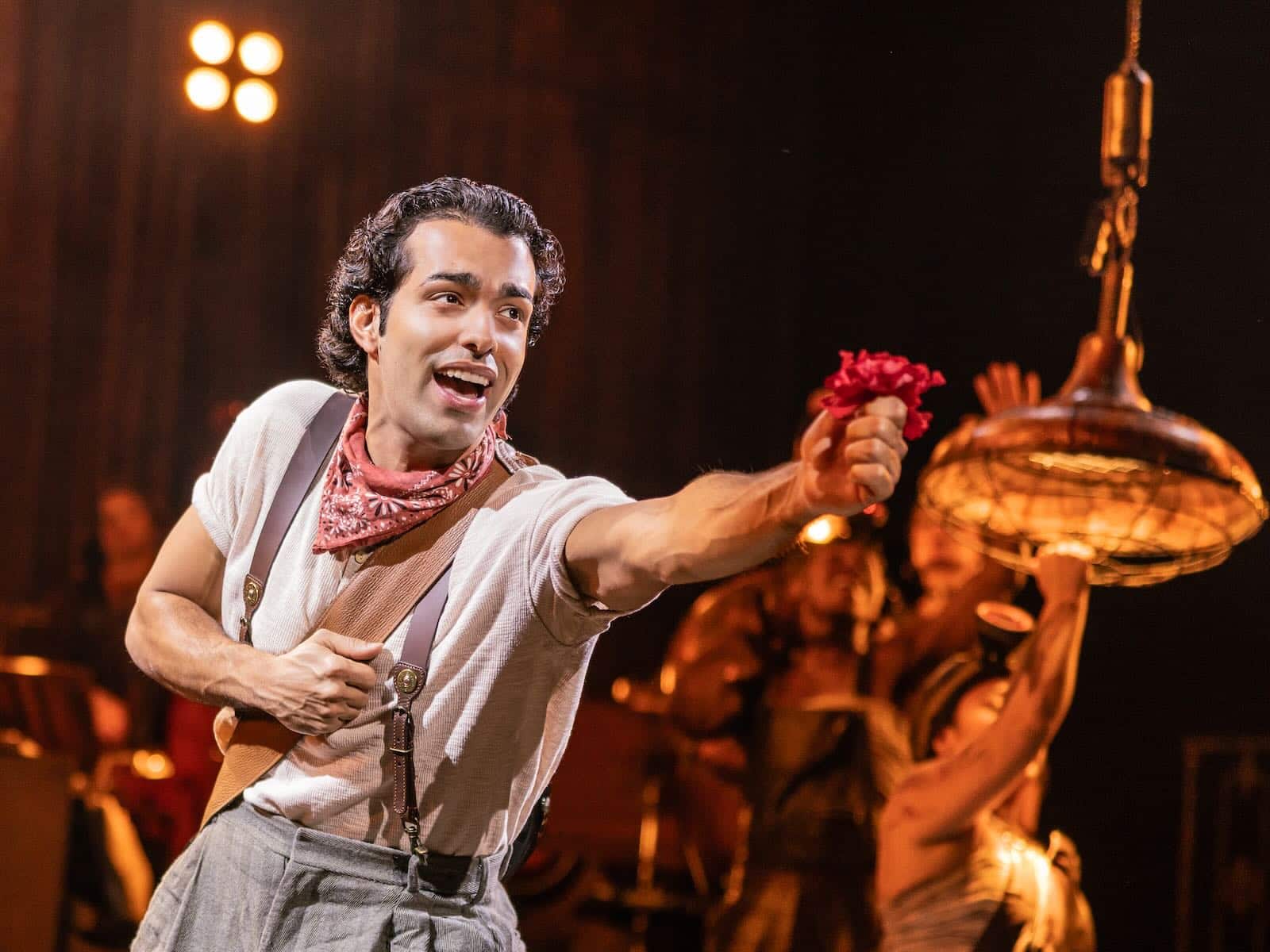
Colton’s gritty, poignant portrayal of Eurydice was astounding in every regard. Her impeccable control of dynamics and vocal range lets her move effortlessly from contemporary pop colors to classic theatrical tones. The emotional force she delivers in every line, in every note, had me in tears on more than one occasion. When Colton’s strong vocals join Contreras’s soft, ethereal falsetto, such as in “All I’ve Ever Known” or “Wait for Me,” it’s quite literally breathtaking. Contreras’s stunning vocals heard throughout the show during the various versions of “Epic” seem to reach otherworldly heights in “Doubt Comes In.” His angelic voice soars overhead, reaching out across the audience in earnest passion as we follow him faithfully on his trek out of Hadestown.
The acclaimed soundtrack from Anaïs Mitchell seems to conjure inspiration from Afro-Caribbean, Latin, and Eastern European musical stylings, creating a lively, soulful, yet eerily dark score that combines jazz, blues, folk, and indie pop. The soundtrack rolls smoothly from one song to the next, mirroring the show’s steam-train metaphor, always in motion. The songs flow together but can also stand alone as unique tracks. For instance, I can’t seem to get “Chant” out of my head — the dark, rhythmic jazz/pop number incorporating solo moments from nearly the entire cast. The composition’s eclectic mix of instruments is practically a character in its own right, with the band embedded on stage and even incorporated into various plot elements. The intimate yet impressive band dazzles under the direction of Cole P. Abod, who in addition to serving as music director also plays piano.
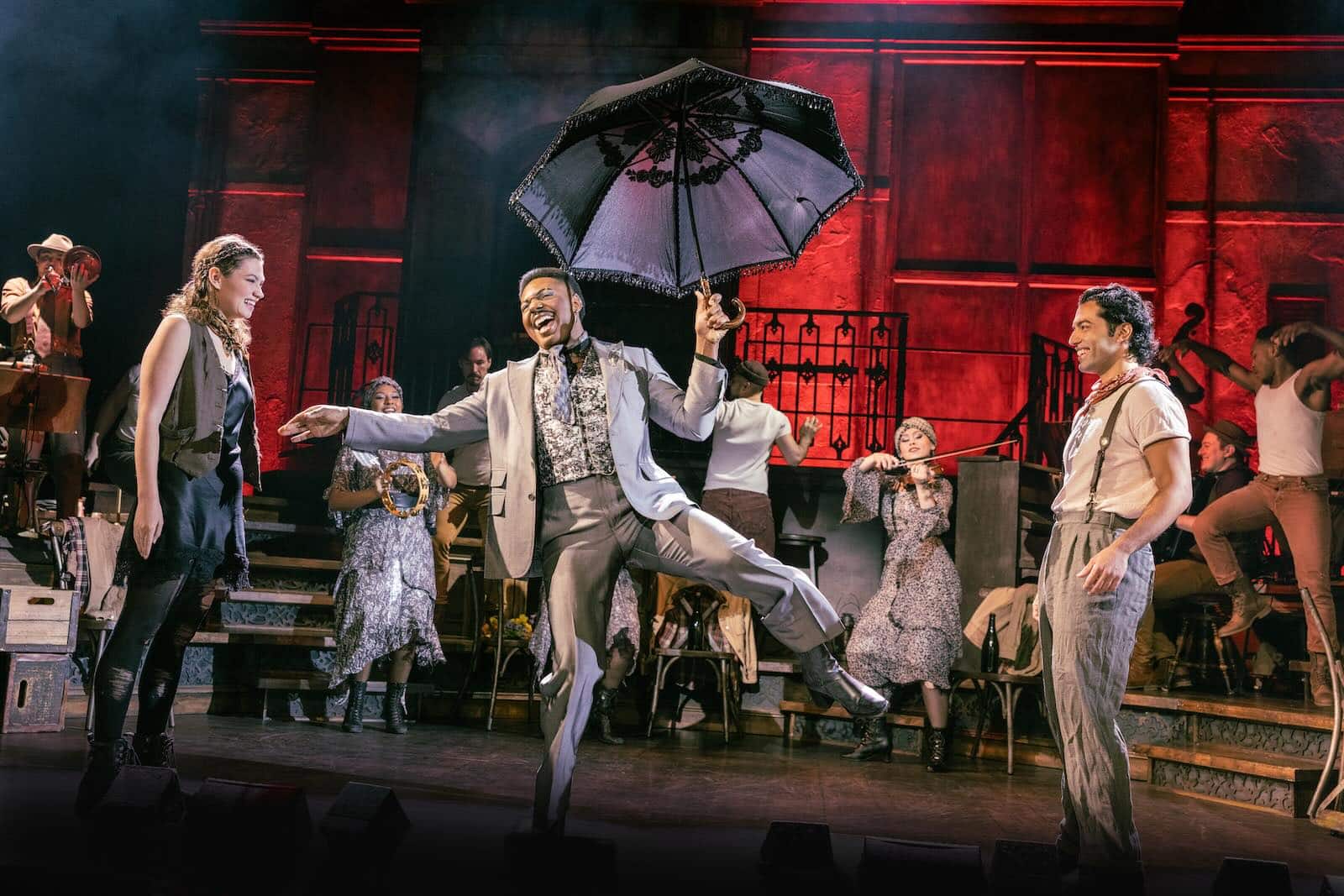
The band and the entire cast of characters are introduced in a jazzy opening number, “Road to Hell,” in which our Narrator, the God Hermes (Rudy Foster), sets the stage for the tone of the show. Foster breathes life into the show from the moment he sets foot on stage, sparkling in layers of silver from head to toe, in a stunning suit courtesy of Costume Designer Michael Krass. Foster’s performance is delicately layered with emotions, from convivial to wistful to mournful, subtly yet powerfully conveying the show’s emotional throughline.
Similar to Hermes, the three fates played by Miriam Navarrete, Jayna Wescoatt, and Michelle E. Carter (understudy for Alli Sutton at the performance I saw), represent the metaphorical narratives of the show by personifying the darkness of the human psyche, reminding us of our doubts, fears, and failures — what becomes of us when we forgo hope. This trio casts a spell on the audience through their enthralling harmonies, often sung a cappella, such as during “Nothing Changes.”
In addition to Orpheus and Eurydice, there is another love story at the center of this story, that of Hades (Nickolaus Colón) and Persephone (Namisa Mdlalose). From the moment Colón steps out in his long black leather coat, black sunglasses, and snakeskin boots, he demands attention, and the audience was more than happy to give it. His deep bass-baritone voice dominates the stage as his powerful, yet alluring movements had us hanging on every guttural yet smooth and pitch-perfect note. Comparatively, the fervent vocals of Mdlalose, twirling out in her verdant dress, radiate throughout, bouncing off Colón’s rich timbre confidently.
Hadestown is filled with constant choreography from original Broadway Choreographer David Neumann and brought to life again on this stage by T. Oliver Reid (who also worked on the original Broadway version of the show). The show’s choreography is clever and captivating, infusing elements of West African tribal dancing, contemporary American hip-hop, Latin ballroom, and Baltic/Mediterranean folk dancing. Every single movement from beginning to end (even the effortless, precise toss-and-catch of a metal mug) is thoughtfully planned yet still feels entirely spontaneous, free, and emotionally driven. At every point in the show, every part of the stage is strategically used, engaging the audience from every angle.
The show’s choreography is further fueled by Aja Jackson’s mesmerizing lighting design. Warm golden lights dance across the stage during “Wait for Me,” wherein three overhead industrial-era lights descend on swinging tethers. As the ensemble cast dances around Orpheus, joining his song, they take hold of the lights, drawing them back with delicate motions before releasing. The warm glow of the lights soars as the tethered lights glide back and forth, perfectly on beat with the song, each performer weaving through, creating a truly beautiful, tangible moment.
David L. Arsenault’s scenic design features dark elements that parallel the show’s dark nature. The set, mainly black, brown, and almost sepia in tone (grounding the audience in the era), contains wooden pieces among iron structures and metal fixtures, including a working steam whistle. Jackson’s lighting matches the dark tone and uses concentrated lighting elements such as lanterns, spotlights, and strobe lights. The various lighting effects seem to be characters in themselves as they quite literally dance across the stage and work to further the story and build a metaphor for emotional resonance.
For instance, during two climatically emotional moments — first from Eurydice (Colton) during “Flowers” and then Orpheus (Contreras) during “If It’s True” — each performer falls to their knees center stage, eyes welling with tears, as all 12 spotlights fall directly on their frail forms. Bright lights, sharp in contrast and shape, shine down like 12 daggers piercing their broken hearts. Another example is the soft lanterns used to highlight Eurydice’s shadow and silhouette as we follow Orpheus out of Hadestown during “Doubt Comes In.”
In that moment, the light reveals the shadows gathering in his mind, the slow, inevitable dimming of hope. We may know how the story ends, but as “Road to Hell Reprise,” the penultimate song of Anaïs Mitchell’s masterpiece, Hadestown, reminds us, we must continue to sing anyway, to carry the tune forward even when the ending seems fixed. Hope survives because we choose to keep it alive.
Running Time: Two hours and 30 minutes, including a 15-minute intermission.
Hadestown plays through November 23, 2025, at The National Theatre, 1321 Pennsylvania Avenue NW, Washington, D.C.. Performances are at 7:30 p.m. Tuesday through Sunday, with additional 2 p.m. matinees Saturday and Sunday. Purchase tickets online or at the National Theatre box office.
The cast and creative credits for the North American tour of Hadestown can be found here.
SEE ALSO:
‘Come Home With Me’: Meet the DMV talent in ‘Hadestown’ (interviews by Daniella Ignacio, November 19, 2025)
‘Hadestown’ returns to DC this fall at National Theatre (news story, August 15, 2025)