Post-Play Palaver is an occasional series of conversations between DC Theater Arts writers who saw the same performance, got into talking about it, and decided to continue their exchange in writing. That’s what happened when Senior Writers Sophia Howes and John Stoltenberg attended the new musical November 4, now playing through December 7, presented by Voices Festival Productions, performing in DC at the Universalist National Memorial Church.
John: It’s been more than a week since we saw the Voices Festival Production of November 4 — an eye-opening new musical that theatricalizes the history-altering assassination on November 4, 1995, of Israeli Prime Minister Yitzhak Rabin — and I can’t get it out of my head. Having witnessed this depiction of the tragic death of a champion of a possible peace accord between Israel and Palestine, I cannot read headlines anymore about the horrific hostilities in the Middle East without recalling that stingingly auspicious scene in November 4 when Rabin, on his way to a pro-accord rally in Tel Aviv — where he will be shot dead by a young anti-accord Israeli zealot — declines to wear a bulletproof vest!
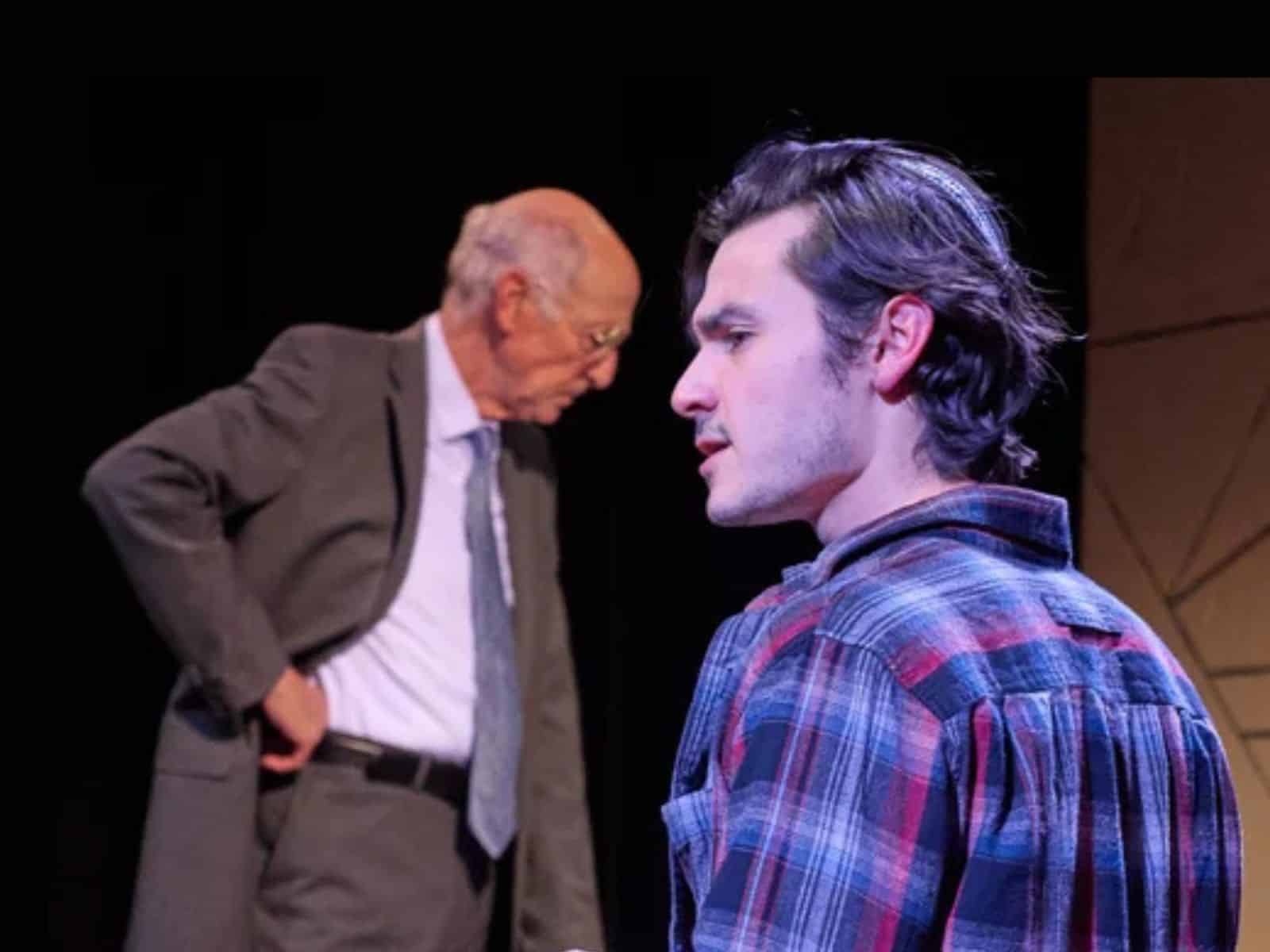
It’s a breathtaking, indelible moment. Rabin’s bodyguard implores him to put on the vest, arguing that “President Clinton wears one, sir,” to which Rabin replies, “President Clinton lives in a nation of individuals where every psycho can buy a gun. We live in a nation of brothers, with strict gun control.” If the irony in that instant were a scenic effect, there would be a blinding lightning and deafening thunder cue. Instead, Rabin has a hauntingly reflective song that begins:
SHOULD I BE AFRAID OF DEATH?
SHOULD I BE AFRAID OF CRASHING TO THE GROUND
A BULLET RESTING IN MY HEART
SILENCING MY THOUGHTS
SEALING UP MY FATE?...
It’s a scene that points to a main reason I am passionate about theater: it can crack open a moral crisis as no other art form I know, and it can emblematize and valorize the human capacity to do the right thing despite the cost.
Not incidentally, for me, in the case of November 4 — which frames events I was unfamiliar with in the familiar genre of musical theater — it far surpassed any notion of infotainment I might have walked in with.
Sophia: I was reminded of a line from Yeats’ poem “The Second Coming”: “The best lack all conviction, while the worst are full of passionate intensity.” As portrayed in the musical, the assassin, Yigal Amir (Noah Mutterperl), is the ultimate extremist. We see him and his brother, Hagai (Chris Daileader), while they are planning the murder. It’s a strange experience. Amir quotes Genesis to bolster his argument that killing Rabin is the right thing to do. He sings about “The Law of Hot Pursuit,” which seems to state that it is OK to kill someone if they are about to sin. He believes that the Oslo peace accords and all they represent, in the person of Rabin, are a sin against the Jewish people. There is something terrible about his certainty. It is a kind of madness.
In the series Death by Lightning, now on Netflix, the assassin of President James A. Garfield, Charles Guiteau (Matthew Macfadyen), has motives that are somewhat more personal. In spite of, or partially because of, a serious mental illness, he provides help to Garfield during the election. He then imagines that he was key to Garfield’s victory, and mistakenly assumes that Garfield owes him a job.
In both dramas, the assassins assert that history will remember their names. The real Amir has never expressed a wish to be remembered, but he has never reportedly displayed remorse either. Guiteau, in the series as in life, does want to be remembered. And, of course, he isn’t. Neither is Amir.
In November 4, Rabin (Mitch Greenberg) represents the assassin’s opposite: the need for moderation, peace, and understanding. This is one reason so many people hate him. Danny Paller and Myra Noveck, who are responsible for the concept and story, create a man who is a visionary in the sense that he sees the possibility of peace. But he is also recognizably compassionate, witty, human, and flawed. The obstacles of negotiation frustrate him. He sings:
AND WHY CAN’T OSLO JUST
MOVE ALONG AT A FASTER PACE
AND WHY CAN’T ARAFAT
PUT HAMAS IN ITS PLACE
AND WHEN WILL OUR SETTLERS
FINALLY FACE THE MUSIC?
It is difficult to put complex historical concepts into song. (See “Please Hello!” in Stephen Sondheim’s Pacific Overtures, although Sondheim is satirizing the fact.) Still, Mitch Greenberg’s performance as Rabin captures his full complexity, as well as his doubts. “God and I have an unusual relationship,” he states. “We question each other’s existence.”
Doubt and questions lead him to think more deeply. This is what keeps him away from extremes. In that sense, November 4 reveals a truth, which is also part of the mission of theater.
John: You’ve hit on a key reason that November 4 works as such a powerful work of musical theater: it counterposes two real-life characters with inimically opposed and deeply held principles — one, Yitzhak Rabin, committed to Israeli–Palestian peace, and the other, Yigal Amir, proponent of Israel’s proprietary presumption — and it shows us in relatable detail scenes from the personal life context of each. Moreover, unlike what a straight documentary could do, it reveals their inner emotional lives through situational songs, many of them quite tuneful and touching, with complex dueting and uplifting choral work, lyrics studded with profundities, and accompanied by a terrific offstage band. Measured against the sentimental and simplistic content of your average musical number, November 4’s words and music meet with singular gravitas and passion, as in the refrain of the lovely anthem that opens and closes the show:
WE HAVE LIVED ENOUGH
LEARNED ENOUGH
LONGED ENOUGH
WE ARE STRONG ENOUGH FOR PEACE
WE HAVE SEEN ENOUGH
LOST ENOUGH
LONGED ENOUGH
TO SING OURSELVES A SONG OF PEACE
“You won’t leave humming the overture,” observes DCTA Senior Writer Lisa Traiger in Washington Jewish Week, “but unquestionably the political, social and moral issues the work examines provide material for thoughtful and provocative conversation.”
While some may object to the consequent “humanizing” of an assassin, to me this was brilliant and engaging dramaturgy (the precedent of Stephen Sondheim’s musical Assassins comes to mind). We know, going in, that a fatal shot is coming, but for the full first half of the show, we are introduced to Rabin (played with high-minded dignity by the imposing Mitch Greenberg) and Amir (played nimbly and most likably by the charismatic Noah Mutterperl) in scenes that not only personalize them and their beliefs but implicitly evoke the stark difference between the once-upon-a-hope Oslo Accords and the far-right policies now ravaging lives.
The very first thing we see when we enter the theater is a simple earth-toned set plastered with posters that pull us straight into the present conflict: “Cease Fire Now,” “Stop the Genocide,” “Stop US Military Aid to Israel,” “Free Palestine,” and so on. Immediately, the exceptionally versatile and talented cast — which also includes Nicole Halmos, Chris Daileader, Emma Wallach in multiple roles, among them Rabin’s wife and granddaughter, Amir’s love interest and brother — tears the posters down! Thus, the show starts off with political scenic shock.
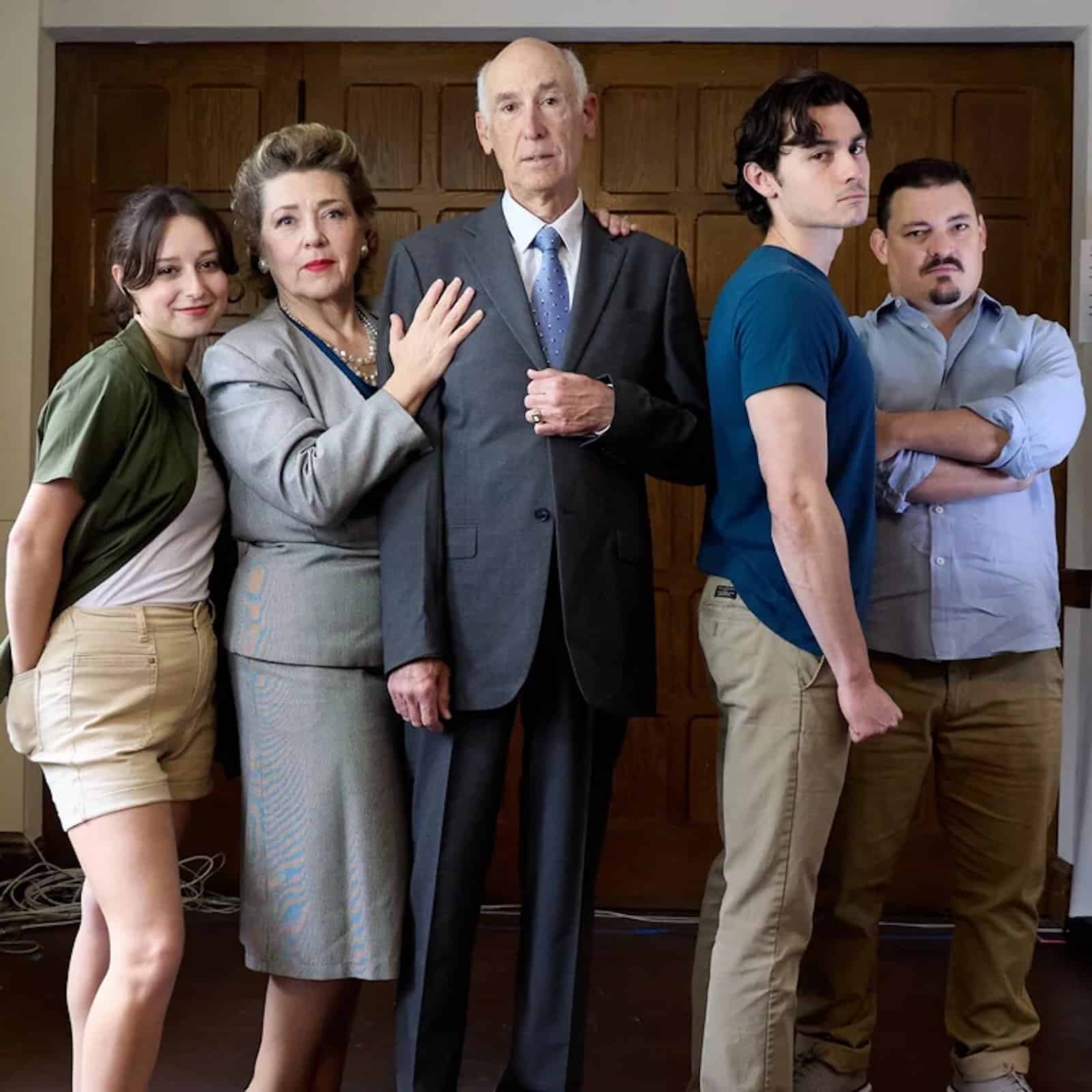
I highly recommend reading the program’s timeline beforehand, but that’s not to suggest the show is a History Channel treatise. It’s actually often entertaining — as when an ensemble of four (minus Amir) has a comic song-and-dance routine (“Babs”) about a loopy notion to invite Barbra Streisand to sing at the Tel Aviv rally. And it can be unabashedly moving, as when Rabin’s wife sings to their granddaughter about how “Grandpa Was a Soldier” and when Amir and his girlfriend, standing on a bridge, dream of “Flying Close to Heaven.”
One might not imagine that the human backstories of a political assassination would lend themselves to musical-theater-ification, much less to a memorable new work in which past and present collide onstage and in one’s conscience. But that is exactly what the storytelling team of Danny Paller (music and lyrics) and Myra Noveck (book) has made happen.
Sophia: Paller and Noveck pay special attention to women. They have many roles in the musical, both inspirational and real. There is the delightfully droll tribute to Streisand, who fails to appear. But there are also real women facing crises, both political and personal.
Rabin’s wife, Leah (Nicole Halmos), naturally despises those who wish the worst for her husband. Still, she hopes for the bloom of peace. She even comforts her granddaughter, Noa (Emma Wallach), who is horrified by the television images of protestors shouting “Death to Rabin!”
“We don’t close up the country because we are scared of terrorists,” she reminds the crying girl, “and we don’t stop pursuing peace because of this lot.”
Halmos’ scenes as Leah with her husband, too, have a touching humor and domesticity. But Halmos also plays Shira, the mother of Noa’s friend Tal. Shira’s defense of her country is blazingly singleminded as we see her chopping vegetables:
Shira (slicing onions):
CHOP - CHOP - CHOP - CHOP - CHOP
CHOP - CHOP - CHOP - CHOP
THEY’RE CUTTING OUR LAND UP
IT’S ONLY BEGUN
FIRST JERICHO, GAZA, AUTONOMY - HEY!
SLICE - SLICE - SLICE - SLICE - GONE!
(Calls as she throws onions in pot) Noa, do you like mushrooms?
As Shoshi, Rabin’s chief aide, Halmos gives us a glimpse of a present-day Palestinian woman post-October 7:
(Shoshi, walking with a cane, enters.)
During the Oslo years I made a friend in Gaza. Mariyam was a young assistant to their negotiating team…. She called me on October 17 to say how horrified she was at what Hamas had done and horrified by some of her neighbors. Since then she’s had to leave her home in northern Gaza … her home, her town are completely flattened. Her brother was killed in line waiting for food…. Even a former Israeli defense minister said it was ethnic cleansing.
Wallach plays both Noa and Amir’s love interest, Shalhevet. As Noa, Wallach’s love for her grandfather as well as her fears for him come across as blisteringly real. At his funeral, at age 18, Noa gave a eulogy for Rabin that is said to have moved the nation (and much of the world) to tears.
Wallach’s monologue as Shalhevet (based on an actual person with a different name) is one of the highlights of the show. After the assassination, like her real-life namesake, she is jailed for failure to prevent a crime. When Shalhevet claims that she never really thought Amir was going to kill Rabin, Wallach makes it easy to believe her.
The characters display a wide range of emotions as they lurch to and fro, battered by the pressure of events. It is sometimes hard to grasp how they are feeling, and why. But that is the nature of responding to trauma. Time is split into pieces like a shattered mirror.. At one moment, life feels like reality. At another moment, it feels like a dream. Peace, no matter how much we long for it, can be one of life’s luxuries. November 4, both musically enjoyable and artistically rewarding, reminds us how essential it is to pursue it.
Running Time: One hour and 45 minutes.
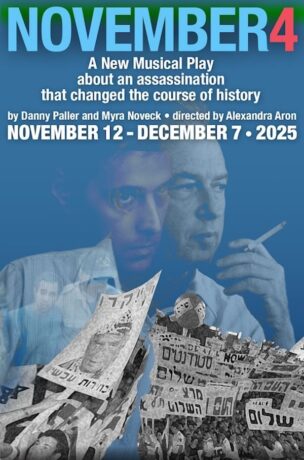
November 4 plays through December 7, 2025, presented by Voices Festival Productions performing at the Universalist National Memorial Church, 1810 16th St NW, Washington, DC. Purchase tickets ($25–$65) online.
The program for November 4 is online here.
November 4
Music and Lyrics: Danny Paller
Book: Myra Noveck
Concept and Story: Danny Paller and Myra Noveck
Director: Alexandra Aron
SEE ALSO:
Voices Festival Productions’ ‘November 4’ sets a political assassination to music (review by Nicole Hertvik and Daniella Ignacio, November 25, 2025)
Voices Festival Productions announces ‘November 4’ cast (news story, October 1, 2025)
Voices Festival Productions announces three-play ‘Voices from a Changing Middle East Festival’ (news story, August 2, 2025)