When An Irish Carol first ran in 2011, playwright Matthew J. Keenan expressed his hope that it would become a DC holiday tradition. At the time, The Keegan Theatre had recently become Dupont Circle’s resident company. Establishing a tradition to share with audiences was a natural way for the theater company to root itself in the neighborhood. Keenan’s story about the miserly David, a Dublin pub owner who prioritizes his pub’s success at the expense of his relationships, mirrors the burdens and blessings of managing a communal space.
Unlike Charles Dickens‘ version, An Irish Carol doesn’t need specters as it relies on the power of place to transform us. Though inheriting the pub appears to mark the beginning of David’s corruption, he is ultimately saved from a lonely life by the community his pub created. Keenan’s play proves that authentic spaces can hold history, reconnecting us to each other, and ultimately, to ourselves.
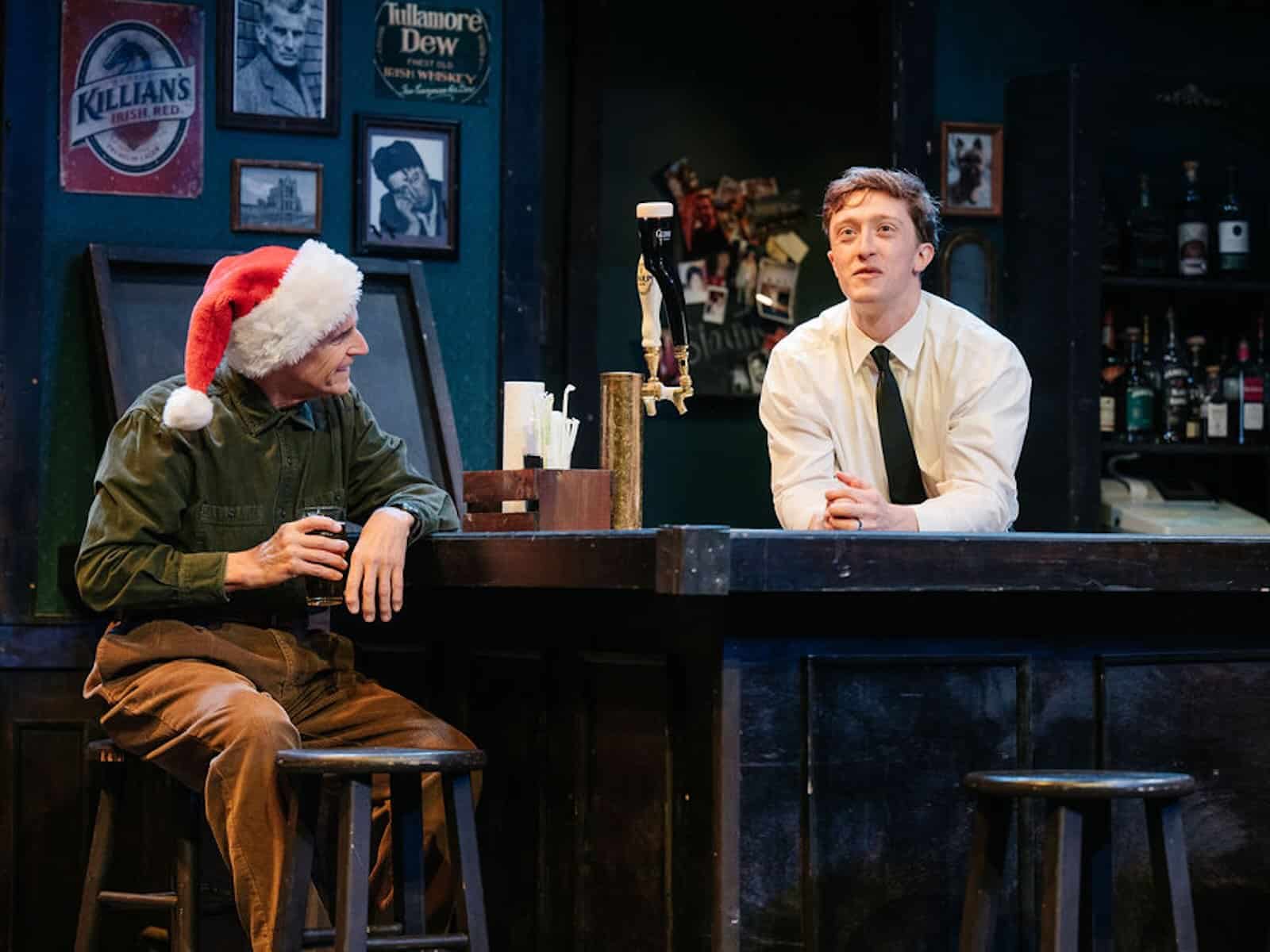
On a rare snowy night in 2008 Dublin, David (Kevin Adams) spends Christmas Eve at his pub. It’s another day of business losses with only two customers, the straight-laced Jim (Mike Kozemchak) and the drunken jester Frank (Timothy H. Lynch). Despite this, David coldly rejects an invitation to close early and join his younger brother Michael (Theo Hadjimichael) and his family for dinner. Determined to keep the bar open at all costs, David orders his sole employee, Bartek (Drew Sharpe), to work the entirety of Christmas Day.
Death hangs over the play like Christmas lights. David’s bitter heart turns to ice after the death of his ex-fiancée, who left him for his best friend Richard (Mick Tinder). Yet, that same loss melts David’s heart when Richard returns with a message from beyond the grave. Frank recounts the harrowing, unmourned death of his abusive father, forcing David to confront the possibility of his own unattended funeral if he keeps pushing people away. These illuminating reckonings spark a new appreciation in David’s heart, restoring his love for community.
Every production of An Irish Carol since 2011 has featured Adams as David and Lynch as Frank. A dynamic duo with a well-worn dynamic: a pub owner and the loyal old drunk. Lynch’s comedic timing feels unforced. His quips roll off the tongue as if improvised. Through his portrayal of Frank’s messy emotional depths, it’s clear the character uses dark humor to stave off a somber reality, a classic Irish Catholic coping mechanism.
Despite his icy exterior, Adams plays David with the same level of sensitivity. I was astonished by his ability to portray cruelty and cynicism as armor for a bleeding heart. Adams’s long face was a steel mask, but his eyes seemed to intentionally give everything away. When David’s spirit lifts at the play’s conclusion, Adam’s features spring up as if jumping for joy.

Mick Tinder returns to the stage as the gentle Richard. His silver-fox looks lend the character a romantic allure, befitting the one who got to live happily ever after. Unlike David and Frank, Richard wears no mask. Tinder plays him with a vulnerability that sharply contrasts with the other old men, making him seem almost younger, sharing the same unburdened spirit as the young Bartek.
Meanwhile, Mike Kozemchak has matured from his usual role as Michael (which he played in years past) to the calm, collected, and always good-humored Jim. Kozemchak brings to this new role a steady presence that extends even to his blocking. As the other characters stomp, dance, and creep across the stage in shifting moods of unease and excitement, Jim remains planted in his seat at the table, allowing the drama to unfold around him while maintaining just enough distance.
As directed by Mark A. Rhea, these men inhabit their roles as fully realized personas. They are attuned to every quirk, movement, and speech pattern of an old codger. Recent additions to the cast prevent the experience from growing stale. Drew Sharpe’s Bartek, in particular, is a breath of fresh air. His offbeat performance could disperse even the thickest tension with laughter from the audience. Keenan’s dream for An Irish Carol was more than a successful play. He envisioned a tradition, something people could return to again and again to renew their spirit and reconnect with their local community. Keenan designed the original set: a faithful replica of a traditional Dublin bar, free of the bells and whistles added for tourists. Within this wooden frame, the production has aged like whiskey in a barrel, its message growing richer and deeper with each run as familiarity settles between the cast, the audience, and the story.
Running time: 90 minutes with no intermission.
An Irish Carol plays through December 28, 2025, at The Keegan Theatre, 1742 Church St NW, Washington, DC. Purchase tickets ($70 for general admission; $60 for students, adults under 25, and seniors) may be purchased online, by phone at 202-265-3767, or in person at the Keegan Theatre Box Office, which opens on the day of the show one hour prior to the performance. All ticket sales include a $5 service charge.
Cast and production team credits and bios are here (scroll down).
An Irish Carol
By Matthew J. Keenan
Directed by Mark A. Rhea