
Back in July 2013, I wrote an exultant rave about the Capital Fringe Festival that I titled “5 Reasons Capital Fringe Is a DC Treasure.” I had only recently begun reviewing DC theater, and I’d become a huge fan of Fringe. As I explained three years later, when “5 Reasons” was republished:
I fervently wanted [Fringe] to survive and thrive. So in a burst of boosterism, I wrote a column about what’s so darned invaluable about it. My intention was simple: I wanted to send a message of hometown pride to DC lawmakers, funders, builders, real-estate wheeler-dealers, and such, in hopes they would become boosters too.
Little did I know then how halcyon those delirious days at funky Fort Fringe would turn out to be. Little did I know then how much imagination and determination would go into operating the Festival next out of Fort Logan in Northeast. Little did I know then how tenuous the Festival’s future would be as, nomadlike, it set up venues here and there in Southwest, Georgetown, and downtown again. For 17 sweltering DC summers, from 2006 to 2024, Capital Fringe was by far the coolest show in town.
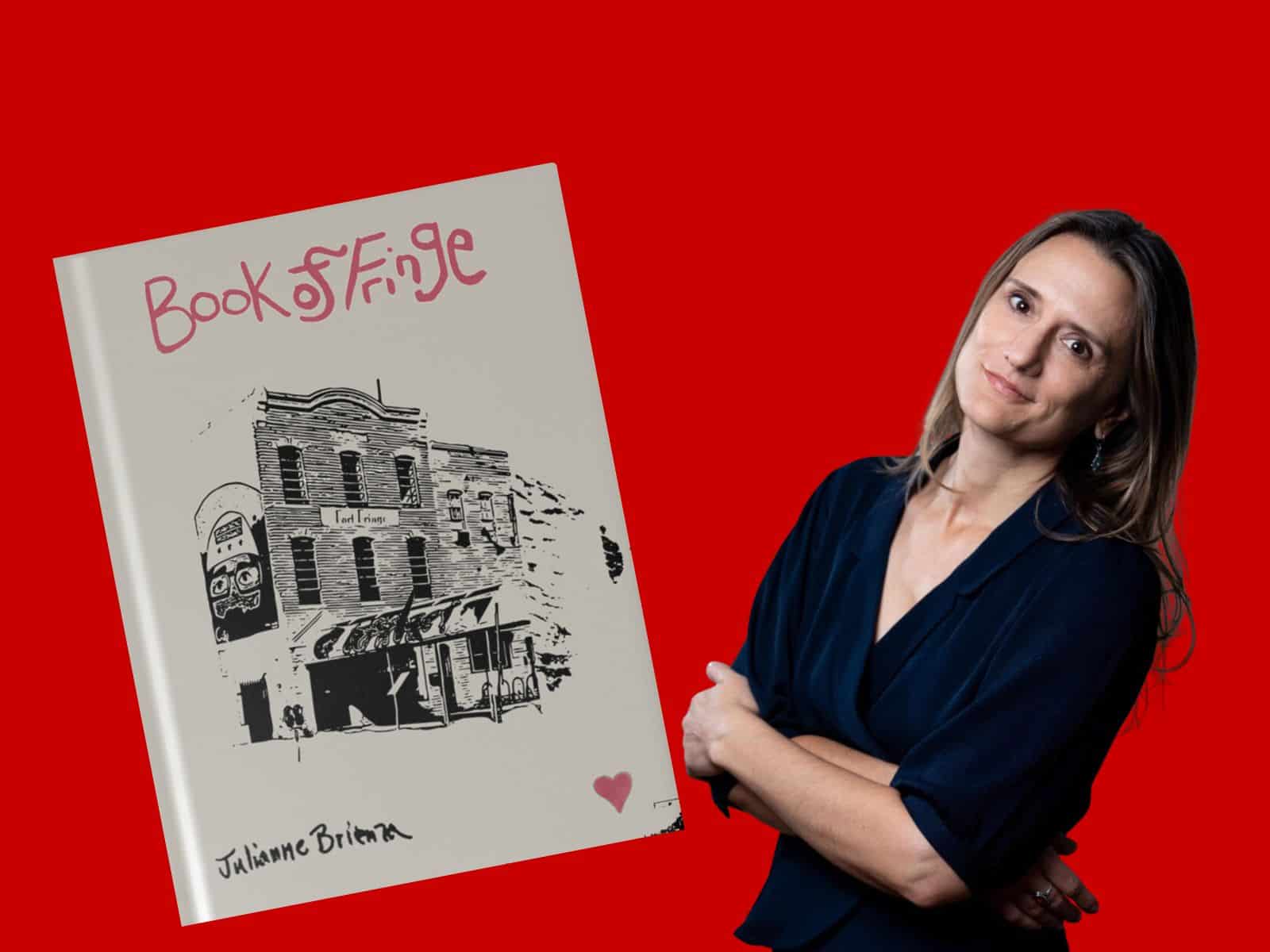
And now Julianne Brienza, the Festival’s visionary founder and leader, has shared with us the absorbing, amazing, and inspiring inside story of how it all came to pass — in a beautifully and meticulously designed Book of Fringe that reopens our eyes to the wonder that once was.
You can leaf through the oversize book’s handsomely bound pages and admire the stunning photography and graphics that, not unlike a school yearbook, will transport one’s inner Fringe-goer back to cherishable moments in time. You can also read Brienza’s fascinating text, which runs alongside the visuals in tidily squared-off paragraphs. I loved Brienza’s voice; she writes with a candor, clarity, wisdom, and principled passion that are absolutely enthralling.
Brienza also does not hold back in her analysis of the civic importance of support for independent artists and how philanthropists, politicians, and property owners can offer much-needed help. For instance:
Washington, DC … can support the arts — but too often only when they serve real estate or top-down planning. What’s missing is a commitment to a full cultural ecosystem…. When only the top is funded, there are no roots, and without roots, a city struggles to hold its soul. Capital Fringe built that bottom: a foundation for creative risk, access, and participation. (p. 91)
No arts advocate’s coffee table should be without this brave and brilliant book. Julianne Brienza’s Book of Fringe is an invaluable “how-to” and “why-to” and a work of art in itself.
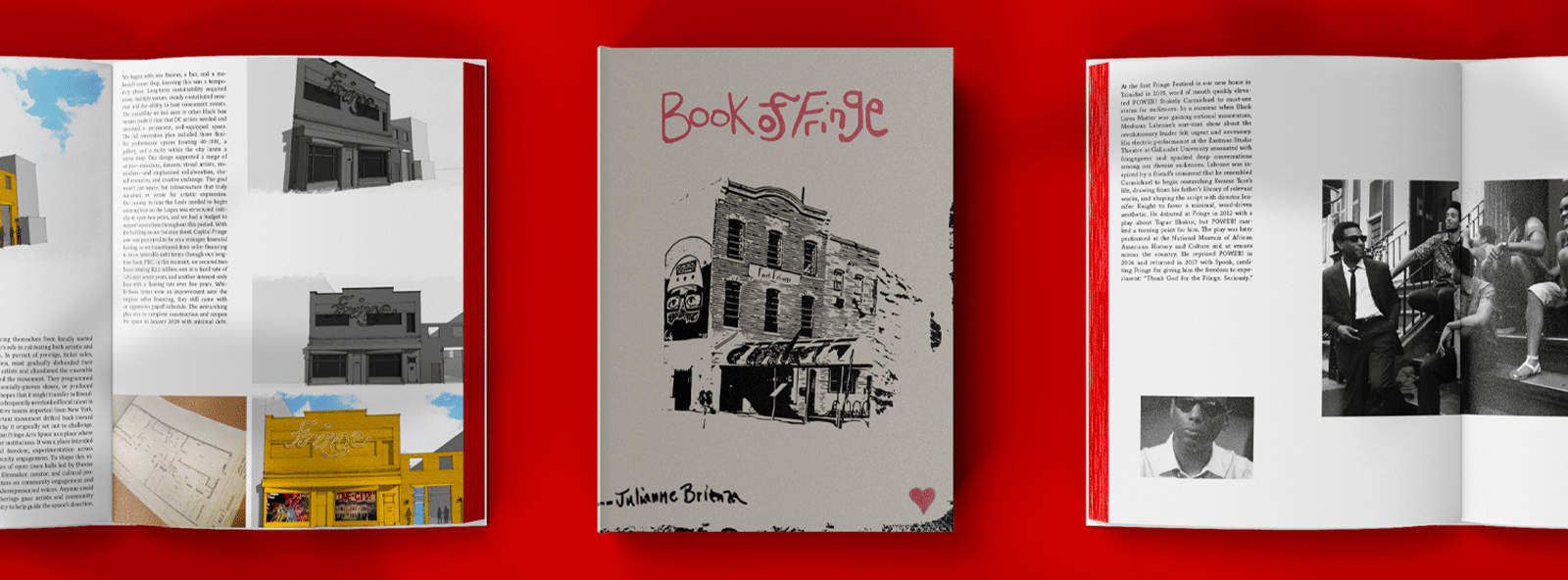
Book of Fringe is available in a limited-edition hardcover and can be ordered here.
160 pages, 9 inches x 10.5 inches, $82 plus $15 shipping
Julianne Brienza posts about Book of Fringe on Substack.
SEE ALSO:
Capital Fringe Festival ends after 20 years (news story, January 28, 2025)
5 Reasons Capital Fringe Is a DC Treasure (column by John Stoltenberg, July 4, 2016)


 was of the people, by the people, and for the people. A stunning new art book reveals how and why that was.)