Rarely does a show’s sound design set the scene so specifically and viscerally as it does in the cavernous Dupont Underground during the performance of The Trumpeter by Ukrainian playwright Inna Goncharova. Audiences are advised beforehand that there will be “sudden loud noises simulating explosions that are prevalent in war time,” which rather understates what we in fact do hear: bombs bursting, sirens wailing, whistling missiles, the low rumble of detonations aboveground. The pounding sounds are multidirectional and terrifyingly real. For we are hunkered down in a bunker-like basement during the Russian bombardment of Mariupol in 2022. And in the midst of this brutal cacophany we meet a trumpeter-composer who blithely seeks to create art under siege. He wants to write, he says earnestly, A Symphony of War — to make sense of senseless conflict and to find harmony in war’s chaos.
Could there be a more apt metaphor for the vulnerable and maybe delusional will to live free and survive?
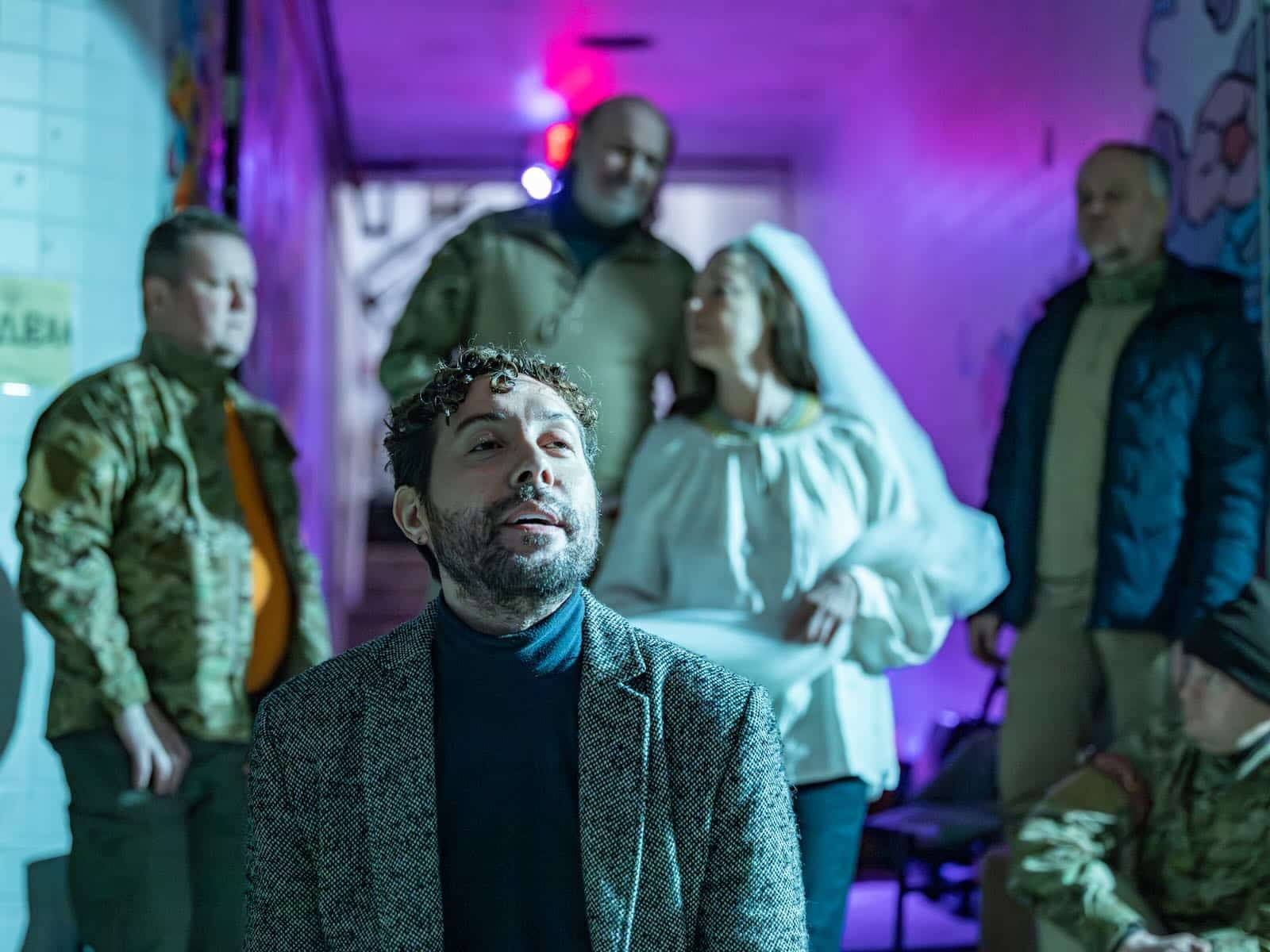
Hungarian director János Szász’s immersive and propulsive production roots for the artist, the central character and narrator, the Trumpeter. Played with grit and grace by the singularly expressive Michael Kevin Darnall, the Trumpeter is the sole survivor of a military band all killed by Russians. With a ragtag bunch of others, the Trumpeter has taken shelter beneath a steelworks, and we are here to hear him tell his tale — during which, ever the musician, he episodically boom-boxes with the rat-tat-tat of bomb blasts, and with delicate hands conducts a symphony only he hears with a maestro’s fortissimo and pianissimo.
Now and then, a literal trumpeter, the skilled and sensitive Kevin McKee, plays mournful and robust tunes on the Trumpeter character’s behalf. There are also four imposing soldiers (Ruslan Bondar, Volodymyr Sukhin, Oleksii Fishchuk, Vlad Tomilin), a beefy quartet who harmonize in Ukrainian in beautiful canticle-like interludes. The soundscape of this dramatic theater work — both the music and the munitions — is simply extraordinary (János Szász, Alan Naylor, and Liam McLain are credited with sound design and projections).
Another bunker mate in the play, the Trumpeter’s scene partner for much of it, is the curmudgeonly Kolya, played with gruff insouciance by Lise Bruneau. The Trumpeter and Kolya have the kind of combative badinage that betokens a foundational friendship that’s reluctant to warm.
KOLYA: Why are you trying so hard to copy the sounds of war?
TRUMPETER: Because search is important for the creator.
KOLYA: Yet you want to find harmony where there is none. It’s senseless to look for harmony in something that has and can never have any!
Despite their squabbling, they each, at different points, tend touchingly to each other’s debility and injury needs. Bruneau also appears briefly as the Trumpeter’s veiled vision of the young woman he once dated and now longs for, a soprano named Lyuba who is in Italy and whom the Trumpeter may never see again. Darnell’s glistening eyes and Bruneau’s fond flirtation become a tender vignette of hope within a wartime story that may or may not end well.
THE TRUMPETER: Survival! This is the main task of each of us, no matter where we are: in the basement of this cursed industrial monster, in the occupied territories or right in the middle of hostilities. We all have to survive, because this war was intended by the enemy to destroy us. If we simply survive, it’s already a big victory.
There is an offstage romance whose players we don’t meet, but the Trumpeter tells us about: a wounded lawyer near death and the nurse, called Nightingale, who cares for him. It’s a haunting subplot about love and loss among the besieged.
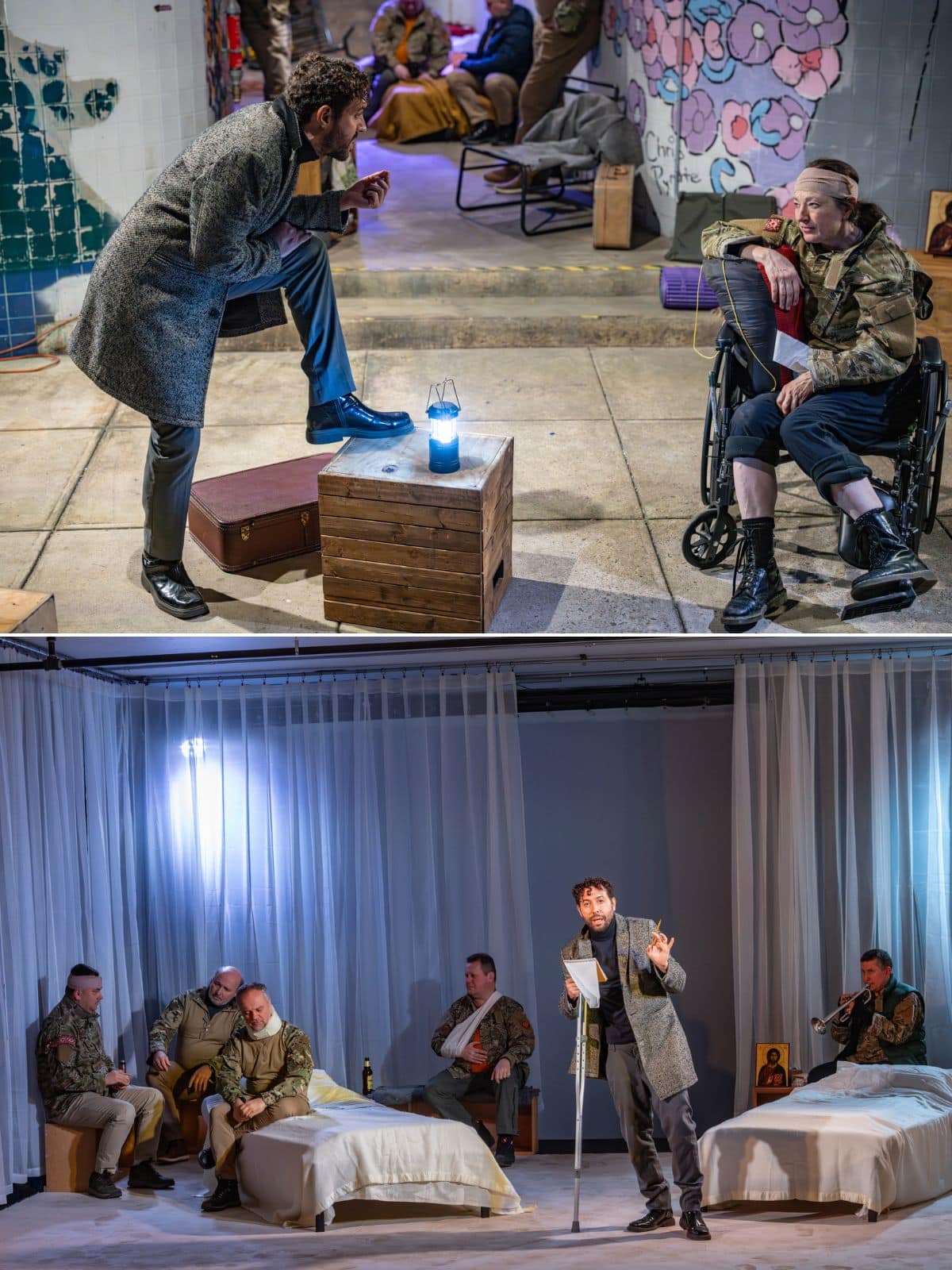
Dupont Underground, a former streetcar roundabout, a vast curved tunnel unlike any other venue in town, has a lobby-bar area, then further on three different playing areas, with separate seating (two have chairs, one has backless bleachers). The audience processes from one to the other, accompanied by trumpet and the male quartet, our path lit by lanterns. So it is a moving experience in multiple ways (stage design is by Daniel Ruiz Bustos). The third scene is an ethereal space set with two white-sheeted beds surrounded by white gauze curtains. I was uncertain where this clearly non-combat zone was meant to be — an afterlife? a dream? a hospital? — but I welcomed its resolution in poetry, calm, and harmony.
Before one passes from the bar area into the first playing area, there is a sobering exhibit of photographs of Mariupol before the war, all of it now bombed. The Trumpeter takes us there while the death and destruction happened. And this play points in precarious hope to a future peace.
“There is no better place to see The Trumpeter,” said Oksana Markarova, former Ukrainian ambassador to the U.S., during remarks on opening night. There is also no better time than now.
Running Time: Approximately 80 minutes, with no intermission.
The Trumpeter plays through February 1, 2026, presented by Alliance for New Music-Theatre performing in Dupont Underground, 19 Dupont Circle NW, Washington, DC. Showtimes are Mondays, Thursdays, and Fridays at 8:00 PM, Saturdays at 2:00 PM and 8:00 PM, and Sundays at 3:00 PM. Tickets are $40 and available online.
The Trumpeter
By Inna Goncharova
English Translation by John Farndon
Directed by János Szász
CAST
Trumpeter: Michael Kevin Darnal
Kolya: Lise Bruneau
Trumpet Player: Kevin McKee
CHORUS
Soldier 1: Ruslan Bondar
Soldier 2: Volodymyr Sukhin
Soldier 3: Oleksii Fishchuk
Soldier 4: Vlad Tomilin
DESIGN & PRODUCTION TEAM
Technical Director: Matty Griffiths
Stage Design: Daniel Ruiz Bustos
Sound Design & Projections: János Szász, Alan Naylor, and Liam McLain
Production Manager: Duane Gelderloos
Stage Manager: Susan Galbraith
TECHNICAL ASSISTANCE TEAM
Israel Rodriguez, Neptune Pringle, and Sol Roling
SEE ALSO:
Dupont Underground to premiere Ukrainian play ‘The Trumpeter’ (news story, January 3, 2025)
In Ukrainian play ‘The Trumpeter,’ the cacophony of war in microcosm (report on the staged reading by John Stoltenberg, May 1, 2025)