A huge round of applause for Keegan Theatre’s full-on commitment to commissioning, workshopping, and producing new works. At a time when many theaters must rely on sure-bet seat fillers based on familiar intellectual properties, it is a pleasure to watch fresh discoveries emerge on stage in Keegan’s Boiler Room Series. And in its latest world premiere, the company has gone all out, mounting a visually and aurally outstanding production to showcase Angelle Whavers’ ambitious and cryptically titled John Doe.
The director of John Doe, Josh Sticklin, also serves as scenic designer, technical director, and artistic director of the Boiler Room Series, and the artful congruence he brings to these multiple roles is evident as soon as the lights come up.
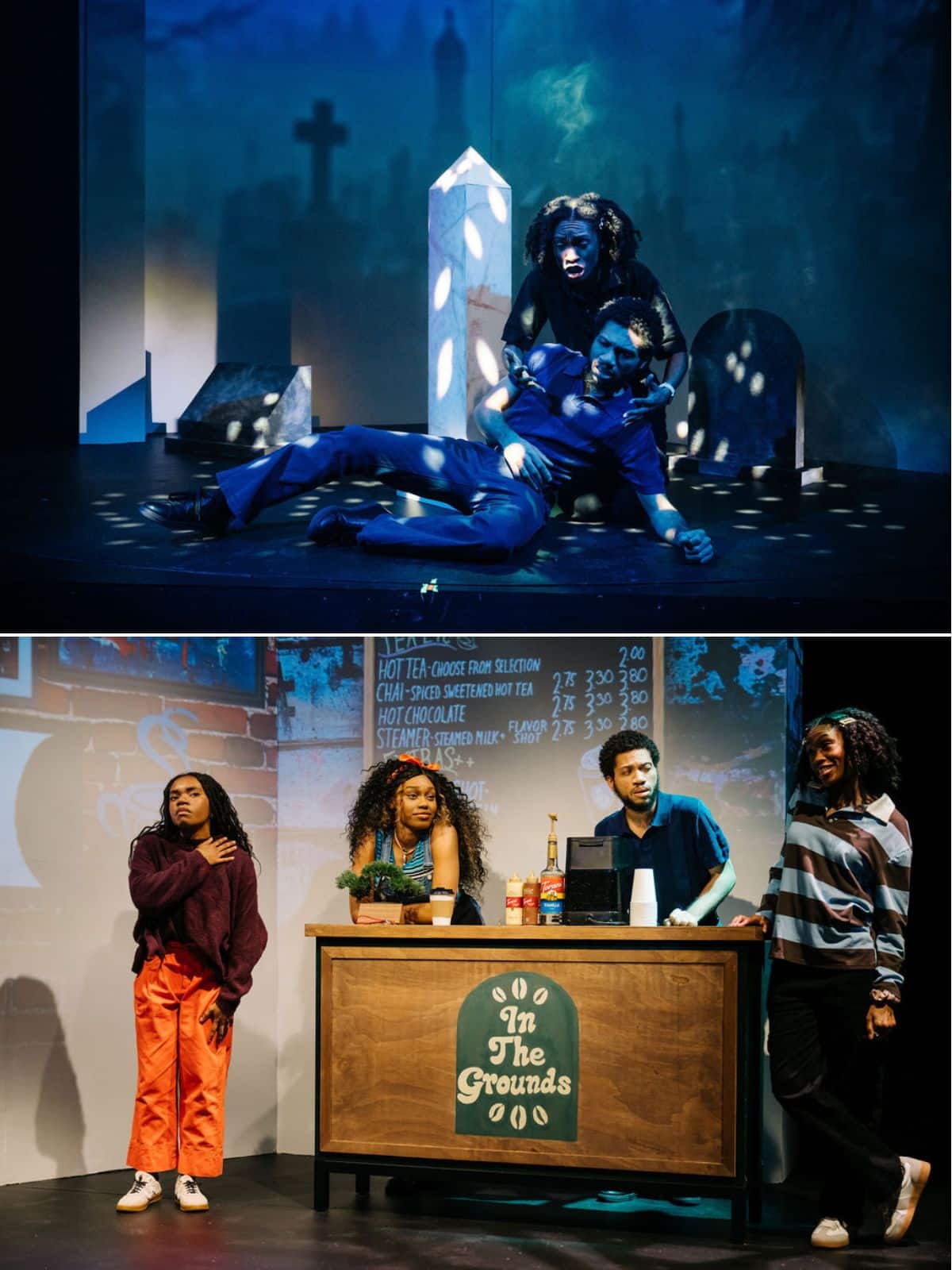
The play begins in a cemetery, where motion projections by Jeremy Bennett depict an expanse of graves beneath windblown trees, while lighting by Niya John, sound by Brandon Cook, and stage fog evoke an eeriness into which a young woman named Zia enters to visit one of two adjacent grave stones. Zia (played by Ariana Caldwell, emphasizing the character’s definitional social anxiety) strikes up a self-conscious, one-sided conversation with someone deceased. The scene ends with an abrupt jump scare as Doe, a young man’s ghost, appears.
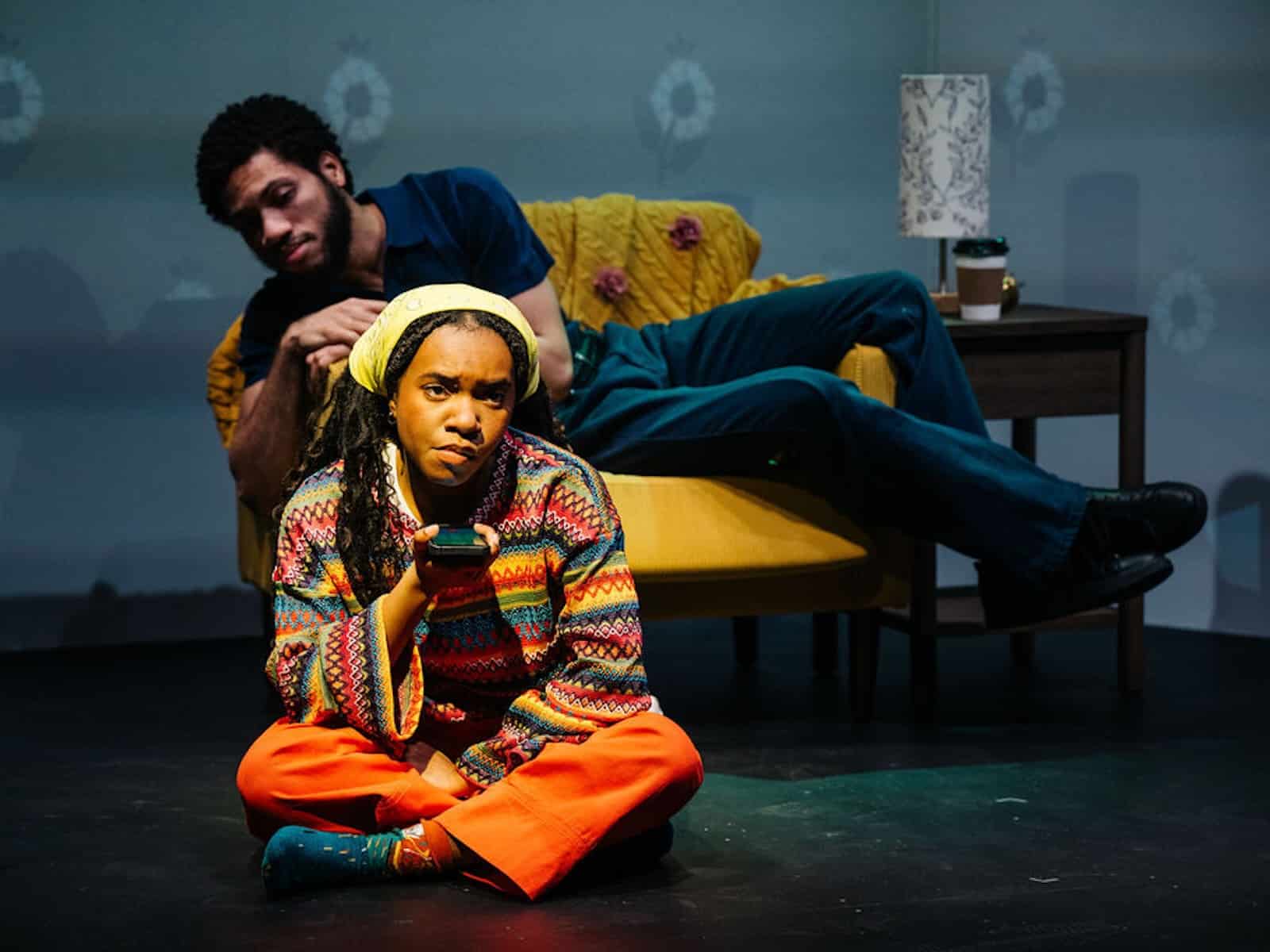
It turns out, Doe (played by Mitchell Alexander with an easygoing elan in marked contrast to Zia’s agitation) needs help with something. He cannot remember how he died, and he wants Zia’s help in finding out who murdered him. Thus is set in motion a play that’s superficially quippy and chatty but that harbors an underlying theme about grief and loss. At the core of John Doe — as we learn through scenes, sounds, and projections that flow cinematically one into another on a turntable — are parallel stories about two women who each tragically lost a brother. (You’ll have to see the play to see how that all unfolds.)
Zia frequents a coffee shop where we meet two other young women, Talisha, the barista, and Nadia, a cemetery guard. Alicia Grace as Talisha and Bianca Lipford as Nadia both deliver their chirpy chit-chat with a swift briskness that belies the sorrow at the play’s center. And when Doe shows up, only Zia can see and hear him (in a nice touch, Talisha and Nadia sense his presence by a sweet scent). Zia and Doe talk to each other mid-conversation with Talisha and Nadia, making for many awkward miscommunications that seem more schticky than illuminating of character.
Zia has a phone call with her mother (Patricia Williams Dugueye, in classic embarrass-daughter mode), who cringeworthily urges Zia to overcome her social anxiety by getting out and socializing more (“You were never a people person,” Mom says unhelpfully). Afterward, Zia bemoans to Doe:
ZIA: I’m a grown woman who panics walking out the door. I go out once a day for a cup of coffee and to say half a sentence to a barista…. And now I’m seeing ghosts. Every step I take, I’m pushed back two and I don’t need her getting on me about that. Asking questions, seeing if I “feel better,” cause I don’t. I never do.
Dugueye appears in a subsequent scene as Jenny, an archivist at a municipal office where Zia and Doe go to seek local murder records. Jenny, attempting to be helpful, shares with Zia that she, too, has social anxiety, even as, unbeknownst to her, Doe the ghost is hanging around.
We actually find out rather late in the play that it has been wanting to be about grief and loss. The tone shifts often, which plays more disconcerting and discordant than genre-bending. Though John Doe is implicitly about grief and loss, it seems not to trust its underlying emotional substance. Its living characters, for instance, seem averse to expressing the kind of interior emotional life that could touch us and elicit empathy. Instead, they lean into quick-paced wisecracky chatter as though to entertain us and keep us from losing interest. The effect is to distance us, as though not to let us into their grief.
Zia’s social anxiety is a throughline that is well observed and represented, but it is more referenced than resonant; it’s recognizable but doesn’t pull us in. Moreover, Doe’s oddly unexplained relation to Zia is not as compelling as it seems meant to be. He constantly refers to her corporeality in terms such as “human skin sack” and “bone rack,” which could be endearments or japes; it’s unclear. For sure, he’s amusingly full of himself, though, as he boasts to Zia:
DOE: Have you ever seen a movie? Just look at me. Stare into my amazingly piercing eyes. I am main character material. People like me don’t just die. People like me don’t come back to unlife for no reason. People like me are either loved or hated by all because our sheer energy elicits the most extreme emotions.
The play’s ending is truly touching — I’ll not say more except that Zia and Doe each have an honestly emotional encounter with mortality — and it feels like what the play has been trying glibly not to be. As a consequence, the ending doesn’t move us as it might. We’ve been wisecracked to death.
Angelle Whavers’ John Doe may be a play that’s still finding its way, but its premiere production is in excellent hands at Keegan, which has uplifted the script with superb stagecraft and even some surprising wit (as in, for instance, a scenic reference to a Ghostbuster movie graphic and a “Thriller” soundtrack clip).
Running Time: 90 minutes with no intermission.
John Doe plays through February 22, 2026, at the Keegan Theatre, 1742 Church St NW, Washington, DC, with performances Thursdays-Saturdays at 7:30 pm, Sundays at 3:00 pm, and select Mondays and Wednesdays at 7:30 pm. Tickets are $55 ($44 students, seniors 62+, and young people under 25) and are available online.
John Doe
Commissioned by Keegan’s Boiler Room Series initiative for new works.
By Angelle Whavers
Directed by Josh Sticklin
CAST
Ariana Caldwell (Zia), Mitchell Alexander (Doe), Alicia Grace (Talisha), Bianca Lipford (Nadia), and Patricia Williams Dugueye (Mom/Oscar/Jenny)
CREATIVE TEAM
Josh Sticklin (Scenic Designer and Technical Director), Niya John (Lighting Designer), Luke Hartwood (Properties Designer), Brandon Cook (Sound Designer), Jeremy Bennett (Projections Designer), Anya Peregrino (Costume & Hair/Wig/Makeup Designer), Mikayla Talbert (Stage Manager), Jared H. Graham (Production Manager), Dan Martin (Lead Electrics Technician), and Isabella Tapia (Revolve Programmer).
SEE ALSO:
Keegan Theatre announces cast and creative team for ‘John Doe’ (news story, January 15, 2026)