Playwright Rebecca Dzida’s visit to the ostentatiously ornate Palace of Versailles in 2010 prompted her to ponder the topic of revolution. “As I walked the grounds,” she recalls in her program note, “I couldn’t help but think, ‘No wonder the peasants rebelled.’”
That curious-tourist’s eye view informs Dzida’s world premiere Cake Eaters (as in Marie Antoinette’s apocryphal quip). Now playing in a basement blackbox in Georgetown — produced by the revived playwrights’ collective The Welders and directed with verve by Seth Rosenke — Cake Eaters is less a subversive manifesto and more a fabulist’s fable. Its characters are cartoonlike, its plot is a circuitous escapade, and its point of view vacillates inscrutably, albeit amusingly, between that of a ridiculous royal family and a naive peasant rebellion.
The two main characters are a princess and a peasant. They meet in a bureaucratic waiting room where the peasant, a young man named Rex (a seriously solid John Jones), has come for a work visa. He’s down and out, not least because he lives by a dump; his parents were killed in an attack by the royals, and he’s been left to take care of his young sister and grandmother. On the walls are emblems of a totalitarian regime: surveillance cameras and propaganda posters of the royal family in the style of religious iconography.
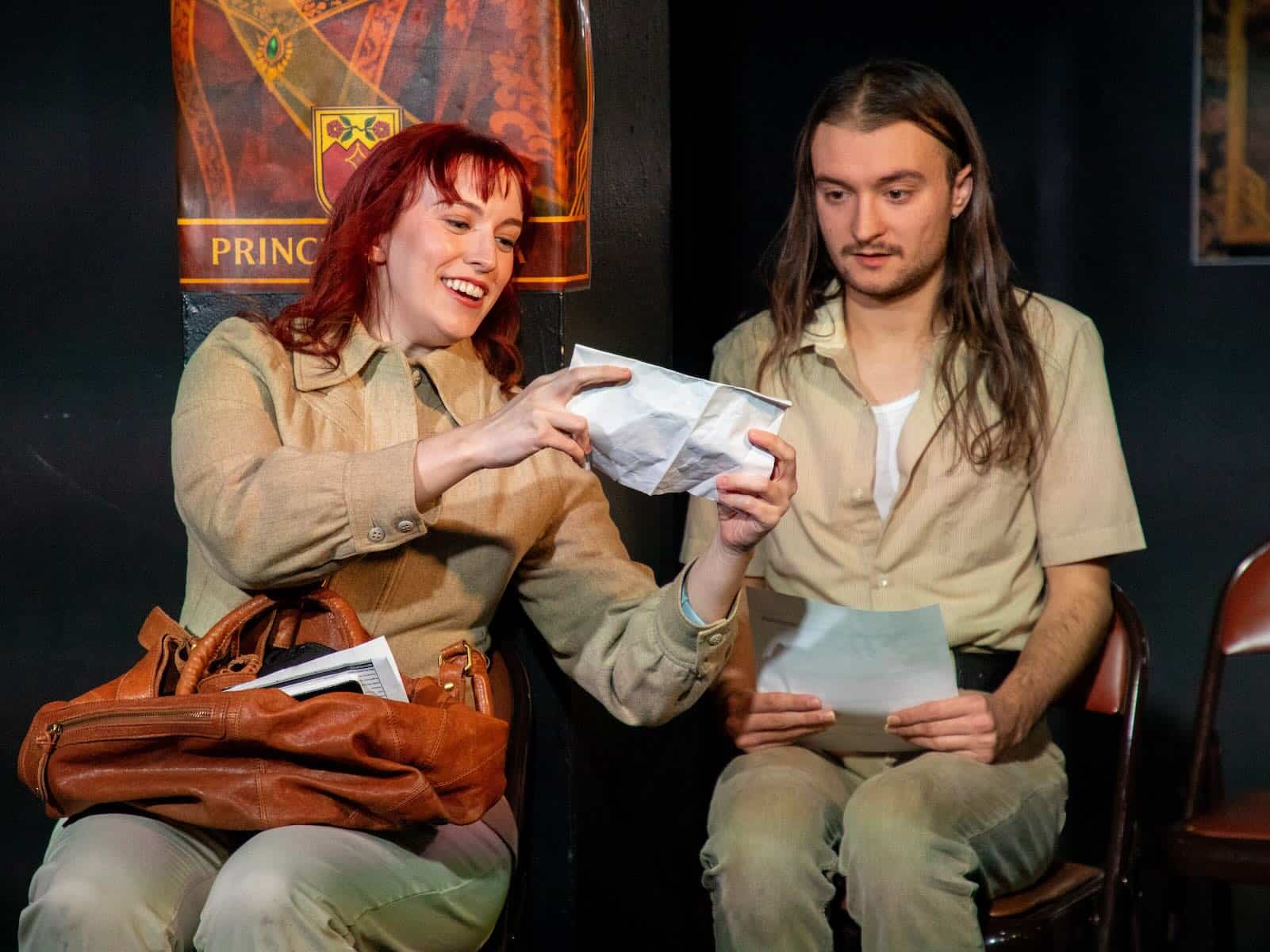
Rex is pestered by a hyperactive and infantile young woman who calls herself Yazzy and imagines herself Princess Ayaz, twelfth in line for the throne. Yazzy is a nosey ditz, and in Caleigh Riordan Davis’s comedic portrayal, she reveals herself to be the real Princess Ayaz. As Davis’ performance increases wildly in range (and blurred lines between reality and illusion become the play’s motif), Princess Ayaz’s role-playing continues, teasing us throughout as to whether she is purely an imperialist or really a rebel sympathizer and collaborator — for in fact a peasant uprising is afoot and Rex is about to be swept into it.
Two stern palace guards show up (Charlotte Kim, who also has a nice turn later as Rex’s precocious sister, and Alex Aspiazu, who doubles as Rex’s mentally diminished grandmother). We also meet Leo (Philippos Sourvinos), an earnest friend who urges Rex to overcome his ambivalence and join the United Proletarian revolt, and Commander Hatsu (Tristin Evans), leader of the rebel forces. (Sourvinos and Evans also stand in for the peasant citizenry.)
The time is some dystopian past or future, and the action moves between multiple locations, including the hovel Rex shares with his sister and grandmother and Princess Ayaz’s posh private quarters in the palace. Minimalist set and prop design by Rooster Sultan and spare lighting design by Ricky Elliot serve to establish the settings, and the interscene sounds designed by Noah Carpenter and Shaquille Stewart (such as music from a discordant piano, a grand opera sample, and a raspy radio broadcast) are noteworthy. McKenna Kelly’s costume design keeps the peasant palette in white and khaki, with red berets for the rebels, and reserves bright blue, silver, and magenta for the palace class. Donning a dress in dazzling hot pink is Princess Ayaz’s older sister, the laughably lush-drunk Princess Benita (a delightful Marley Kabin), eleventh in line for the throne and first in line for the liquor.
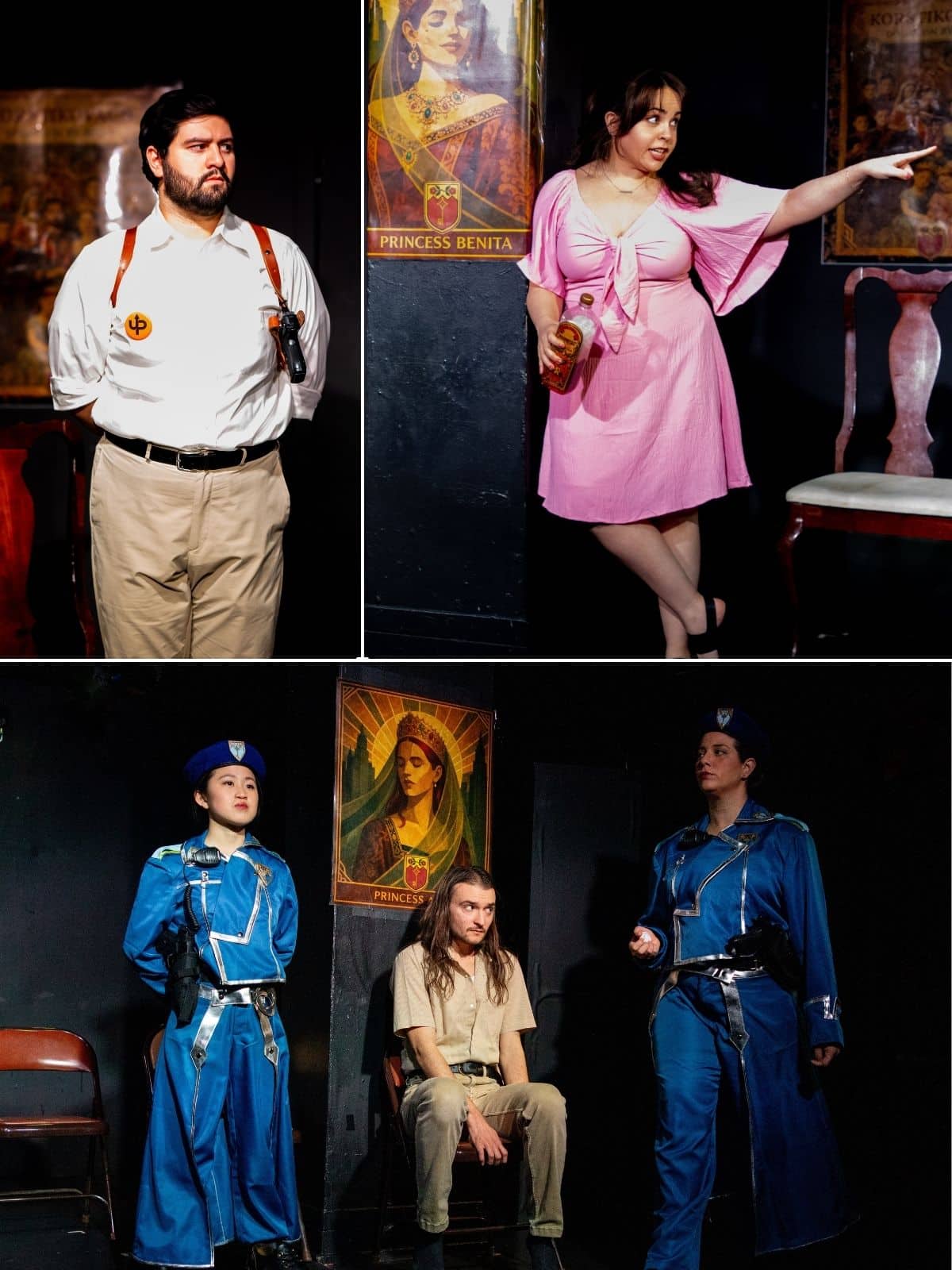
Though the plot, in which the rebels attempt a palace coup, is convoluted, in fairness, it’s kind of fun to watch and try to figure out. After the first act sets up the characters, the second act kicks off like a cuckoo caper, with a veritable what’s-going-to-happen-next vibe.
Along the way, we learn that Princess Ayaz wants “A new world order where there are no princesses,” and Rex, too, says, “I want to live in a new world.”
Then rebel Commander Hatsu weighs in with a rude reality check: “Revolution doesn’t mean things get better; it means things get flipped. Those on the bottom become those on top. If you don’t see that, you’re living in a fucking fairy tale.”
I’ll not disclose how the equivocating story ends (I’m not certain I even know), except to say that fight director Bess Kaye stages a bloody and brutal finish that, seen up close in this tiny venue, feels shockingly like it’s happening in your lap.
What, I wondered as I left somewhat shaken, was the message in all the mess? It’s for sure not an exhortational or motivational political tract. Cake Eaters is more like a spectator sport with peasants versus royals and all the rules unreal, as if none of what happens matters once one steps outside the theater. So one is left not so much revolutionarily nourished by authentic radical advocacy as wishing for a piece of the actual cake that is served on stage.
It looked to be red velvet.
Running Time: Approximately two hours and 15 minutes with one intermission.
Cake Eaters plays through February 22, 2026, presented by The Welders performing at The National Conservatory of Dramatic Arts, 1556 Wisconsin Ave NW, Washington, DC. Purchase tickets (from $25) online.
The program is online here.
Content warnings: This play takes place in a patriarchal world where state-sanctioned violence is a regular occurrence. Graphic depictions of violence, use of prop guns on stage with gunshot sound, references to sexual assault, strong language, use of r-word, c-word, and f-word.
Cake Eaters
Written by Rebecca Dzida
Directed by Seth Rosenke
CAST
Rex: John Jones
Ayaz/Yazzy: Caleigh Riordan Davis
Hatsu/Citizen: Tristin Evans
Eva/Soldier: Charlotte Kim
Leo/Citizen: Philippos Sourvinos
Benita: Marley Kabin
Markuzi/Irina: Alex Aspiazu
Swings: Lila Cooper, Cate Ginsberg
PRODUCTION AND DESIGN
Stage Manager: Alana Isaac
Set & Props Design: Rooster Sultan
Lighting Design: Ricky Elliot
Sound Design: Noah Carpenter and Shaquille Stewart
Fight & Intimacy Director: Bess Kaye
Costume Design: McKenna Kelly
SEE ALSO:
The Welders return with world premiere of Rebecca Dzida’s ‘Cake Eaters’ (news story, January 25, 2026)