In the community room at a Jewish home for the aging, four elderly residents form a supper club to entertain themselves and while away the time with knitting and games of Scrabble and charades. Three are octogenarians, one is a septuagenarian, and they are a gas: Fanny, Barbara, Hal, and the youngest, Ruth. The tenor of their recreational banter is sitcom-ish, like The Golden Girls, but plus a Guy.
The well-appointed sitting room looks comfy and idyllic (the scenic design is by Misha Kachman in calming tones of magenta, turquoise, and tan, and through the windows can be seen a Southern California landscape with desert vegetation). Little do these convivial seniors know that in the remaining days of their lives they will face the literal end of days — the time prophesied in the Hebrew Bible and the time promised in the title of Ali Viterbi‘s astonishingly stirring play, The World to Come. And then the world as they and we know it will be over and gone.
Oldsters encountering the apocalypse, there’s a hot premise for you: the perfect occasion for a personal and collective reflection on entertainment as eschatology.
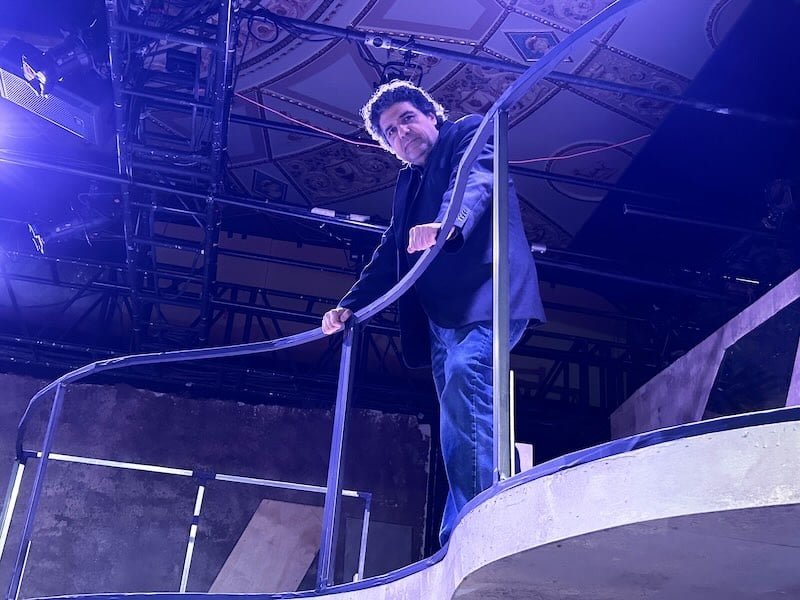
The World to Come starts as a comedy (with a rom-com twist: Hal and Ruth get it on), and the lighthearted approach to laugh things becomes a gripping look at last things — with stunning special effects that I won’t give away, except to praise the lighting by Colin K. Bills, the sound by Sarah O’Halloran, the projections by Kelly Colburn, and the terrifying avian by Ksenya Litva. Director Howard Shalwitz, returning to Woolly Mammoth, the theater company he co-founded 45 years ago, has notched another triumph in his career.
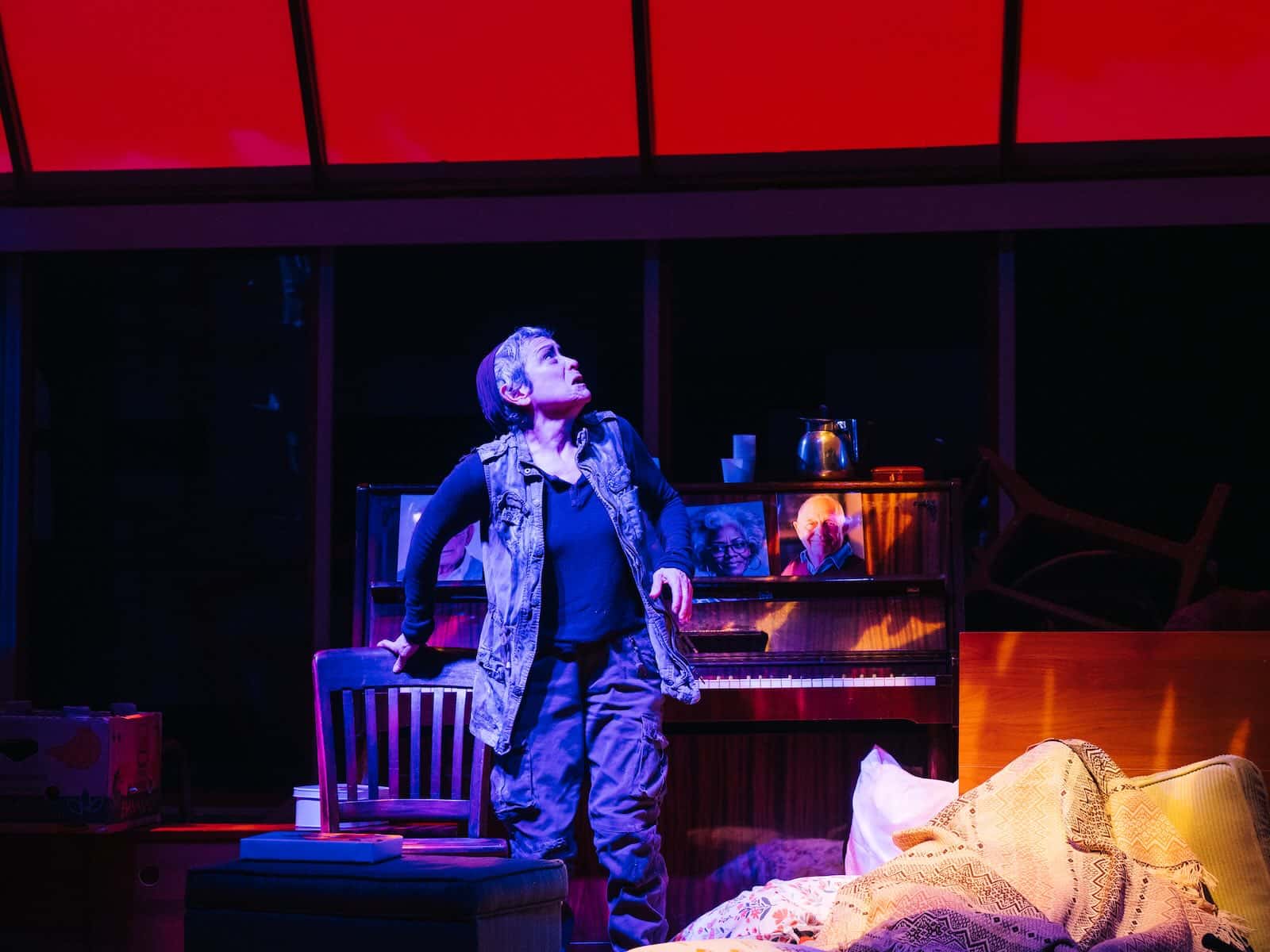
Among the old folks at this home, Fanny is the prickliest, a no-nonsense Holocaust survivor with a Hungarian accent, played transfixingly by Naomi Jacobson. Barbara, a former nuclear physicist with memory issues who now has moments of lucidity, is played deliriously, touchingly by Brigid Cleary. Hal, a borderline sexist who is romantically smitten with Ruth, is played by Michael Russotto with utterly credible charm. Ruth, the widow of a Rabbi, is determined to locate her doctor son but can’t; Claudia J. Arenas brings to the role a great depth of both sorrow (about her son) and rapture (about Hal).
In multiple roles, including a series of nurses, is Ro Boddie, whose performance stands out as riveting, whatever he is doing — whether proficiently giving Hal his meds and taking Barbara’s blood pressure or officiously garbed in hazmat gear in one of the play’s first signals that something horrific is encroaching. (A wall of concrete blocks outside the windows is another.) A highlight of the play for me was a remembered beach-blanket scene in Act II, when Cleary, as 20-year-old Barbara in a bikini, has a tender exchange with Boddie as Jerry, her attentive beau (and now dead husband). If that beautiful moment of memory supplanting grief were a song, I’d have it on repeat.
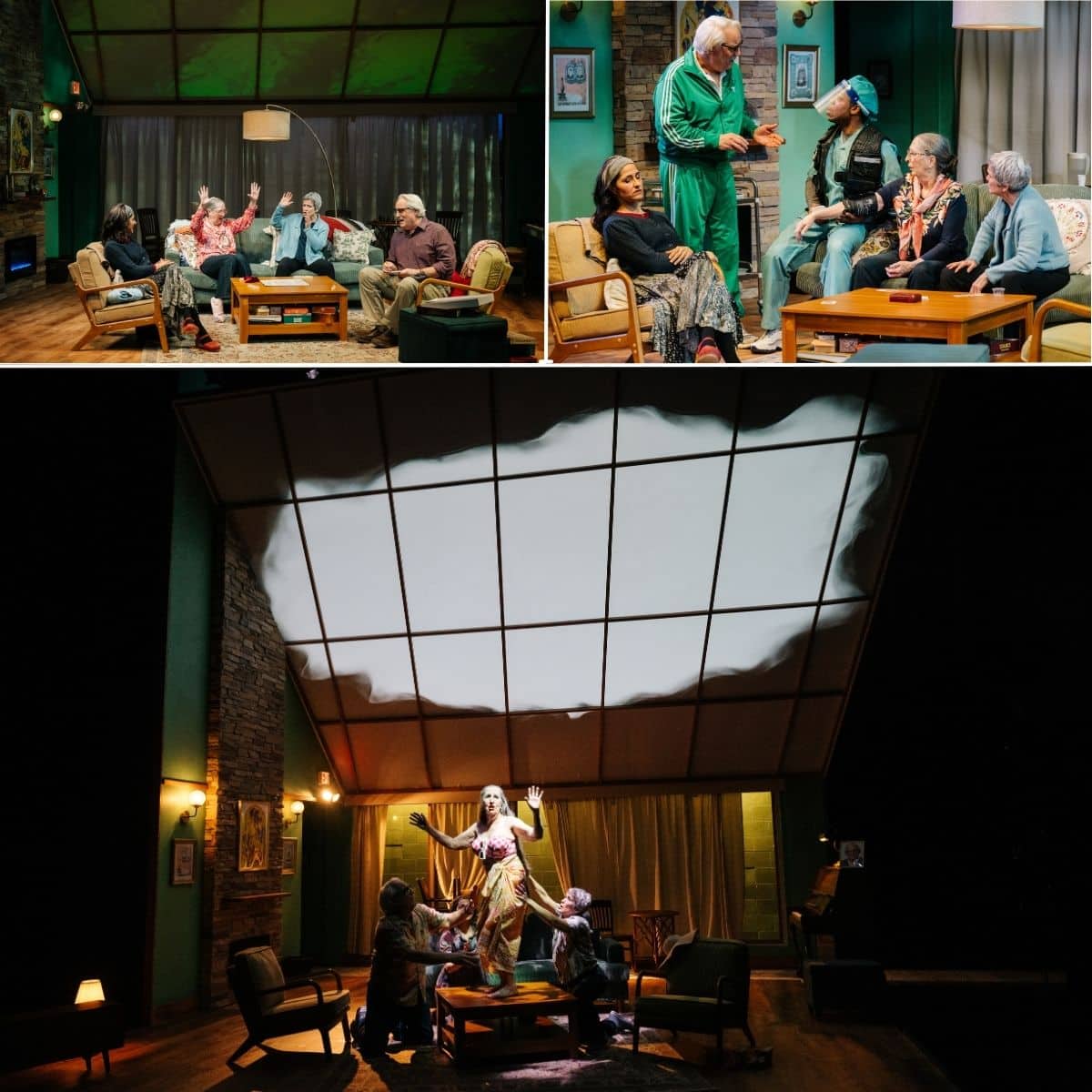
There are intimations that these elders have been warehoused and meant to perish. And to that point, Barbara, speaking spontaneously from memory with a stentorian falsetto, declaims an apocalyptic biblical prophecy.
HAL: You know, I’m starting to believe Barbara’s crazy theory. I mean, they’re obviously not doing this for our protection.
RUTH: No. They think we’re a waste of space.
FANNY: Someting to get rid of.
HAL: Don’t they realize we could help? That we’ve lived through things? That we might actually be useful to them if they didn’t lock us up?
FANNY: De folly of youth.
As might be expected, death is a motif of the play, but what cannot be foretold is how fascinatingly the theme is handled. Set atop the piano in the community room is a succession of framed photos of the most recently deceased residents. And the play presents a panoply of perspectives on what happens when we die, including agnosticism:
RUTH: It’s not about what comes next in Judaism. It’s about what we do now. The way we live on is in each other. Here. On earth.
FANNY : I don’t believe in dis World to Come.
RUTH: So you just believe… what? When you die, you die? That’s it?
FANNY: I don’t know and I don’t care.
I cannot imagine that anyone witnessing The World to Come would not in some way become mindful, perhaps even emotionally, of their own and their loved ones’ relationship to mortality — and what that means about how to live. From the jokey badinage at the beginning to the cataclysmic spectacle at the end, this play prompts us to do exactly that. And if there is any heart to be offered and taken here, I think it may be tucked in this inspirational line of Ruth’s: “Our most transformational journeys can happen even towards the end of our lives.”
Running time: Two hours and 15 minutes, including one intermission.
The Woolly Mammoth Theatre Company and Theater J co-production of The World to Come plays through March 1, 2026, at Woolly Mammoth Theatre, 641 D St NW, Washington, DC, with performances Wednesdays-Sundays at 8 PM, Wednesdays at noon, Saturdays and Sundays at 3 PM. Single tickets start at $31. Twenty Pay-What-You-Will tickets are also available for every performance, online or in person. Tickets are available online, by phone at (202) 393-3939, via email at tickets@woollymammoth.net, or at TodayTix.
The program is online here.
SEE ALSO:
Looking forward to the end times with Howard Shalwitz and Ali Viterbi (interviews by Celia Wren, February 2, 2026)
Woolly Mammoth and Theater J to premiere ‘The World to Come’ (news story, January 15, 2026)