
Playwright Edward Albee famously said, “I am not interested in living in a city where there isn’t a production of Samuel Beckett running.”
The Washington Stage Guild, now in its 40th season, brings us the opportunity to see a major work of one of the 20th century’s greatest writers.
Born in Ireland, Beckett lived in Paris for most of his life and wrote in French and English. During World War II, he was a member of the French Resistance. Winner of the Nobel Prize for literature (in 1969), he was a novelist, poet, and critic as well as a playwright. He is widely considered a master of the Theater of the Absurd.
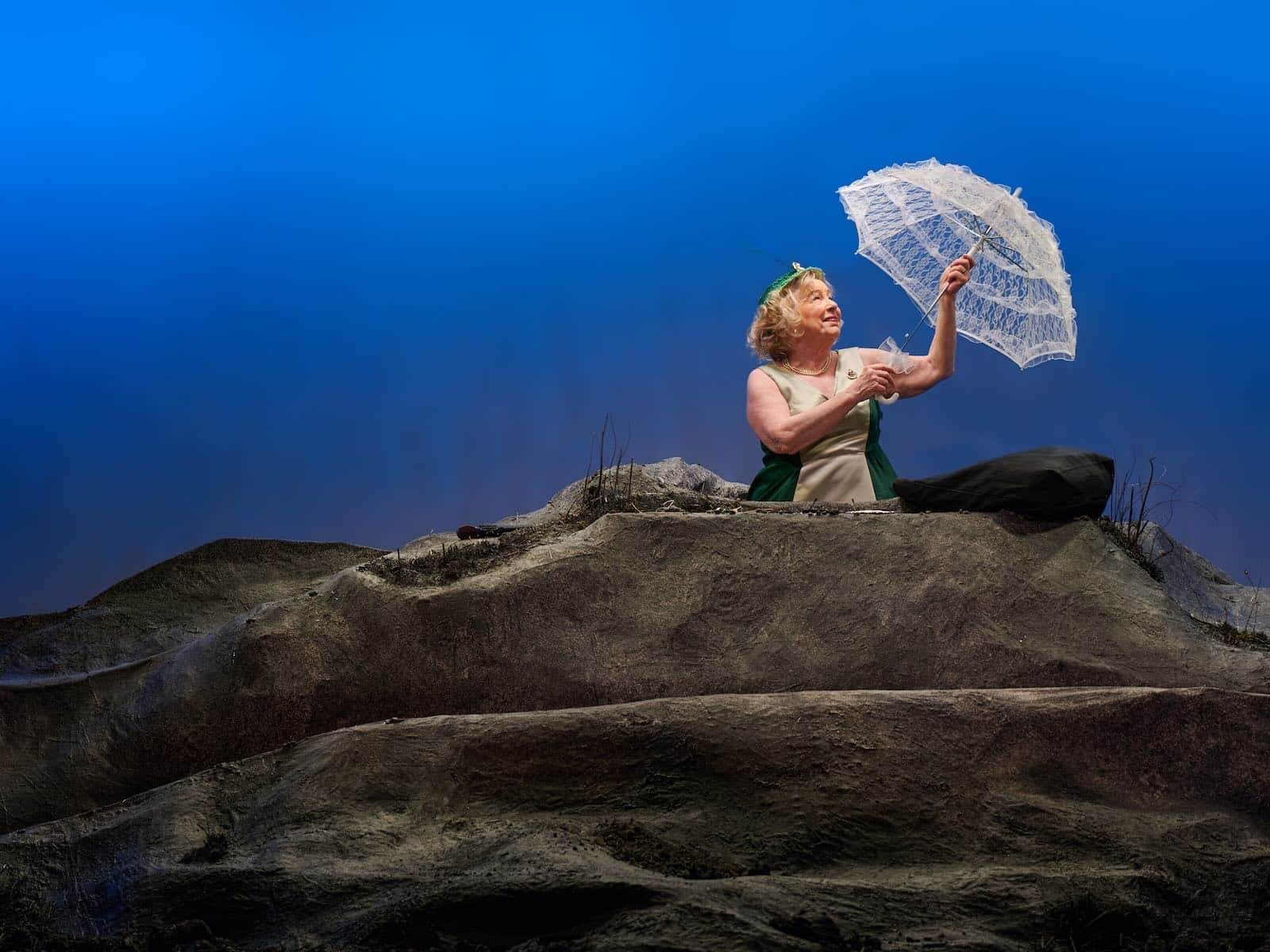
Washington Stage Guild’s Happy Days (1961) is perfectly pitched, full of musicality, wistfulness, and tightly guarded emotion. Director Alan Wade refers to it as “a play about a marriage” with “all of Beckett’s attendant interests.” This focus on Winnie (Lynn Steinmetz) and Willie (Matty Griffiths) as a couple adds a unique intensity to their connection as well as their loneliness.
The central character, Winnie, is sometimes viewed as an iconic role for women, much as Shakespeare’s Hamlet is for men. Many great actresses have played Winnie. French actress Madeleine Reynaud, who referred to critics as “les affreux” (“the terrible ones”) or “les fauves” (“the wild beasts”), became Beckett’s favorite. An Italian actress, Clara Colosimo, once went on a hunger strike when she was denied the chance to play the part beyond her local region due to a legal dispute. (Beckett intervened, and the matter was later resolved.)
Steinmetz has her own distinctive interpretation of the character, and it is a compelling one. She appears up to her waist in a mound, with a black bag, full of useful items — a toothbrush, glasses, a magnifying glass, a mirror. Lipstick. A handkerchief.
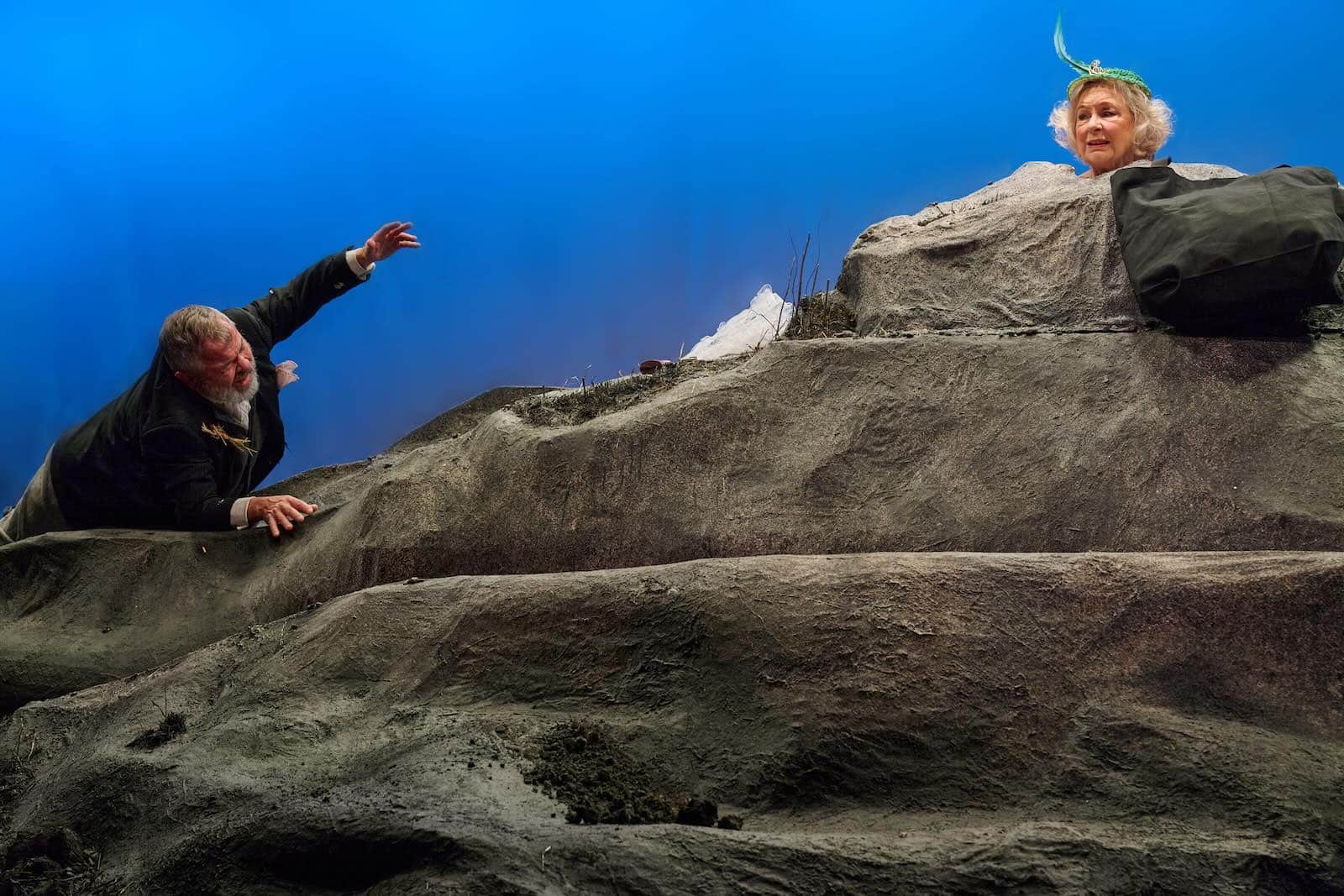
Her spouse, Willie, lies nearby. As she goes through her day, full of optimism, she reminds herself of her many blessings. The pacing of this stunningly poetic, almost-monologue, in this incarnation, is strikingly musical. Here is Winnie:
WINNIE: Ah, yes, great mercies, great mercies. [Long pause. Low.] Sometimes I hear sounds. [Listening expression. Normal voice.] But not often. [Pause.] They are a boon, sounds are a boon, they help me…through the day. [Smile.] The old style! [Smile off.] Yes, those are happy days, when there are sounds.
Beckett was a passionate lover of music, among his favorites being Schubert, Beethoven, and Hayden, though he hated Bach. Beckett described him as “like an organ grinder churning out musical phrases.” The music in the production is especially lovely. (Sound designer is Marcus Darnley.)
Beckett described Winnie thus to British actress Billie Whitelaw:
One of the clues of the play is interruption. Something begins; something else begins. She begins, but doesn’t carry through with it. She’s constantly being interrupted or interrupting herself. She’s an interrupted being. She’s a bit mad. Manic is not wrong, but too big … a child-woman with a short span of concentration — sure one minute, unsure the next.
“She’s like a bird,” he adds. “A bird with oil on its feathers.”
Dressed mostly in green, with a green feathered hat perched jauntily on her head, this Winnie muses on her past, her present, and most of all Willie. She quotes, obliquely, from an astonishing number of writers, from Shakespeare to Dante to Milton.
Matty Griffiths as Willie wears a rakish boater and groans occasionally. At one point, he hands Winnie a saucy postcard. There is an air of the British music hall about him. He reads a newspaper, remarking, “Opening for smart youth,” or sometimes “bright boy”. Occasionally, he disappears.
Like Steinmetz, he captures the essence of his character, and the two together are unmistakably a long-married couple, till death do them part. Willie is not a talker, though, to say the least. As Winnie remarks, “Oh I know you were never one to talk, I worship you Winnie be mine and then nothing from that day forth only titbits from Reynolds’ News.”
When it came to the staging and design, Beckett demanded simplicity. Megan Holden’s scenic design and Marianne Meadows’ lighting design are both simple and effective. Winnie and Willie’s costumes (costume designer is Cody Von Ruden) suit them well, and are true to Beckett’s vision. Director Alan Wade has achieved a unity of style and performance that echoes Beckett’s existential theme while presenting us with characters who are all too human.
Running Time: One hour and 30 minutes, with one 10-minute intermission.
Happy Days plays through February 22, 2026, presented by Washington Stage Guild, performing at The Undercroft Theatre at Mount Vernon Place United Methodist Church, 900 Massachusetts Avenue NW, Washington, DC. Purchase tickets ($30–$60) online.
Happy Days
By Samuel Beckett
CAST
Winnie: Lynn Steinmetz
Willie: Matty Griffiths
CREATIVE AND PRODUCTION TEAM
Director: Alan Wade
Scenic Designer: Megan Holden
Costume Designer: Cody Von Ruden
Lighting Designer: Marianne Meadows
Sound Designer: Marcus Darnley
Stage Manager: Elaine Randolph
Assistant Stage Manager: Luca Maggs