
“Little Miss Perfect” — the song — began its life as the standout musical number of the 2019 Write Out Loud contest. Written by Joriah Kwamé long before it became a musical, the song spoke about the constrictions of expectation and the pressure to conform in pursuit of success. Sung on YouTube in a spiraling staccato by Broadway star Taylor Louderman, the lyrics resonated with queer theater kids across America and sparked an obsession with the unknown details beneath the song’s surface. In the words of Kwamé, the book writer, composer, and lyricist, who spoke to audiences before this week’s world premiere at Olney Theatre Center, “Little Miss Perfect — the musical — came to fruition because the world asked for it.” The answer to that request isn’t the sapphic fantasy fans imagined; it’s the authentic vision of Kwamé: unapologetically Black, queer, and laughing in the face of adversity.
The titular Little Miss Perfect is Noelle Sanders (Leanne J. Antonio), a high school senior who dreams of leaving her small Michigan town to attend Howard University. Despite her mother’s (Kara-Tameika Watkins) wish for nothing to change — for her daughter to stay near and familiar — Noelle meets with a Howard admissions counselor (Brynn Williams). After years of hiding in her religious home and majority-white school, Noelle must embrace leadership to win a scholarship. Freshman Eli Johnson (Donovan Fowler) convinces her to run for student council president against the incumbent, the cumbersome Gia Douglass (Mia Goodman), the school’s self-proclaimed queen. An aspiring editor, Noelle turns her critical eye on herself. Yet her efforts to be perfect unravel when she meets Malaya Cruz (Madelynn Elizabeth Ayen), a foreign exchange student from the Philippines. Her attraction to Malaya awakens a desire for a love that does not require self-abandonment.
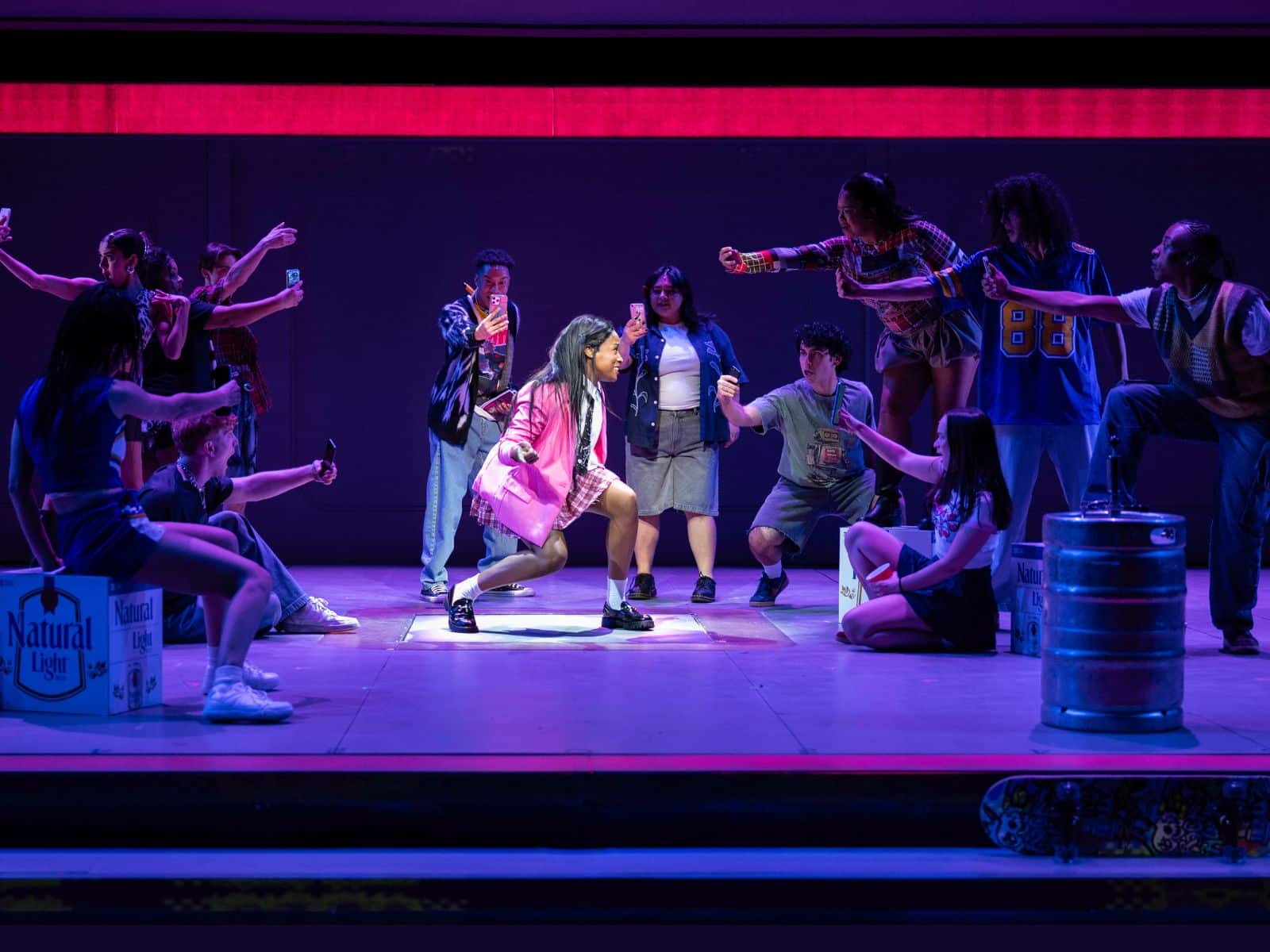
Antonio’s entrance as Noelle is a masterclass in character introduction, set during the opening number “Perfect.” She exists as an invisible presence, her identity shaped for the audience by formative comments from the adults in her life. By the time she appears, kneeling in a white square, we already know what to expect. Noelle is a contortionist, a chameleon. Yet even as the show praises her illusionist abilities, we glimpse her inner rebel — a promise of the confident Black girl who will soon make up her own mind: “Oxford considers perfection a noun, but I consider it a verb. It’s what I do,” she shares.
The set design, guided by Lawrence E. Moten III, mirrors Noelle’s social standing. Her world is small, hemmed in by her mother’s insistence that she remain a “good” Christian girl, her reputation as the brightest student at school, and the racially insensitive attitudes of her classmates. Her bedroom is staged as a dense square, scarcely larger than the box she first appears in, isolated in the middle of Olney’s vast mainstage.
When the action shifts to school, the set expands to fill the stage, yet Noelle often lingers at the margins of these larger environments. In “Black Girl Magic,” she shrinks against towering projections of the Howard admissions counselor, visually outsized and outnumbered. Only later, during the turning-point number “Political Party,” does Noelle slip into the spotlight with a commanding presence, aided by Antonio’s natural star quality. Antonio’s gravitas grounds the show’s meme-driven humor and culturally specific easter eggs in its larger, relatable coming-of-age arc, bridging the gap between the communities represented onstage and the intergenerational, diverse audience beyond it.
As Noelle’s love interest, Malaya, Madelynn Elizabeth Ayen’s shining moment is “Ordinary,” a belter about radical acceptance in the face of total rejection. Though a power ballad this early in the first act risks feeling premature, it effectively establishes Malaya as the immovable boulder that will alter the course of Noelle’s life. Ayen plays Malaya with perfected butch swag — an intentionally subtle yet noticeable ease, a cool that comes from knowing who you are.
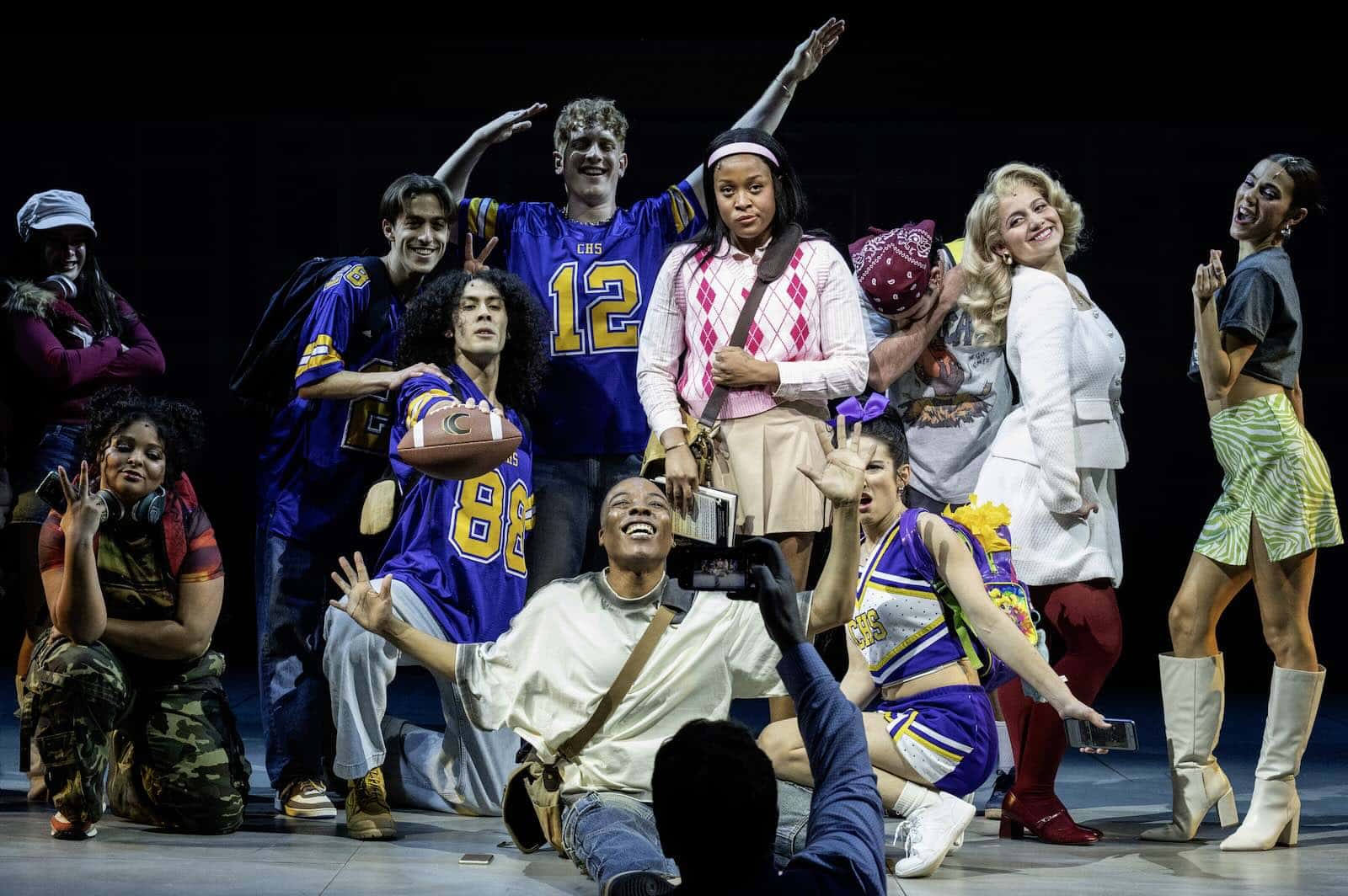
The second act opens with the ensemble piece “New Noelle,” which showcases Chloe O. Davis‘s impressive choreography. It begins as a solo number for the reigning class president and mean-queen Gia, whom Goodman performs with high spirits and even higher hair. Goodman’s aggressive choices for Gia made me question what popularity actually means at this high school. The show relies on Gia’s “emotional punching bag” and sidekick, Leanne Stewart (Graciela Rey), to tell us that Gia is charismatic, but we never experience it, condemning the character to one-dimensional villainy.
“New Noelle” then explodes into a full-cast dance number that is as narratively sharp as it is technically seamless. Each performer fully occupies their space; no shrinking or blending into the background, yet their energies align. The result is the convincing illusion of an entire high school pulsing with its own ecosystem of ambition and insecurity.
Little Miss Perfect’s development from a single viral song into a full musical was slow, spanning years as Kwamé struggled to hear his authentic story amid the thunderous applause for his song. Now, with the help of director Zhailon Levingston (fresh off directing Broadway’s Cats: the Jellicle Ball), the coming-of-age musical embraces its adolescent messiness.
Levingston described its evolution as “a cycle of learning and unlearning, knowing and unknowing.” That was most clear in the late-stage reinvention of the eleven o’clock number, “Redefined,” rewritten just weeks before opening and tweaked through the final dress rehearsal, all in pursuit of the perfect emotional punch. “Redefined” didn’t deliver me a knockout blow, but it was fresh and endearing like the musical itself. By embracing imperfection in both its story and its creative process, Little Miss Perfect redefines the American high school musical by asking who gets to fall in love, who gets to succeed, and where change is allowed to take place.
Running Time: Two hours and 15 minutes with a 15-minute intermission
Little Miss Perfect plays through March 8, 2026, on the Roberts Mainstage at Olney Theatre Center, 2001 Olney-Sandy Spring Rd, Olney, MD. Tickets ($42–$102) are available online, by calling the box office at 301-924-3400, or through TodayTix. Discounts for teachers, active military, and first responders are available at olneytheatre.org/discounts.
The program for Little Miss Perfect is online here.
Music Supervision & Music Direction by Patrick B. Phillips; Costume Design by Danielle Preston; Lighting Design by Abigail Hoke-Brad; Sound Design by Kevin Alexander; Projections Design by Zavier Augustus Lee Taylor
SEE ALSO:
Olney Theatre to premiere Joriah Kwame’s ‘Little Miss Perfect’ in February (news story, December 4, 2026)