At a certain point in playwright Dave Harris’ Tambo & Bones, now making its DC debut at Spooky Action Theater, a record scratch moment occurs. Through a series of call-and-response rap numbers, performed by the show’s titular duo, we realize that we are no longer watching a play about Tambo and Bones. We are at a concert.
“If y’all havin fun say yeah.”
(Yeah! The audience enthusiastically responds.)
“If y’all feeling sexy say yeah.”
(Yeah!)
The audience is all in, responding to each call from the stage, until this one: “Now say, Imma real n*gga!” the actor prompts us, and the very white, largely older audience falls silent.
It’s no secret in the theater world that stages are diversifying faster than the audiences filling them. But few playwrights have confronted that imbalance with the audacity and precision that Harris does in Tambo & Bones. In that single moment, when participation shifts to paralysis, Tambo & Bones forces the audience to see itself.
This moment is only one of many in this blistering, virtuosic production, when Harris’ script — reinforced by stellar performances from the show’s two leads — leaves the audience squirming in their seats. By the play’s end, we realize with profound discomfort that no one — not the oppressed, not the oppressor — escapes the insidious influence of race-based, money-for-minstrelsy capitalism in America.
But also (just trust me on this one), it’s mesmerizingly funny.
The fact that this theatrical feat plays out at Spooky Action Theater, one of the region’s scrappier companies, in a tiny blackbox space in a church basement, proves that good things really do come in small packages.
Tambo & Bones spans centuries with a small cast of four (two of the actors don’t appear until the final scene). As the title characters, Deimoni Brewington (Tambo) and Jeremy Keith Hunter (Bones) are onstage for nearly the entire ride, and together they hold the audience in the palm of their hands. They dive headfirst into the complexities of the script and navigate wide tonal pivots from joyful laughter to uncomfortable truths. (Brewington and Hunter are the most spellbinding duo I’ve seen on a DC stage since Hassiem Muhammad and Ryan Sellers took home the Helen Hayes Award for their joint role as Caliban in Round House’s 2023 adaptation of The Tempest. But I digress…)
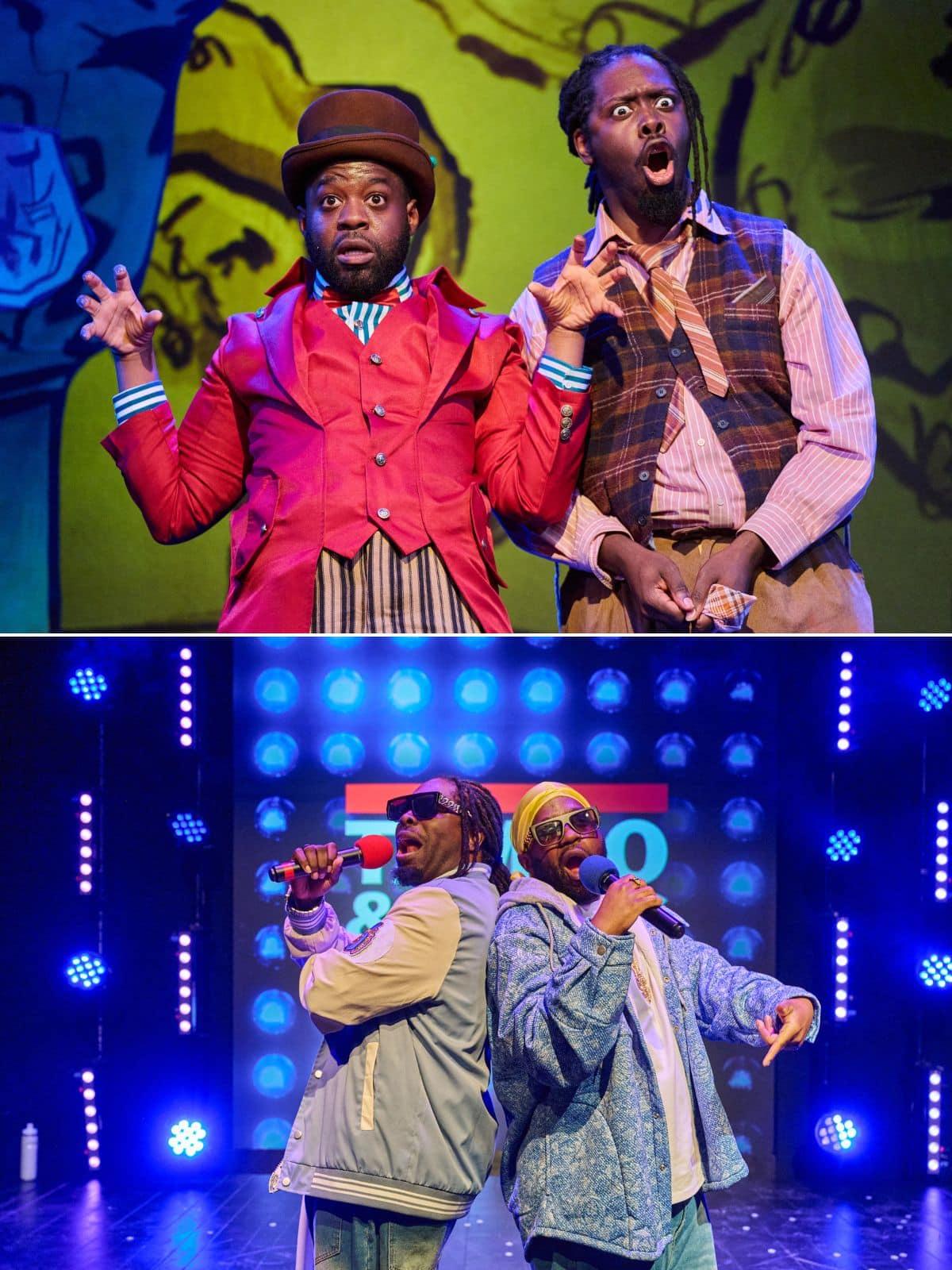
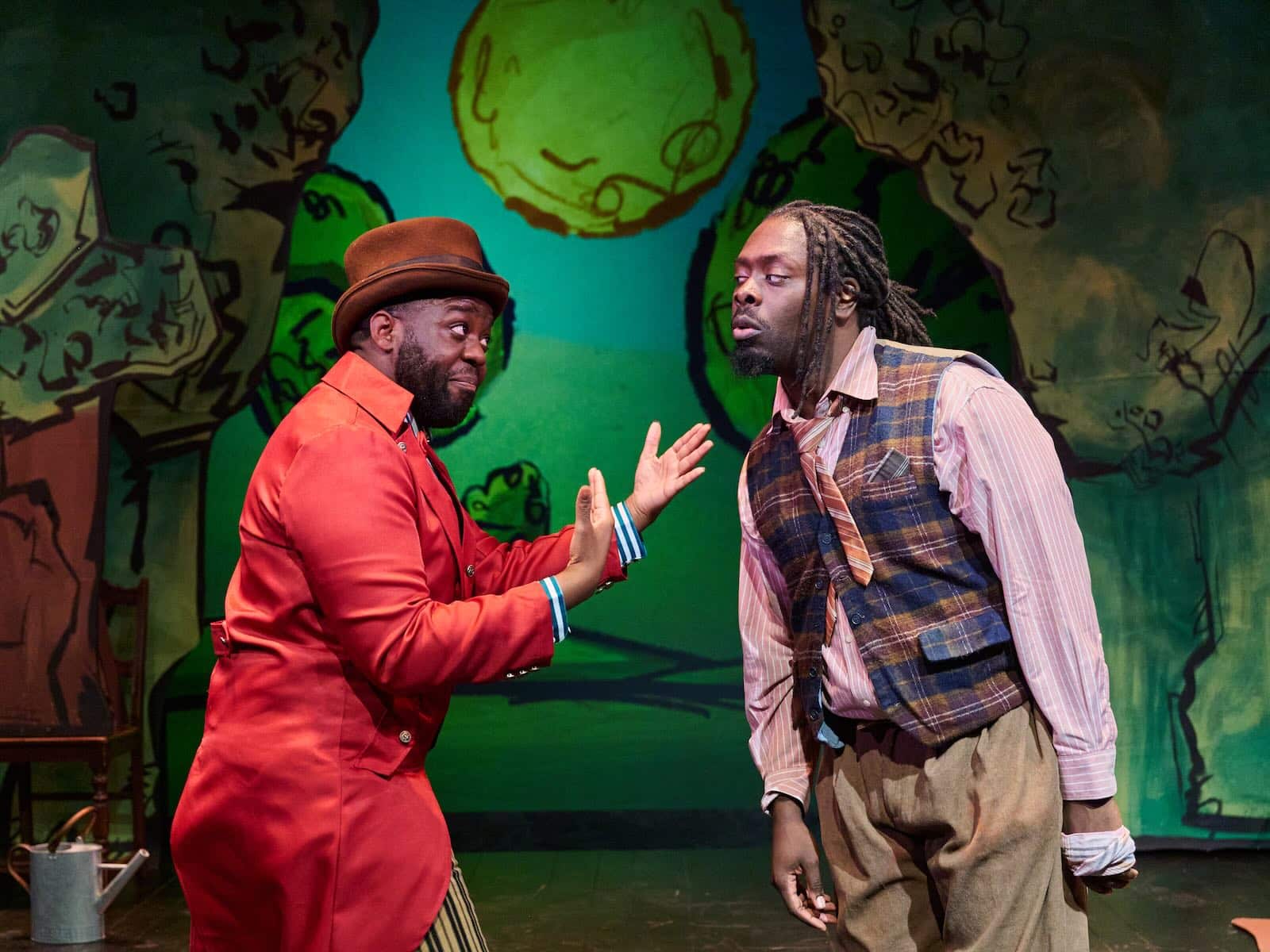
The play unfolds in three totally distinct acts (with an intermission between the second and third). In the first, Tambo and Bones appear as “clowns” in an exaggerated pastoral landscape that nods to Samuel Beckett’s Waiting for Godot. They wear brightly colored, loose-fitting suits (costumes by Rukiya Henry-Field) that nod to the early 20th century. The pair volleys ping-ponging, associative dialogue before slowly, horrifically, realizing they’ve been written into a minstrel show by an unseen playwright. But they don’t want to perform, especially not for an audience of white people with deep pockets. Tambo — woken from slumber and forced into introspection — longs to rest, and Bones is just trying to make a quick buck. They have no time for this writer’s nonsense.
In act two, we jump to the early 2000s, where Tambo and Bones are rap stars, still on a quest to educate the public (Tambo) and make money (Bones). And in act three, we are transported to a post-apocalyptic future that you just have to see for yourself.
Ashleigh King’s direction taps into the heart of the play with deftness and care, handling the script’s playfully digressive dialogue with ease and crafting a whole that is a testament to the stellar individual elements that comprise it.
At its core, Tambo & Bones is about the way capitalism infects the psyche. In a system built on racial hierarchy, survival becomes a primary instinct. Everyone adapts, and in adapting, becomes complicit.
“I be getting money, money make the rules. I took the master’s house cuz I took the master’s tools,” boasts one lyric.
Tambo’s evolution tracks the cost of awakening. Early on, he sleeps, blissfully ignorant. Once Bones forces him to confront the history and present reality of Black suffering in America, however, Tambo asks, “Am I ever going to be able to sleep again?” As played by Brewington, Tambo evolves from a caricature, the lazy, contented stereotype imposed on Blacks in minstrel shows, into a scholar, an educator, and then a disgruntled revolutionary. When education fails to produce change, rage simmers. His trajectory ominously echoes the question posed by Langston Hughes in his poem “Harlem”:
“What happens to a dream deferred? / Does it dry up … / Or does it explode?“
Bones, meanwhile, understands the game. Cynical beneath his charming exterior (and in playing Bones, Hunter exudes charm), he sees that wealth flows from white power, and he is determined to siphon what he can. If that means performing for the oppressor, he will perform, in the minstrel show, in the rap era. “That’s the way it’s always been, so Imma work it til I beat it at its own game,” he shrugs.
Fight choreographer Robert Bowen Smith did double duty on this project, appearing as the character X-Bot 2 (joining Clint Blakely as X-Bot 1) in the play’s final scene. But it was his fight choreography that stood out to me: The play’s numerous moments of physicality included one actor smashing a metal podium onto another’s head, and two actors ripping a dummy apart. Moments like this came across as natural, effortless, and (eek!) full of heightened emotion that could have gotten someone hurt if not choreographed correctly.
Scenic designer Sarah Beth Hall did as much as she could with minimal resources, embracing theatrical artificiality. Or perhaps the “minimal” nature of the set — canvas strips painted with cartoonish greenery frame the stage — is intentional, echoing Harris’ own sardonic stage directions: “fake ass pasture,” “fake ass sky.” The aesthetic underscores Bones’ lament: “Everything around me feels so … fake.” “Once we have what they have, then will we be real?”
Sound designer and composer navi’s work binds the eras together. The inclusion of “In My Merry Oldsmobile” in the production’s pre-show tracks — a vaudeville staple later co-opted as a General Motors jingle — slyly reinforces the play’s thesis about the degenerative impact of capitalism on society. Later, navi’s influence is heard in original underscores backing the show’s several rap numbers. Navi — who often composes eclectic, electronic tunes for the shows he designs — worked closely with Brewington and Hunter to flesh out the show’s seriously engaging rap numbers.
Tambo & Bones doesn’t let anyone off the hook, not the characters on the stage or those of us in the audience. It suggests with in-your-face urgency that oppression and exploitation are not distant historical artifacts, but living systems that spread like a virus, infecting everyone who encounters them. It’s also one of the most impactful theatrical experiences I’ve had in a long time. See it while you can.
Running Time: Two hours with one intermission.
Tambo & Bones plays through March 7, 2026, presented by Spooky Action Theater performing at Universalist National Memorial Church, 1810 16th St NW, Washington, DC. Performances are Thursday, Friday, and Saturday at 7:30pm, Sunday at 2 pm, plus one Wednesday performance on March 4 at 7:30pm. All tickets are General Admission and range from Pay-What-You-Can to $43. Purchase tickets online. The UNMC is an older venue and is currently not accessible to wheelchairs.
The program for Tambo & Bones is online here.
Tambo & Bones
By Dave Harris
CAST
Deimoni Brewington: Tambo
Jeremy Keith Hunter: Bones
Clint Blakely: X-Bot 1
Robert Bowen Smith: X-Bot 2
Everett Judd: Tambo understudy
Jaden Michael Madgett: Bones understudy (performing 2/22 & 3/1)
PRODUCTION
Ashleigh King: Director
Sarah Beth Hall: Scenic Design
Emmanuel Garcia-Castro: Lighting Design
Rukiya Henry-Fields: Costume Design
navi: Sound Design & Composition
Luis Garcia: Projections Designer/Co-Lighting Design
Robert Bowen Smith: Fight Choreographer
Maria Mills: Production Stage Manager
Jaden Michael Madgett: Assistant Stage Manager
Everett Judd: Assistant Director
Matty Griffiths: Technical Director
Gillian Drake: Associate artistic Director
Anderson Molina: Production Manager
SEE ALSO:
‘Tambo & Bones’ time-traveling hip-hop fantasia next at Spooky Action Theater (news story, January 15, 2026)