Presented at Lincoln Center Theater’s Claire Tow Theater through its LCT3 initiative, dedicated to producing the work of new artists and building new audiences, Night Side Songs – originally commissioned by American Repertory Theater, co-produced by A.R.T. at Harvard University and Philadelphia Theater Company, and performed in its NYC debut in the Under the Radar Festival with Lincoln Center for the Performing Arts – is an intimate, immersive, participatory new work by The Lazours (words and music), developed with Director Taibi Magar, that espouses healing through connection, shares copies of The Night Side Songbook of select lyrics with the seated audience before the show begins, and invites everyone to sing along with the cast, providing a background chorus and engendering a collective feeling of harmony.
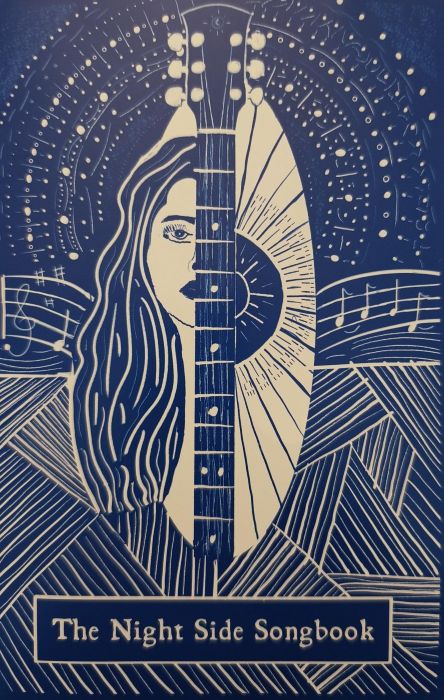
The title is derived from a quote by multi-award-winning American writer Susan Sontag, who died of acute myeloid leukemia in 2004, at the age of 71: “Illness is the night side of life.” Not your typical musical, the inventive ten-part show combines direct-address narration and commentary, enactments of key episodes, and twelve original interspersed songs (in addition to the bittersweet 1984 Cyndi Lauper hit “Time After Time,” written by Lauper and Rob Hyman), with a cast of five (Brooke Ishibashi, Mary Testa, Robin de Jesús, Kris Saint-Louis, and Jonathan Raviv) assuming a variety of roles – family, friends, doctors, and random subsidiary people encountered along the way or dealing with similar issues – in the story of the life, illness, and death of Yasmine (portrayed with a full range of emotions by Ishibashi), a young woman who notices a lump in her skin while talking on the phone with her mother Desirée (a laughably testy character played with gusto by Testa).
Staged on a bare flat floor with rows of seating on three sides, chairs and musical instruments lined up in front of the theater’s far wall, and side aisles through which the company members enter and exit (minimalist set design by Matt Saunders), the performance area is overhung with a large circular sculpture of blue glass bottles inserted horizontally into a metal framework, which, though resembling a chandelier, is not a lighting fixture per se, but its enlightening significance is revealed at the show’s conclusion by the dying Yasmine, who sees in it the uplifting interconnections of life, from atomic particles to the greater cosmos.
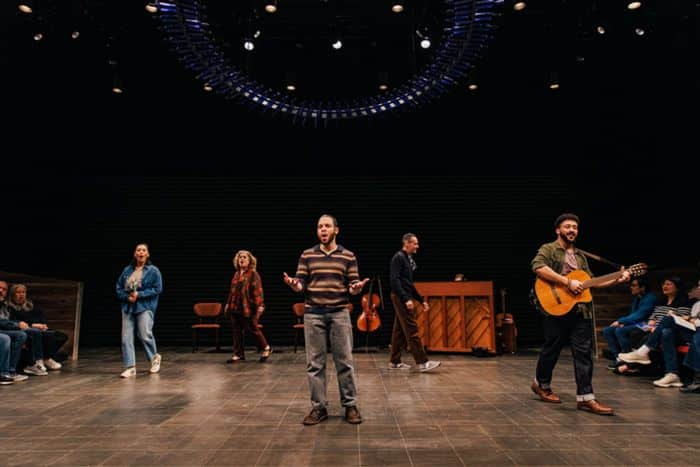
Under Magar’s agile direction, the cast, dressed in casual everyday clothing (costumes by Jason A. Goodwin), actively moves around the space, using simple, readily identifiable props (cell phones, a bottle of wine, the portable chairs they move, use, and replace), costume accessories (doctors’ gowns, flower leis, a scarf and jacket ) and shifts in lighting, from brightness to spotlights in the darkness (by Amith Chandrashaker), all simply employed to indicate changes in locales, characters, and mood, without distracting from the actors, their songs, and the fundamental human element of the story. The focus is on appealing to the audience with experiences and reactions, thoughts and feelings, that everyone can relate to in our shared life journey, the surprises and shocks of its irrevocable defining moments, and how we get through them.
Yasmine’s narrative includes the initial diagnosis, treatment, remission, and recurrence of her cancer, the high cost of medical bills that are only partly covered by insurance and she can’t afford, a growing friendship with her doctor, who was her 8th-grade crush (played with a sense of professionalism and concern by de Jesús, who also affably conducts the audience in singing and repeating the lines of the songs, which often emulate religious chanting), her romance and marriage to Frank (Raviv, who goes through the rollercoaster of her cancer and caregiving, and the feelings of love, distress, anger, and unconditional support that result), her conversations and questions, memories and joys, pain and struggles, and ultimate necessity of letting go and recognizing the beauty of life, with touches of humor to lighten the increasingly heavy load placed on her and everyone who knows and loves her.
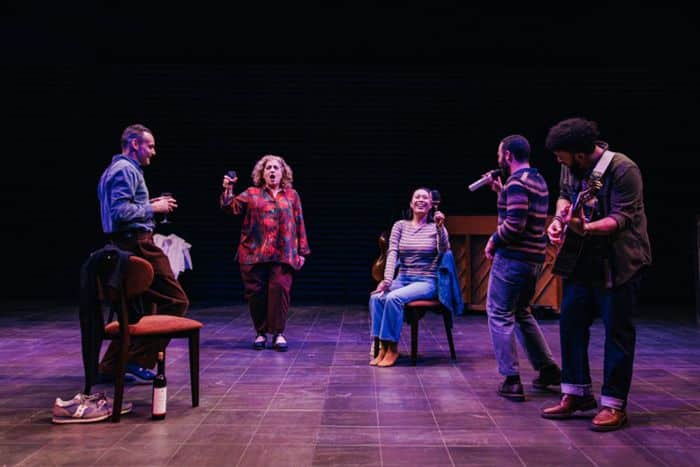
Rounding out the empathetic company is the tuneful Saint-Louis, who contributes an expressive song and accompanies himself on guitar, and Music Director Alex Bechtel (who, with Daniel Lazour, also provided the orchestrations), always in view, masterfully playing his piano arrangements and guitar, and beautifully enhancing the melodic core of the show (with sound by Justin Stasiw).
While the inescapably weighty themes addressed in Night Side Songs are common to all of us, there’s a trigger warning that “viewer discretion is advised as the subject matter explores emotional and sensitive topics” and the “performance contains descriptions of medical procedures, cancer treatments, caregiving; dramatizations of loss and mortality; strong language,” and some might find it overwhelmingly heartrending and tear-inducing. But the intent is to offer a fully cathartic and unifying look at the power of music, theater, and community to help heal what we can’t change, with the realization that we’re all in it together.
Running Time: Approximately 95 minutes, without intermission.
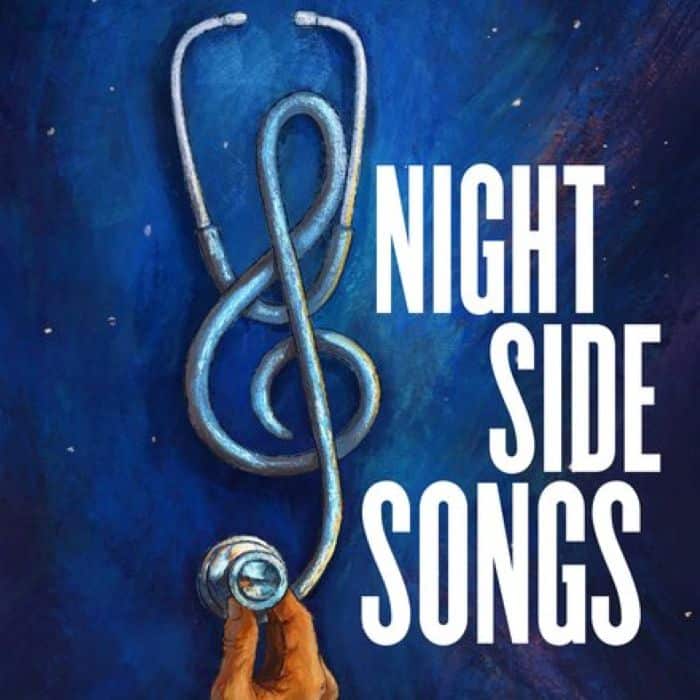
Night Side Songs plays through Sunday, March 29, 2026, at Lincoln Center Theater, Claire Tow Theater, 150 West 65th Street, NYC. For tickets (priced at $38.50, including fees), go online.