It is daunting to dare to review the British Players’ The Real Inspector Hound, because one of Tom Stoppard’s targets in this early work is pompous, pretentious, and hypocritical critics. Stoppard, a prolific and renowned playwright best known outside the theater for penning the screenplay for Shakespeare in Love, was once a critic himself, so he knew his subject from the inside. Whether that makes for affectionate satire or not is for viewers to decide.
In this play, and in its companion piece, The Fifteen Minute Hamlet, Stoppard indulges many of his favorite themes — intellectual and philosophical ponderings interrupted by sexual yearnings, parody, plays-within-plays, absurdism, convolutions of plot and wordplay that change meanings, and Shakespeare.
The show opens on two theater critics, Birdboot (Tom Howley), a theatrical old hand with a caddish penchant for “fostering young actresses’ careers,” and Moon (Erica Smith), a second-string who only reviews when his superior is unavailable, facing the inevitable chorus of “well, where is he, then?” They are sitting in a box preparing to review a typical country-house whodunnit, to which they are barely paying attention. Birdboot is slavering over the actresses while hypocritically feigning outrage whenever Moon mentions his activities with women other than his wife, while Moon is musing on his overwhelming jealousy of the critic in whose shadow he lives, to the point of contemplating murder.
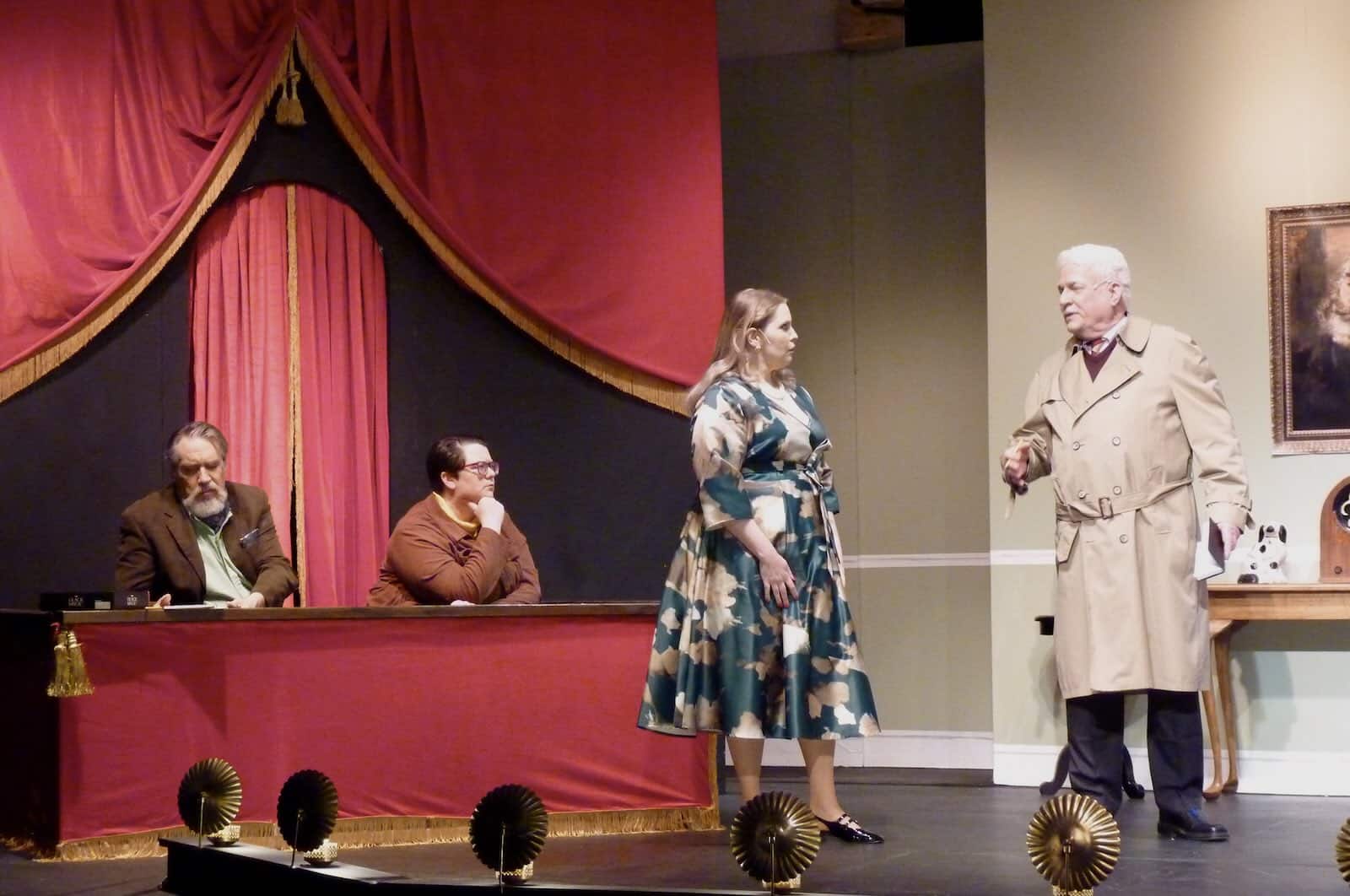
Their speeches punctuate the action on stage, which is a deft parody of melodramatic murder mysteries in the style of Agatha Christie. The housekeeper narrates the setting every time she answers the phone, “Hello, the drawing room of Lady Muldoon’s country residence, one morning in early spring…,” and every time a character turns on the radio, there is another police report about a murderous madman loose on the moors near Muldoon Manor. The cast is suitably over-the-top, hamming up a heated love quadrangle with just about every character hissing at some point, “I’ll kill you, Simon Gascoyne!!” to the duplicitous leading man. And to cap the silliness, there is a dead body under the settee that no one notices.
Meanwhile, the action is punctuated by the critics, pre-writing their reviews, with Birdboot waxing lyrical about his sudden new love-of-his-life, the actress playing Cynthia Muldoon, while Moon, making the most of his rare chance, is cramming every philosophical cliché he can into his critique: “There are moments … when I think the play, if we can call it that, and I think on balance we can, aligns itself uncompromisingly on the side of life. Je suis, it seems to be saying, ergo sum.”
So far, so satisfyingly satirical. But then the play takes a strange leap into the absurd. During a pause in the action, the onstage phone rings, but no one answers it, until Moon finally climbs out of the box to discover it is Birdboot’s wife on the line. Birdboot takes the call (“I told you never to call me at work!”), and in a very funny exchange in which we can hear Myrtle’s whiny, wheedling voice but can not make out what she is saying, he has to reassure her, in front of a full theater, that he is her own “fluffy bunny-boo” before he can hang up.
And then, before he can get back to his seat, the play begins again, with him in the role of the womanizing Simon Gascoyne. Moon keeps telling him to come to his senses and sit down, but he is so enthralled with Cynthia that he cannot. All the actors repeat their lines and actions as before, with Birdboot’s baffled responses somehow fitting into the structure of the script. But this is a murder mystery, so we know there’s trouble ahead….
As with any whodunnit, it would be a crime to spoil the surprises. But this one has the added mystery of how the critics fit into it all, and the answer is strange indeed.
The pacing of such a work, with its pauses, monologues, and interruptions, is tricky. Director Seth Ghitelman and his cast do their best, but at times, the pauses on stage while the critics pontificate stretch from intentionally absurd to unfortunately awkward. Mrs. Drudge, the housekeeper (Andrea Spitz), bears the brunt of this; it is difficult to dust and sweep one room for 15 minutes and keep it interesting. Perhaps there could be more humorous business. But most of the time, the space is filled by the actors’ hammy overacting. When Spitz gets to deliver lines in her best cockney, or mimic the other characters, or even just hide behind her feather duster pretending not to overhear, she is excellent. As Felicity, the spurned mistress, Chloe McGinness is suitably jealous and spiteful in a striking red dress (costumes by Patricia Kratzer). Paul Brewster as Inspector Hound has little to do beyond being confused, but he does that well. Louis Pangaro, as the obviously disguised Magnus in his wheelchair, is suitably suspicious. Richard Jacobson’s Simon is appropriately slimy as the mysterious man and consummate cad. And Lena Winter Chang as Cynthia gives a masterclass in melodrama.
But the show really depends on the two critics, Erica Smith as Moon and Tom Howley as Birdboot, and it is in very good hands. Smith’s Moon manages to rattle off his pompous critiques with aplomb and makes his murderous musings sound more bemused than evil. And Tom Howley is terrific, ricocheting between cartoonish infatuation, fake high dudgeon, and humorous bewilderment when caught in the snares of the plot.
The production team makes excellent use of the Kensington Town Hall space, building a convincing country house drawing room (perhaps needing a few more chairs) with French doors onto a lovely backdrop, and menacing fog at suitable times. There was also a spiffy set of old-fashioned footlights lining the stage. During intermission, the crew hid all this behind pipes and drapes, set out plain black blocks as furniture and set pieces, and prepped the stage for the second show of the evening, The Fifteen Minute Hamlet.
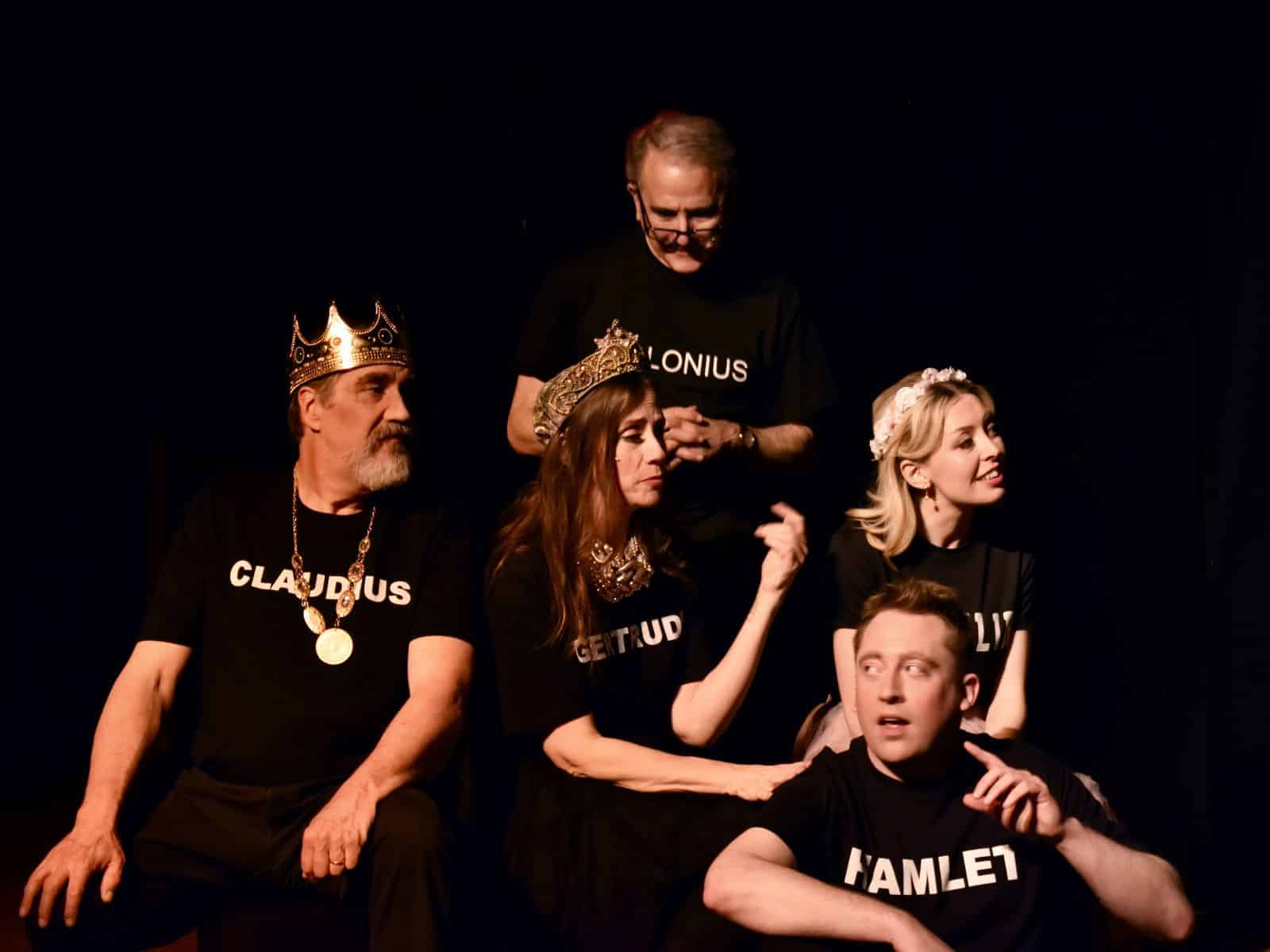
This part is hugely different from the first, although absurd in its own way. The actors all come on in black, wearing T-shirts with the names of characters in Hamlet. They are then joined by Howley as Shakespeare (a role he has played before), commanding the stage and demanding applause as he expertly delivers the show’s prologue. But here the lines are not Stoppard’s; they are Shakespeare’s. And thus begins an extremely abridged version of the Bard’s longest play, a “greatest hits” compilation of a work that is quoted so often that most of its lines have become clichés. The humor comes from the absurdity of the actors trying to get through the mammoth work in 15 minutes, with a looming red digital clock counting down the seconds. Hamlet (Jacobson) starts off those immortal lines “To be or…” only to be interrupted by Ophelia (McGinness), to his obvious annoyance. But there is joy to be found, too, in the glory of Shakespeare’s language, which reminds us, even (or perhaps especially??) in this massively truncated form, why he is so justly revered. And there is also a nifty sword fight.
And do they get through it in 15 minutes — yes. Less, in fact.
So they come back on and do it again, faster.
The Real Inspector Hound and The Fifteen Minute Hamlet are silly plays for thinking people, which dance around the more serious subjects Stoppard treats (always with humor) in his later works. They provide a taster’s menu of absurdism, mystery, and Shakespeare — a light snack for the brain. If other thoughts are sitting too heavily on you right now, this is a refreshing change of pace.
Running Time: One hour and 30 minutes, including one intermission.
The Real Inspector Hound and The Fifteen Minute Hamlet plays through March 14, 2026 (Friday at 8:00 pm, Saturday at 2:00 pm, and 8:00 pm, Sunday at 2:00 pm), presented by The British Players performing at Kensington Town Hall, 3710 Mitchell St, Kensington, MD. Adult tickets are $28, children (under 12), $15, with group discounts available. Purchase tickets online.