Before a single note was heard, the audience at Lisner Auditorium rose to their feet in a spontaneous standing ovation as Artistic Director Francesca Zambello and General Director Timothy O’Leary took to the stage to welcome returning audience members to Washington National Opera’s 70th season and the celebration of what can only be described as a hero’s victory wrested after a protracted battle. Scott Joplin’s opera Treemonisha, with its themes of community coming together, fighting for good, and a people’s survival, resonates with current times and amplified recent events in WNO’s history and its exiting and severing ties with the Kennedy Center. So much had to be weathered for this night to even be a reality. More than anything, the mounting of this historically significant American opera symbolizes the freedom necessary for creative expression and the resilience of the art form and the artists who must come together to tell stories through music.
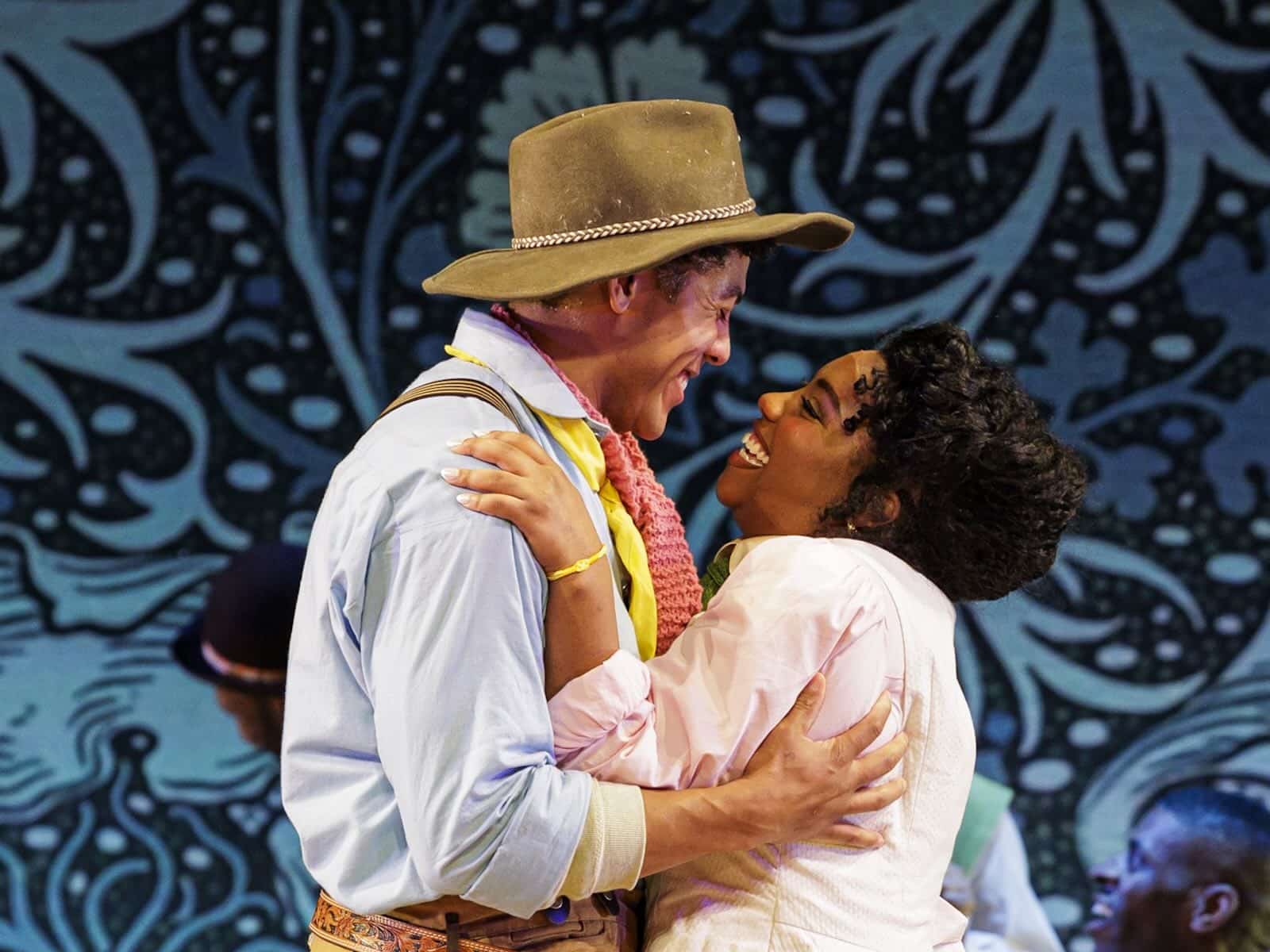
Treemonisha is, in part, a story about a rural African American community during Reconstruction and, in part, a folktale. A childless couple finds a baby under a sheltering tree and decides to bring her up as their own. The adoptive parents send the child, Treemonisha, to be educated. When Treemonisha grows up, girded with both knowledge and a fearless sense of leadership, she stands up against a pack of mischief-makers, “conjurers,” who use superstition and tricks to lead many in the community astray. Their leader, Zodzetrick, abducts Treemonisha and hides her with his band of no-gooders in the forest. Remus, a loyal and clever friend, leads the neighbors on a rescue mission and succeeds in bringing her home. While many in the community seek vengeance and to mete out severe punishment on the miscreants, Treemonisha urges forgiveness, compassion, and education as moral guidance and rehabilitation. Community members recognize her wisdom and choose her to be their leader.
Joplin is beloved as the king of popular ragtime tunes, but his opera, for which the composer wrote his own libretto, is little known and seldom produced without rewrites. This production is no exception. Kyle Bass was brought into the collaboration to “bring greater narrative definition to Scott Joplin’s original libretto” and to give the female protagonist “more agency” by adding new scenes and spoken dialogue.
Nonetheless, the story and the music still lack a certain dramatic forward movement.
Composer Damien Sneed has adapted the score and provided new orchestration, and I especially liked having Sneed at the piano and banjo player DeAnte Haggerty-Willis on stage as part of the significant overture with integrated choreography to set the communal opening. However, compositionally, many songs were structured similarly: for instance, a soloist carried a line, then it was echoed back or resolved musically by the ensemble, without building or letting the voices rise melodically or with variation. The orchestra was conducted by the young, gifted Kendrick Armstrong in his WNO debut.
The gorgeous Denyce Graves has made an elegant and successful career transition from major soprano diva to stage director and has created a sense of close community of people who express themselves by moving seamlessly between working, singing, dancing, and praying. She has also managed to inject a lot of humor into the staging of individual characters’ responses to situations and events. The children were given little cameo moments of resisting, fighting, and clowning, and they performed with aplomb. The “baddies” were not converted to model citizens unanimously or instantaneously. Tenor Jonathan Pierce Rhodes, as the chief villain and plot instigator, physicalized and colored both obsequiousness and menace vocally and certainly seemed to signal in a modern interpretive twist that he was not on board to be rehabilitated and would never be fully repentant. Certainly, the church scenes, led by the aptly-named Parson Alltalk (Nicolas LaGesse), inserted plenty of wry, humorous touches in the proceedings.
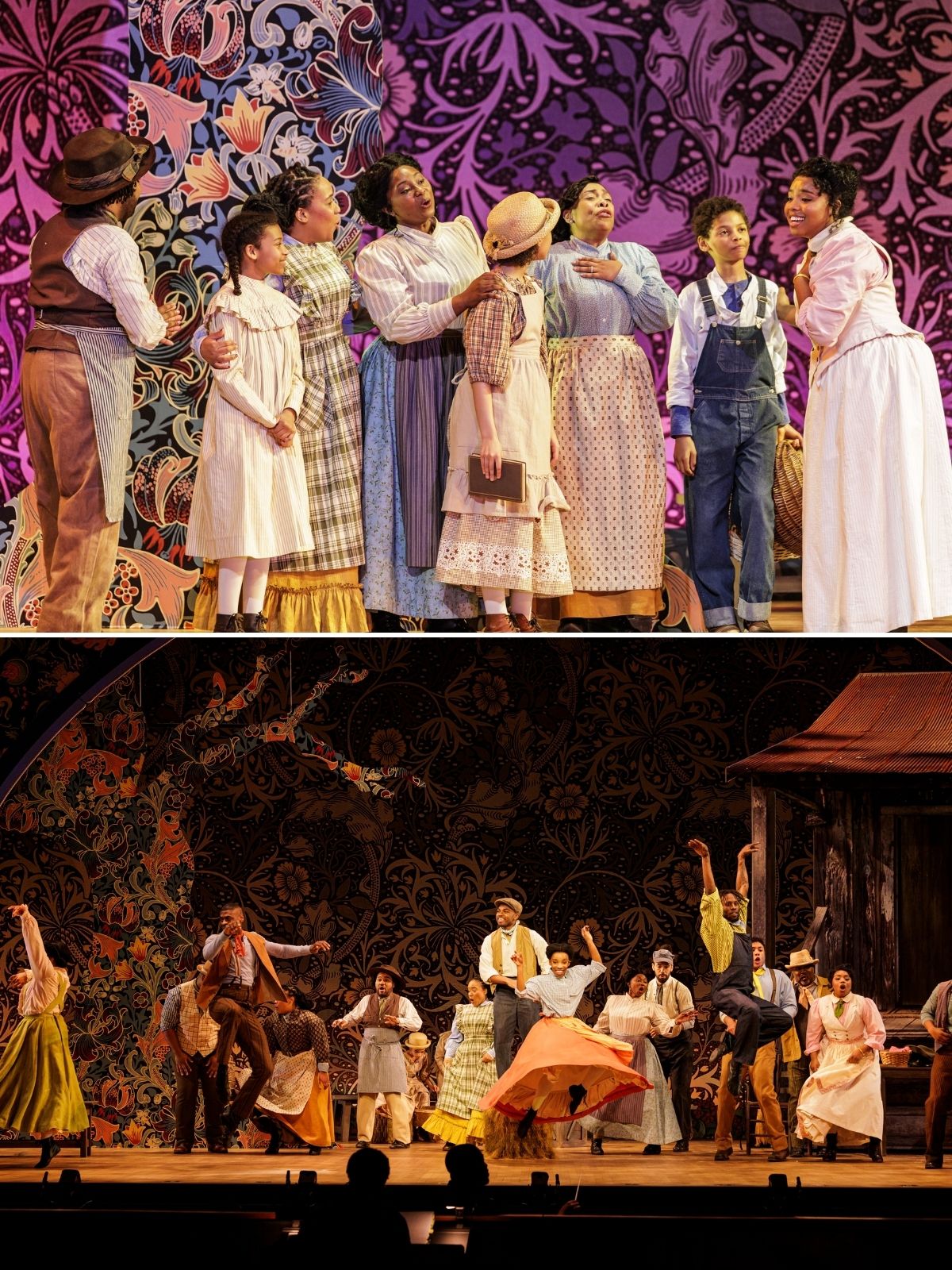
I was especially taken with the often humorous yet fully rounded characterizations of Mother Monisha (Tichina Vaughan) and Father Cephus (Ernest C. Jackson Jr.). They conveyed a complex couple’s relationship, she at times exasperated, and he patiently mollifying her while finding minor ways to rebel and stay independent. But they were united in their love and parental protectiveness of their daughter.
Vivian Goodwin filled the title role. She and Justin Austin played the two friends, Treemonisha and Remus, who, through their trials and common fight to make their community more enlightened and just, became more than friends.
This production was conceived and staged as an ensemble piece, both vocally and physically. The stage was almost always filled. Special recognition to the ensemble members, including Angeli Jemilda Ferette, Hakeem Henderson, and Jim Williams, wonderful local singers, who filled the storied community with grace and emotional sensibilities.
The choreography by Eboni Adam was terrific, as were the WNO dancers, as they integrated the entire ensemble into the movement. The last number with the full company celebrating through dancing “The Slow Drag” made Joplin rag fans like me want to holler and join in.
A last note about the decision to simplify design elements. I thought it was a good, if necessary, one. This was not meant to be “grand opera.” The entire story played against two staggered backdrops. Set designer Lawrence E. Moten created a colorful floral pattern downstage that gave a nod to William Morris and the period of his fabric design. Upstage, a second backdrop featured a monochromatic deep indigo-and-off-white pattern reminiscent of classic batik from Asia or perhaps Africa. The only other scenic elements were the magic tree, which symbolized nature and our necessary stewardship, and a small one-room cabin façade, reminding us of the precarious lives eked out by Blacks in the rural South during the years of failed Reconstruction and the years Joplin witnessed. Lynley A. Saunders followed suit in the simplicity yet functionality of the costume design. Nothing overpowered the singers and the storytelling.
The truth is, we were there to rally and support our city’s opera company, and we were ready to make accommodations, including for the slightly chaotic box office and cramped rows of seating, while these two organizations learned to “play nicely in the sandbox.”
Treemonisha will be followed by a production of the new American opera The Crucible from March 21 to 29. WNO is worth supporting.
Running Time: Two hours and 15 minutes with a 20-minute intermission.
Tremonisha plays one more performance March 15, 2026, presented by Washington National Opera at the George Washington University Lisner Auditorium, 730 21st St NW, Washington, DC. Purchase tickets ($87.70–$200) online.
Download the program here.
Tremonisha
Composed and written by Scott Joplin, Adapted by Composer Damien Sneed with new scene dialog by Kyle Bass, Directed by Denyce Graves, Conducted by Kedrick Armstrong, Set Design by Lawrence E. Moten III, Costume Design by Lynly A. Saunders, Lighting Design by Jason Lync, Choreography by Eboni Adams
CAST: Viviana Goodwin, Justin Austin, Tichina Vaughan, Jonathan Pierce Rhodes, Kevin Short, Nina Evelyn, Angeli Ferrette, Brittani McNeill, Alexandria Crichlow, Hakeem Henderson, Ernest Jackson, Nicholas LaGesse, Thandolwethu Mamba, Jim Williams