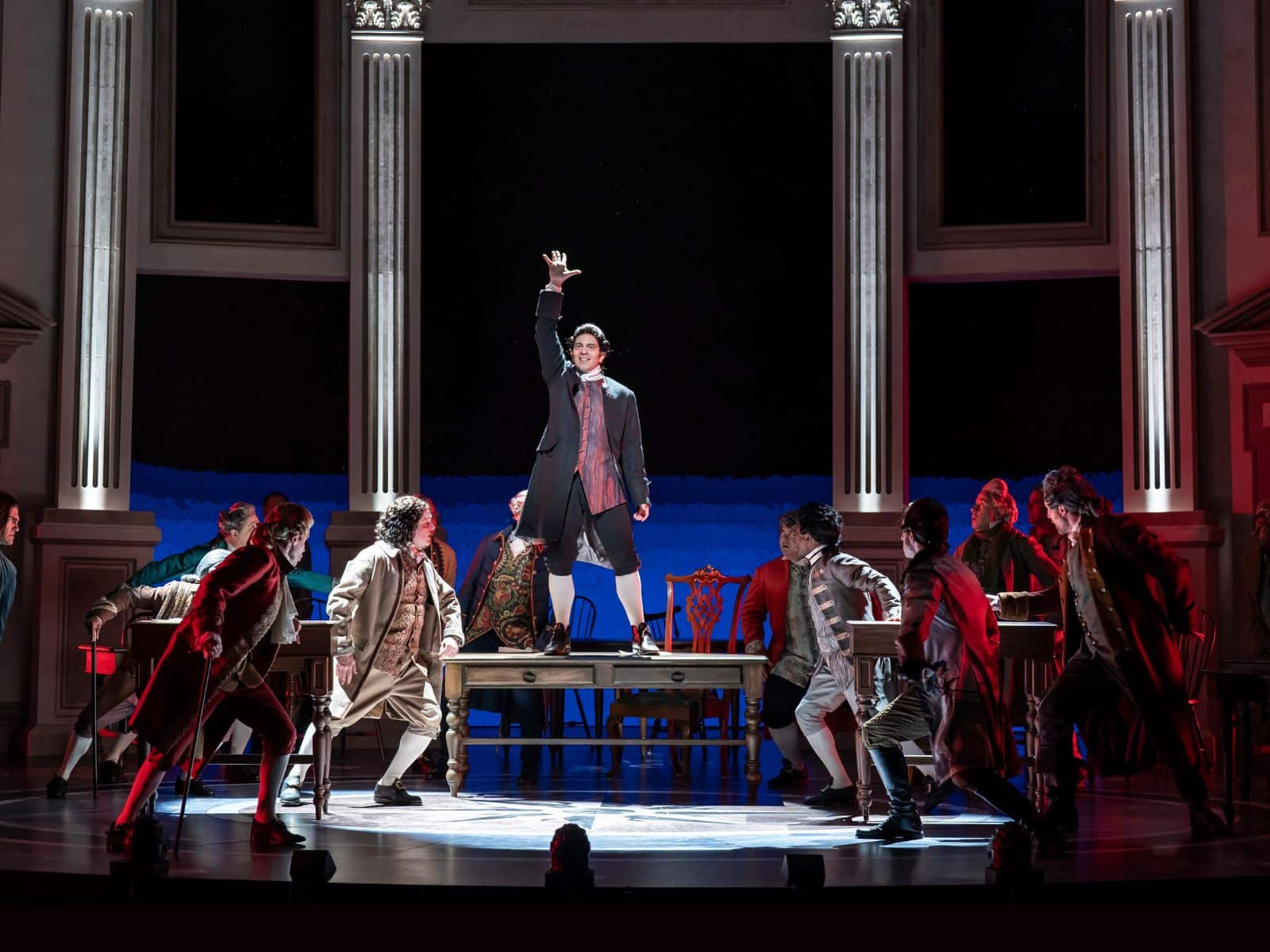
One of the most dramatic episodes in Ford’s Theatre’s rousing revival of the Tony Award–winning musical 1776 is also the most unsettling: When South Carolina delegate Edward Rutledge (a terrific Joe Mallon) stands up to demand removal of an anti-slavery passage in Thomas Jefferson’s original draft of the Declaration of Independence. Excise the language, the enslaver Rutledge demands, and get passage of the document that will create a new country. Or, keep it in and remain subject to Great Britain. It’s a terrible, shocking choice that leaves the Declaration’s most ardent supporter (and the musical’s chief protagonist), John Adams, on the edge of surrender and despair. To his credit, 1776 composer and lyricist Sherman Edwards doesn’t shy away from this troubling episode in our nation’s founding, but rather, highlights it with one of the musical’s best, most engaging numbers — the rocking, calypso-inflected “Molasses to Rum.” Delivered with high energy by Mallon, the number implicates all of the delegates (and, by extension, us) in America’s original sin. Ford’s dynamic, visually and aurally sumptuous production faithfully delivers this complex story behind our nation’s founding document while adding new layers of meaning for our own, equally confounding, moment in time.
Rutledge’s bitter paean to the Atlantic slave trade and the Founders’ shared complicity in it may be one of the most striking episodes in the musical, but 1776 is really John Adams’ story. It is Adams (a sterling, completely engaging Jonathan Atkinson) whose determined, ceaseless “agitations” prod the reluctant Congress, ever so slowly, toward “independency.” We meet Adams as his frustration with Congress’ inaction is about to boil over. “What are they waiting for?” he demands of his chief co-conspirator, the sagacious bon vivant Ben Franklin (a wonderfully amiable Derrick D. Truby Jr.), before sarcastically concluding that “one useless man is called a disgrace, two useless men are called a law firm,” but “three or more useless men are … a Congress.” Not to be outdone, a weary Congress responds to Adams’ agitations in the comedic, up-tempo “For God’s Sake, John, Sit Down!,” the show’s opening number and another musical highlight.
Helping Adams navigate these legislative vicissitudes is wife, Abigail (an assertive, sympathetic Kanysha Williams), who steps out of their correspondence to challenge, affirm, and support her husband’s campaign for American independence. Williams shines in the late solo “Compliments,” as well as in the duets with Atkinson, “Till Then,” and the touching epistolary sign-off “Yours, Yours, Yours.” Noteworthy in this production (as in the 2022 Broadway revival) is the diversity of its cast. While the original 1969 Broadway production was all-white, Williams is among ten or more African American or Asian American actors in this production (including Justine Moral’s Martha Jefferson and Derrick D. Truby Jr.’s Benjamin Franklin). The choice to cast non-white actors as Founding Fathers and Mothers serves, as it does in Lin-Manuel Miranda’s Hamilton, to make the story of America’s founding more inclusive and more reflective of the nation as it is today and as it aspires to be. Noteworthy in this vein are African American actors John Floyd and Jay Frisby. As Congressional Secretary Charles Thomson, Floyd is called upon to present an initial reading of the Declaration, with its language about all men being “created equal”; then, to record the debate about the anti-slavery clause as it angrily whirls around him. As Pennsylvania delegate James Wilson, Frisby is called upon to cast the deciding vote for independence. Ironically, here it is an African American actor, Truby, who (along with Benjamin Franklin) insists that not striking the anti-slavery paragraph from the Declaration is “a luxury we can’t afford” because it would “jeopardize the cause.”
Other moments of greater or lesser substance stand out in what is a uniformly strong production. Michael Perr Jr.’s Richard Henry Lee is a true Virginia ham, jumping, kicking, and dancing his way through “The Lees of Old Virginia,” the production’s most energetic number, as he loudly exclaims the virtues of membership in the “FFV” — the “first family of Virginia.” In contrast is Hunter Ringsmith’s Continental Army Courier, more worn and exhausted each time he appears with a missive from the general, all gloom and doom. His “Momma, Look Sharp” (in which he is joined by Ricky DeVon Hall’s Leather Apron) is a moving, percussion-heavy dirge for fallen comrades and the mothers whose job it will be to bury them. Credit to director and choreographer Luis Salgado, music director Clay Ostwald, and their cast for making this tonal shift effortless and deeply felt. The musical’s final number echoes that wistfulness, as the beleaguered Adams, alone in the empty meeting hall, and thinking his efforts to pass the Declaration have all been for naught, asks “Is anybody there?/Does anybody care?/Does anybody see what I see?” In this production, he is briefly joined by Floyd’s Secretary Thomson, adding a special irony to the song’s final lines: “I hear the cannons roar/I see Americans — all Americans/Free forever more.” That reality would have to wait four score and seven years for the man whose name is forever associated with Ford’s Theatre, and even then, for many Americans, it would not be much more than a word.
It’s impossible to overlook the historic resonance that Ford’s adds to this story about America’s founding. That is not lost on Luis Salgado, who situates Edwards’ tale in Ford’s adjoining history museum, where backpack and camera-laden “tourists” roam the stage, examining costumes, artifacts, and furnishings associated with the men who made up the first Continental Congress. At rise, a notice board displayed at center stage reads “Ford’s Theatre America 250 Special Interactive Exhibit” in a nod to the nation’s upcoming semi-quincentennial. It’s not hard to see the shadow of Abraham Lincoln here, whose majestic Gettysburg Address was directly inspired by the Declaration of Independence, who used that document in support of emancipation, and who was, of course, assassinated in Ford’s Theatre less than a century later. No great stretch, then, to step from the world of Lincoln to that of Philadelphia’s Independence Hall in 1776, as this production does.
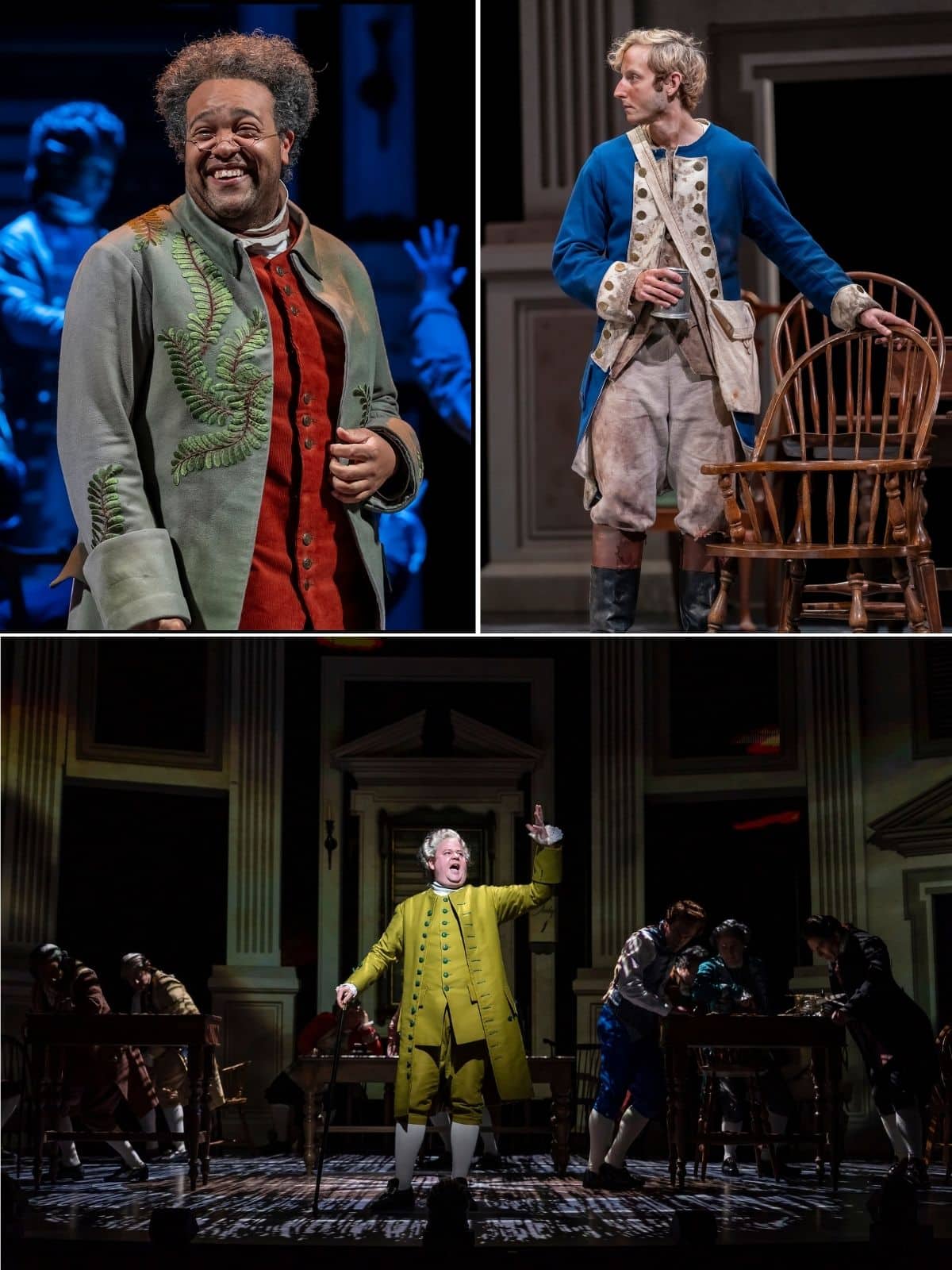
Final acknowledgements to Milagros Ponce de Leon for the production’s handsome set design, replicating the neoclassical architecture of Independence Hall; to Clint Allen for projections, including a reproduction of John Trumbull’s famous painting of the signing of the Declaration on the back wall; to Ivania Stack for the colorful variety of period costumes, echoing the 1972 film; and to Venus Gulbranson for lighting that sets tone and highlights figures and transitions. Clay Ostwald directs a tight band that includes keyboards, reed instruments, trumpet, violin, bass, and percussion, instruments that, in earlier form, the congressional delegates would have known well. They build in the finale’s portent-full, jazzy score as the delegates, having finally voted for independence, rise to sign their names to the document by which they pledge their lives, their fortunes, and their sacred honor. A bell — the Liberty Bell? — tolls behind them.
“What will posterity think we were, demigods?” Benjamin Franklin rhetorically asks John Adams earlier in the story. “We’re men, no more, no less.”
And that is how Ford’s has presented them.
Running Time: Three hours, including a 15-minute intermission.
1776 plays through May 16, 2026, at Ford’s Theatre, 511 10th St NW, Washington, DC. Tickets range from $41–$100 and are available, along with showtimes, online. Tickets are also available at TodayTix.
The program is online here.
1776
Music and Lyrics by Sherman Edwards
Book by Peter Stone
Music Direction by Clay Ostwald
Directed and Choreographed by Luis Salgado
SEE ALSO:
Ford’s Theatre announces cast and creative team for ‘1776’ (news story, January 29, 2026)