The first thing I noticed as I settled into my seat at Shakespeare Theatre Company’s Harman Hall for the opening night of Hamnet was the letter A.
Surrounded by wooden scaffolding, two ladders press together to form a steep triangle, reminiscent of a country church, with a platform bridging them. This crossbar stabilizes the A-frame structure and conceptually evokes the letter — without it, there is fragility; without it, the shape unravels. In Hamnet, we watch the similar structural integrity of a marriage collapse under ambition and grief. The Royal Shakespeare Company production, now making its U.S. premiere at Shakespeare Theatre Company, aims to show how art can reconstruct meaning from the ruins of misery. While successful at this, playwright Lolita Chakrabati’s adaptation of Maggie O’Farrell’s best-selling novel never resolves the emotional conflicts of the piece, giving the ending an abrupt and unearned sense of closure — in other words, the A comes apart and is never put back together.

Hamnet follows the marriage of William Shakespeare (Rory Alexander) and Agnes (Kemi-Bo Jacobs) through the birth of their three children, and the untimely death of their 11-year-old son, Hamnet. The couple is physically separated by William’s new life in London, as Agnes remains in the countryside to care for their daughter Judith’s (Hamnet’s twin) fragile health. The loss of their son is the final blow to their relationship, severing their emotional bond yet inspiring William’s greatest creation, Hamlet.
What marks this production as truly special is the actors’ ability to show different faces within a single role, or to slip convincingly into another, like a carousel of disguises. Jacobs plays Agnes with a consistently strong demeanor, though her emotional volatility is largely confined to the beginning of the play, her teenage years. She simmers in the presence of her cruel stepmother, Joan (Nicki Hobday), her rebellious spirit visible in the furrow of her brow, but erupts into a disturbing intensity when she speaks of her dead mother. After becoming a mother, that strength softens into a gentler disposition — silly rather than rebellious, protective rather than defensive. Her physicality shifts to slower, more contained movements; she no longer runs, as the children now do. Her intensity turns inward instead of outward.
Actor Ajani Cabey isn’t revealed as the titular character, Hamnet, until Act Two, and he immediately exceeds expectations. I giggled at how convincingly Cabey, a grown man, embodied an 11-year-old boy. He moved like his arms and legs were outgrowing his torso, and he had no choice but to drag them along the best he could. His hands grabbed at everything, never standing still or sitting straight, always rushing to and fro. At other times in the play, Cabey plays Thomas Day, a London actor, with a strikingly different performance: stoic, feet firmly planted, his posture so upright he seemed taller, as if he had literally grown.
This necessary evolution in performance, as the show spans years, is evident across the cast. As William Shakespeare, Rory Alexander’s initial acting choices are suave yet surreptitious, which suits a William who lives in fear of his father’s wrath and retreats into stories. As William begins to make his fame as a playwright, Alexander’s choices gain gravitas but retain their joviality — until the death of his son, when a generational anger creeps into the performance.
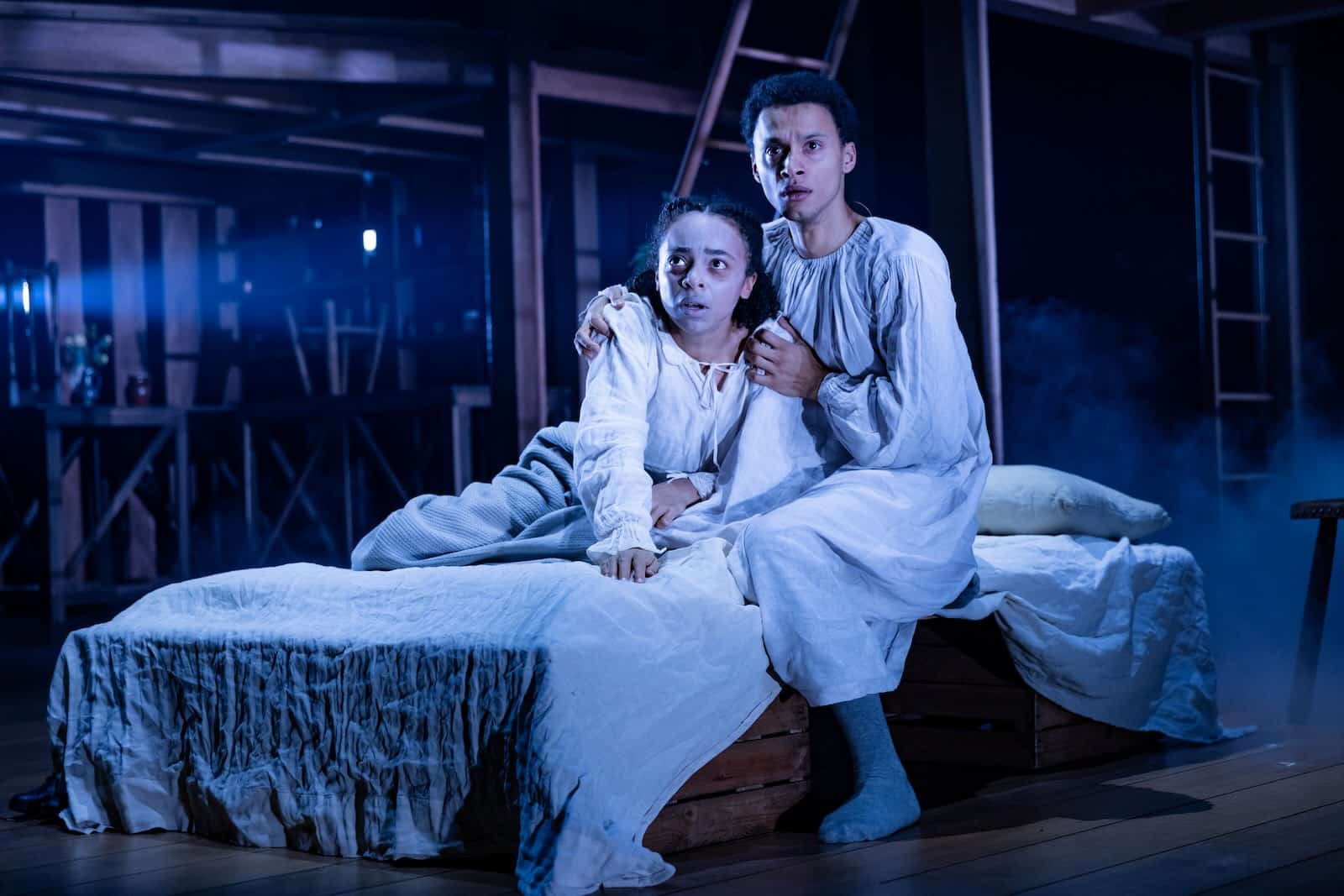
Like much historical fiction, Hamnet attempts to turn a loud, ugly truth into a beautiful whisper, a feat director Erica Whyman accomplishes in scenes that aestheticize moments in time. In one early moment in the play, a young, unmarried William and Agnes have sex on a kitchen table. Their animalistic passion, soon to be met with violence, is rendered in an artful freeze-frame: their bodies curve toward each other, then fall still as the music (Oğuz Kaplangı) crescendos.
Similarly, Agnes’s first pregnancy is staged through the wrapping of her belly in white linen by the very children she is destined to birth. She gathers handfuls of fabric against her stomach as the twins, Judith (Saffron Deyz) and Hamnet (Cabey), grip the ends and circle her like a Maypole.
Hamnet’s corpse is also wrapped in linen, and when Agnes finally sees him at the end of the play, on her estranged husband’s stage, the doors of William’s playhouse hang in strips, pale blue light filtering through them like a gloomy day through window blinds (set and costume design by Tom Piper). It reads like an allusion to Agnes’s ability to see through the veil, and a romanticization of her acceptance of her son’s death.
The tension in the final scenes between Jacobs and Cabey is a standout example of Whyman’s direction. I held my breath as Agnes approached her son, who, in this scene, occupies a kind of Russian nesting doll role: he is both a classical actor playing Hamlet while unconsciously channeling William’s dead son. He does not seem to see Agnes as she reaches out, and just before her fingers brush his skin, he moves out of reach — no contact made. I exhaled with force.
“She [Lolita Chakrabarti] asks us how we might find redemption through art,” writes Artistic Director Simon Godwin in the production’s playbill. As a critic and observer, I am less interested in this inquiry and more interested in whether redemption through art is even possible, and whether Hamlet truly redeems this fictionalized William Shakespeare.
Hamlet becomes William’s new legacy, replacing the legacy lost when his only son died. Chakrabati’s adaptation, however, left me questioning what was truly being grieved, given William’s little involvement in Hamnet’s life (or in the raising of any of his children). At the play’s conclusion, Agnes declares that while she has visions, it is William who is the real visionary. Yet the show leaves unresolved whether their marital harmony is restored, or whether William ever extends the same reverence to his daughters. I found the ending frustrating in its attempt to impose an emotional resolution when the family remained fractured. To pull back the curtain on William Shakespeare’s life is to reveal the ways in which the man of great imagination was still just a man, and while this adaptation dares to do so, it loses its courage in the end.
Running Time: Two hours and 30 minutes with a 15-minute intermission.
The Royal Shakespeare Company and Neal Street Productions’ Hamnet plays through April 12, 2026, at Shakespeare Theatre Company’s Harman Hall, 610 F Street NW, Washington, DC. Tickets (starting from $39–$42) are available at the box office, online, by calling (202) 547-1122, or at TodayTix. Shakespeare Theatre Company offers discounts for military servicepeople, first responders, senior citizens, young people, and neighbors, as well as rush tickets. Contact the Box Office or visit Shakespearetheatre.org/tickets-and-events/special-offers/ for more information. Audio-described and captioned performances are also available.
Hamnet
Adapted by Lolita Chakrabarti
Directed by Erica Whyman
The Asides program for Hamnet is here.
Set and Costume Design by Tom Piper; Lighting Design by Prema Mehta; Composed by Oğuz Kaplangı; Sound Design by Simon Baker; Movement Direction by Ayșe Tashkiran; Fight Direction by Kate Waters.
SEE ALSO:
Full casting announced for U.S. stage premiere of ‘Hamnet’ (news story, January 29, 2026)