By Kenny Neal
You just enjoyed a night at the theater. The playwright wrote an engaging script. The actors were great, and you’re pretty sure the director had something to do with that. The scenic designer and their team created a really cool set, and the costume designer and their team’s work was really impressive. The lighting designer made everything look pretty, and the show featured projections! That’s neat. And the sound designer … did their job? You didn’t really notice.
When you see a production photo from a play, notice the caption — sometimes, in addition to listing the actors, it will include credits for the scenic designer, costume designer, and lighting designer, because their work is what you can see in the photo.
But when you’re in the audience, you’re not just using your eyes; you’re also using your ears. When you listen to a radio play or a cast album, you hear actors, singers, musicians, and sometimes, additional sound design.
Think about sight and sound as two ways of experiencing a theatrical production — one for your eyes, the other for your ears. Neither is a complete representation of what you witnessed
OK, but what exactly does the sound designer do? Most theatergoers probably couldn’t tell you.
The broad answer is that the sound designer, uh, designs the sound. That much you could have guessed. But within that broad definition resides a wide variety of responsibilities.
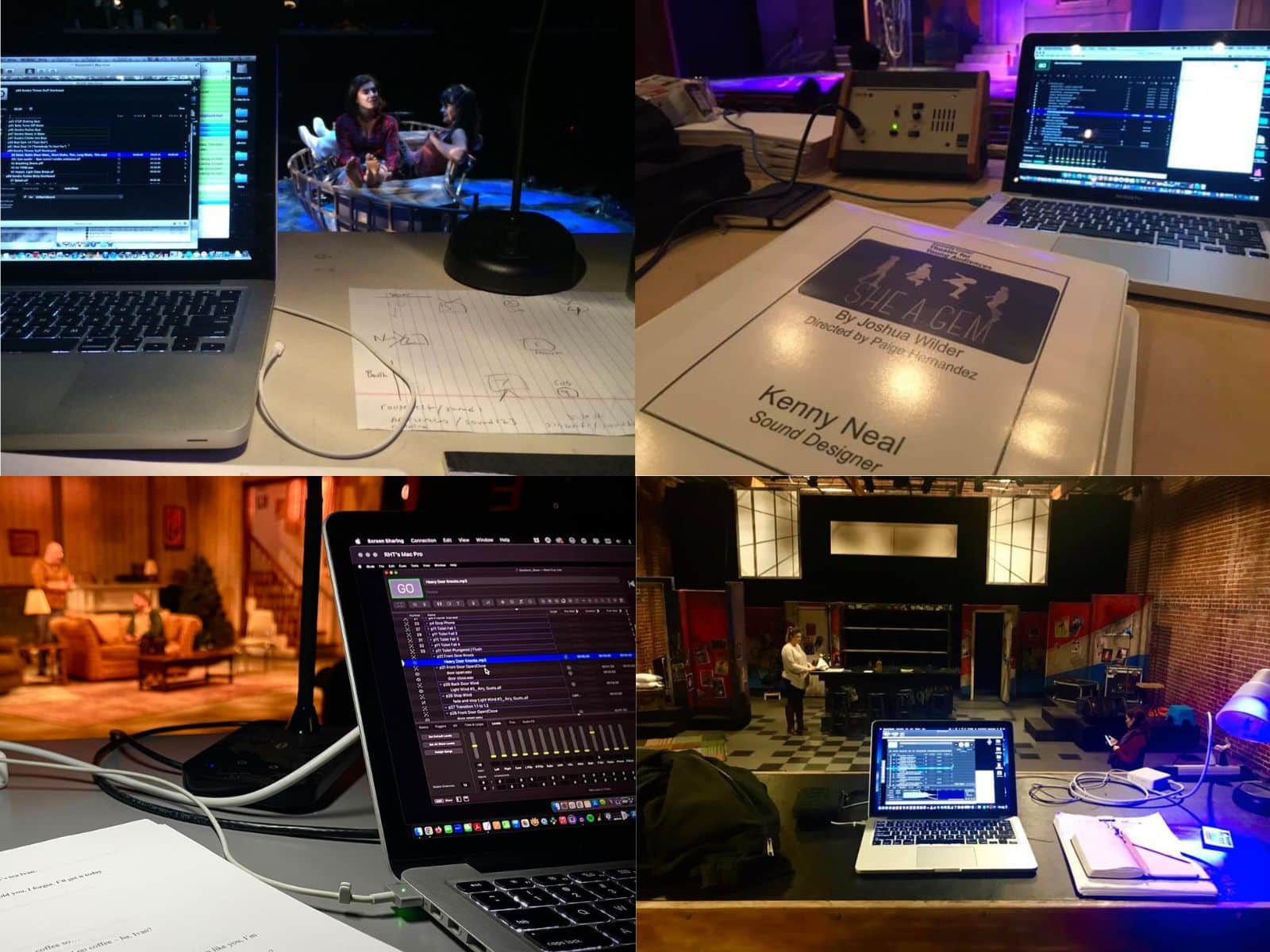
Sound in theater can include the diegetic sound effects that live in the same world as the characters. Door bells, telephone rings, thunder, music on a record player. Sound designers can source these cues from vast libraries of hyper-specific recordings or, in some cases, create them from scratch using their own recordings.
There are also non-diegetic sounds, sounds the audience can hear but the characters cannot, like transition music, pre-recorded voice-over narration, or a huge record scratch when something funny and unexpected happens in the story.
The sound designer programs these sounds, known as “cues,” into the theater’s sound system (which at its most basic includes microphones for voices, a computer to play pre-recorded sound cues, a mixing board to create the desired blend of everything, amplifiers to make the mixed sounds loud enough, and speakers that send the sound to your ears), and the stage manager is responsible for those cues being played at specific moments in a production, usually with the assistance of a dedicated person (the board operator) who plays the cue when told to do so.
And just as the lighting designer decides where each lighting instrument hangs in the theater’s grid, the sound designer (working with the theater’s audio supervisor) decides what audio equipment is needed and where each speaker is placed in the theater. Usually they are in expected places around the audience, and sometimes surprising places (for example, hidden inside a prop record player so it can play music, or even in a realistic doll to make it sound like a baby crying). Once smartphones were introduced, software was developed to allow sound designers to remotely play cues through their tiny speakers.
But the sound designer pays attention to so many more things in a production. Are an actor’s footsteps too loud backstage? Ask the scenic team to add carpeting backstage. Is a piece of furniture that has to be slid across the stage making too much noise? Ask the scenic team to add felt or nylon glides to the feet. Did you notice music playing while you found your seat and read the program? The sound designer programmed it and made very specific choices about what you hear leading up to the start of the show. The recorded announcement asking you to turn off your phone? The sound designer recorded that, usually in a makeshift recording booth in one of the theater’s storage closets.
And then there are microphones. Microphones might be visible and handheld, or hidden around, above, or even in the set to help boost quiet moments. Small microphones are placed on the actors themselves, under their costumes, on the sides of their faces, or even in their hair (or wig) on their foreheads.
In a musical, where singers are usually wearing wireless body mics, the sound designer works with the A1 (“Audio 1” — the engineer who sits behind the sound console, usually near the back of the audience, and mixes the many channels of audio during the show) and the A2 (“Audio 2” — the person who helps distribute, collect, and maintain the microphone gear backstage). The sound team makes decisions about adjusting not only volume levels but also the brightness or warmth of the sound, effects like reverb and echo, and where sounds are placed within the theater’s speaker system. The sound team works together, along with the costume designer, hair and makeup, and the choreographer, to find the best placement of microphone gear (typically a small microphone is placed on the cheek or forehead, and a small wireless transmitter is attached under the costume). Ideal mic placement has to be concerned with how it sounds but also how it looks, and how the actors need to move while wearing it.
In addition to guiding the balance of dozens of singers, sound designers also work with the music director to make sure the orchestra sounds its best. Whether the musicians are contained in a traditional orchestra pit, hidden offstage around the theater, or even in full view on stage, the sound designer is responsible for the music sounding its best.
So the responsibility of everything you can hear in a production — the actors’ voices, singers, the orchestra, transition music, diegetic and non-diegetic sound cues, and even the recorded pre-show announcement — falls to the sound designer. And, as with anything, all of the above can be done well or poorly. When done well, this is the stuff that people say they didn’t notice about the sound. When done poorly, it’s really hard to ignore. No one can ruin a play like a sloppy sound designer.
But that’s just the nuts and bolts. What artistic contribution does the sound designer make?
Sound designers often are tasked with two very different artistic priorities:
First, working with the other designers to create a convincing and cohesive world on stage. This can be very realistic and include all the sounds we hear around us every day. This is the diegetic ambiance of the world the characters live in (the next time you have a moment, listen and notice all the things around you that make noise). This can also be stylized or abstracted and not at all real. It can follow specific directions from the playwright, or deviate wildly. The team of designers creates a world of sights and sounds that aligns with the director’s concept and makes sense within this play.
Second, the sound designer observes the director’s and actors’ work to develop a soundscape that directly interacts with and comments on the story’s emotions. It is in this aspect a sound designer has the most influence on what the audience experiences: they can use music to deepen (or undercut) the emotion of a scene or transition; they can use sonic textures, drones, subsonic tones, etc. to create tension or dread that resonate outside the range of human hearing and create physiological reactions; they can use rhythms to drive the tempo of a scene, creating excitement or caution.
Imagine a scene in which actors are expressing sadness. If it makes sense to add musical underscore, sad music would be the obvious choice. But what if the music instead expressed humor? The dialogue and performances don’t change, but the scene now starts to feel like melodrama or satire. Sound can be used to powerful effect on the emotion of a scene.
Because the choices made by the sound designer (in collaboration with the director) can speak directly to the audience’s emotions, this is the most appropriate area to evaluate the sound designer’s skill and execution. It’s also where the sound designer can make bold, unexpected choices, hopefully to a transcendent effect.
To be sure, many productions do not need or ask for additions to the storytelling. Many productions can be performed on a bare stage with simple lights up/lights down. Just as good design can be defined by what you add, it can also be defined by the choice to hold back.
So, the next time you are in the audience, think about what you see versus what you hear. If you were not able to see what was on stage, would your ears provide enough information to follow the plot and emotion of the story? The sound designer’s goal is to allow you to answer yes.
___

Kenny Neal is a Helen Hayes Award–winning sound designer, composer, and educator. His work has been heard at Signature Theatre, Studio Theatre, Round House Theatre, The Kennedy Center, Olney Theatre Center, Mosaic Theater, 1st Stage, Theater J, Faction of Fools, Adventure Theatre MTC, Imagination Stage, Rep Stage, Solas Nua, Keegan Theatre, NextStop Theatre, Prologue Theatre, Constellation Theatre Company, Theater Alliance, Taffety Punk, Rorschach Theatre, Flying V, Pinky Swear Productions, and Young Playwrights’ Theatre, as well as many DC-area universities. Regional credits include Barrington Stage (MA), Cleveland Playhouse (OH), The Village Theatre (WA), and The Maltz Jupiter Theatre (FL).
About the series
How Theater Works is a new DC Theater Arts series designed to give readers a deeper understanding of the essential, often-overlooked disciplines that shape a theatrical production. Beyond performances and scripts, theater is built by a network of artists whose work isn’t always visible to audiences: designers who create the world you see and hear, directors who shape storytelling, and stage managers who keep it all running. By breaking down these components of theater, this series offers audiences the tools to better understand, appreciate, and evaluate the full scope of what goes into bringing a play to life.
SEE ALSO (IN THE ARCHIVE):
In the Moment: Kenny Neal on his Sound Design for NextStop’s ‘Eurydice’ (interview by David Siegel, November 3, 2016)