Maryland Ensemble Theatre’s production of The Crucible is one of those shows that is very … interesting. Director Julie Herber’s reimagining of the play, featuring near-constant ensemble movement, rapid-fire line readings, actors delivering lines straight out to the audience, and starkly dramatic lighting and sound, could not be further removed from the naturalism typically associated with Arthur Miller’s work.
The events that inspired Miller’s script — a 17th-century Massachusetts witchcraft panic and the 1950s Red Scare — scarcely come to mind while watching the production. Instead, the show becomes about the psyche of a community, beset by fear, division, and metastasizing lies, going wildly and catastrophically off the rails. Religion amplifies the pathology, functioning in a way somewhat analogous to social media, with witchcraft as a viral conspiracy theory. The concept succeeds in intentionally unmooring the play from the times and places of its origin and the lives of its individual people, while directing the audience’s attention to broader, more contemporary concerns.
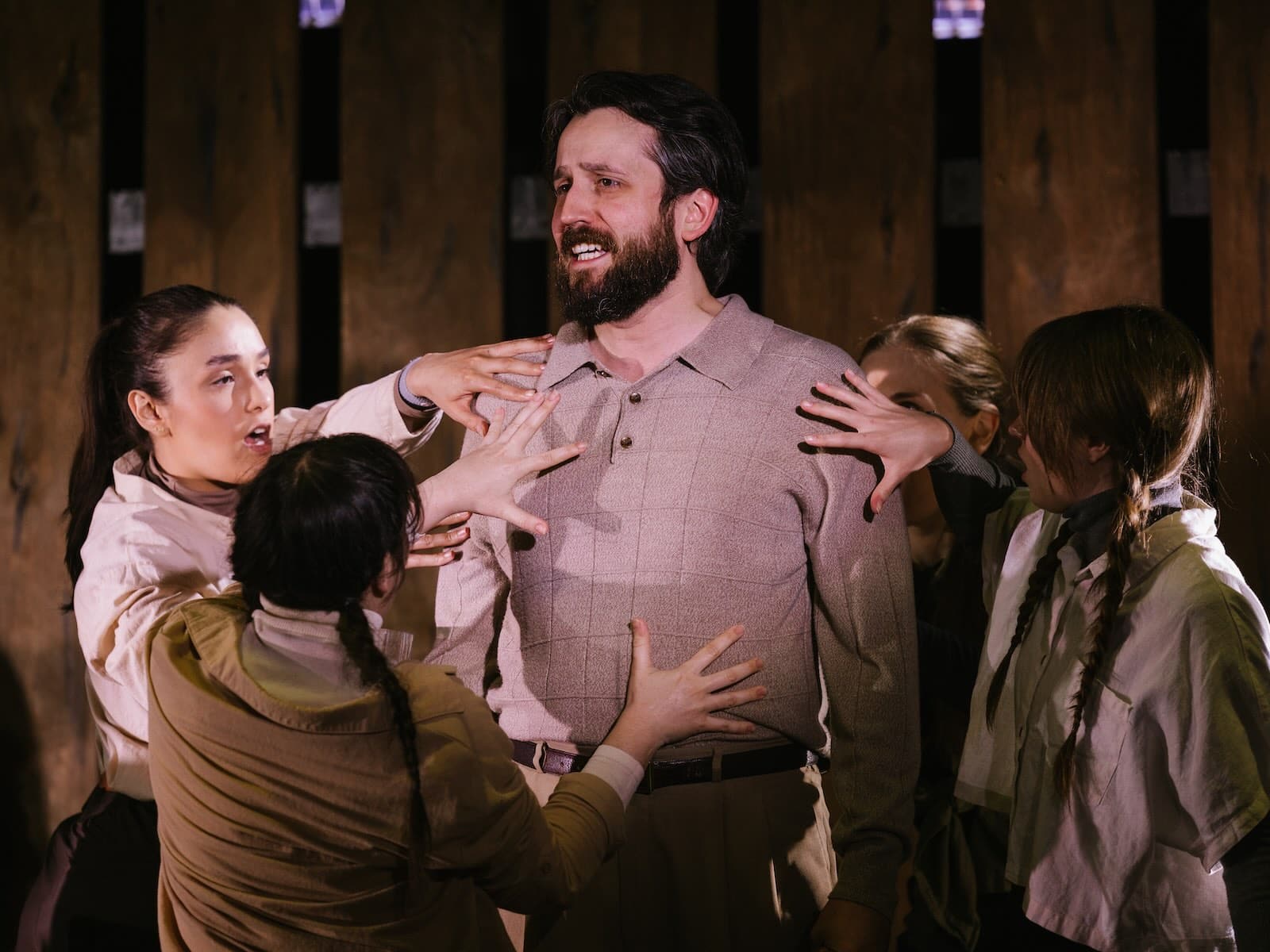
There is merit in shaking the cobwebs off a frequently performed classic. There can also be a cost. The cost here is a loss of focus on character. Sometimes that loss is in the mechanics of the production. Giles Corey, for example, is played by three different actors, becoming lost in the shuffle. Sometimes, even for someone familiar with the play, it is difficult to figure out which character is speaking.
In carrying out the very quick pace of the show, actors speak so rapidly that what they say, and its importance for their characters, can become a blur. Jeremy Myers, starting off the show as the histrionic Rev. Parris, begins the sprint. In the second act, the seriousness and gravitas of Judge Danforth (Reiner Prohchaska) fall victim to the pace of his scenes.
There are two crucial moments in The Crucible that require one-on-one intimacy to work. One is the “forest scene” opening the second act (kudos to Herber for not cutting it), which is essential to understanding the dynamic between John Proctor (Joe Waeyaert) and Abigail Williams (Victoria Davidson). It is here that we come to better understand both Abigail’s motive for revenge (not just on John, but on the community as a whole) and John’s underlying cruelty. While more palpable erotic tension between the two would have been beneficial, the intervention of several ensemble members partway through the scene also stifled its potential. Miller put John and Abigail alone together in the woods for a reason.
The other is the final scene in the prison between John and his wife, Elizabeth (Shea-Mikal Green). A successful portrayal of this struggle for John’s life and soul cannot happen without laser focus on their emotional intimacy, the first time in the play that they connect on a deep level. Instead, we get John on stage left and Elizabeth on stage right, trying repeatedly to get to each other, only to be physically blocked by several ensemble members before finally being allowed an embrace. To be sure, there is value in using this symbolism to show a community preventing characters from coming together. But instead of the last, tragic intimacy of a couple in extremis, we get frenetic, silent movie-like action.
On the other hand, Hebner’s staging of the first scene between John and Elizabeth works well. They encounter each other around the MET stage’s central pillar (covered with timbers in Cody James’ excellent rustic wood set). The two try to reach each other, only to find that they have always circled around to the other side of the pillar from their partner. It’s a nice metaphor for their estrangement.

Another notable bit of blocking, this time in the second act, shows Rev. Hale, wringing his hands in uncertainty on stage left. Rev. Parris, rigid and unmoving, stands tall across the stage. The two bookend much of the rest of the ensemble, neatly contrasting doubt and certainty in the divided community.
When characters frequently deliver lines facing front, not looking at one another or even standing near one another, the effect can be visually arresting, but the building of relationships among characters suffers. Likewise, the pervasive group movement, while enlivening the proceedings (no problems in this production with static blocking), can mask the development of dynamics among characters. For example, Abigail’s “yellow bird” moment is visually striking, with bright yellow light and a rapidly developing tableau among the girls. But the process through which Abigail has motivated the other girls to join her is less clear.
The entire ensemble, pre-set on stage in a freeze as the house opens, moves in a unified and disciplined manner, whether gathering in groups that form and then dissolve, stomping their feet, waving their arms, dropping objects all at once, or simply observing a scene. The community, in all its disorder, is never absent nor passive. Herber and the cast deserve credit for making the production’s concept work with precision.
Given the production’s direction, it can be difficult for the actors to delve deeply into their characters. Waeyaert’s John Proctor is unusually low-key through much of the show. His “God’s icy wind will blow” line at the climax of the first act is barely a zephyr. He does summon energy and volume for the “give me my name” speech, however. Similarly, I’d have liked to have seen greater charisma from Davidson’s Abigail, who, though a teenage girl in a patriarchal society, leads a movement that overturns the social order, at least for a time
The play’s longest character arc belongs to Rev. Hale (Bill Denison), ranging from arrogant intellectual to defense advocate to pleader for the lives of the condemned. Dennison’s take on the character was heartfelt but sometimes overwrought. Among the smaller roles, Katie Martin’s Tituba was a standout, and Jean Rosolino was a touching Rebecca Nurse.
Doug Grove’s lighting design featured quick, sharp cues; intense specials (e.g., on Betty Paris in the opening scene), and moody background colors. Kaydin Hamby’s sound design effectively emphasized the ominous atmosphere. Logan Benson’s modern-ish costumes, mostly in a subdued color palette, underscored the production’s timeless setting. The highlight of Lori Boyd’s prop design was the poppets, the small rag dolls that play an important role in the plot. They were delightful, and there were several more of them on stage than in traditional productions of the play.
It’s bracing to see an intentionally non-traditional take on a play many theatergoers have seen frequently, one that avoids performance traditions that may have become entrenched over the years. Finding new ways to perform and watch a classic, and to explore its psychological dimensions in ways that might otherwise be missed, has substantial merit.
Running Time: Two hours and 20 minutes, including one intermission.
The Crucible plays through April 26, 2026, at Maryland Ensemble Theatre‘s Robin Drummond Main Stage, 31 W Patrick Street, Frederick, MD. Tickets ($15–$36) and can be purchased by phone at 301-694-4744, online, or in person at the MET box office, open Tuesday to Thursday, 12 6 p.m., Fridays 12–4 p.m., and one hour before performances. Pay-What-You-Will discounts are available to students, seniors, and military, starting at $7 per performance, while supplies last.
The Crucible
By Arthur Miller
CREATIVE TEAM”
Directed by Julie Herber
Stage Managed by Eli Bendel-Simso
Asst. Stage Managed by Olivia Pietanza*
Set Designed by Cody James*
Lighting Design by Doug Grove*
Sound Design by Kaydin Hamby*
Costume Design by Logan Benson
Properties Design by Lori Boyd*
Intimacy Consulting by Mallory Shear
Dramaturgy by Mars Renn
CAST
Joe Waeyaert* as John Proctor
Victoria Davidson as Abigail Williams
Shea-Mikal Green* as Elizabeth Proctor
Bill Dennison* as Reverend Hale
Jeremy Myers* as Reverend Parris
Jean Rosolino as Rebecca Nurse, et al.
Katie Martin as Hawthorne, Tituba, et al.
Reiner Prochaska* as Danforth, et al.
Lucy Campbell as Betty Paris, et al.
Karli Cole* as Mercy Lewis et al.
Candace Claggett as Mary Warren et al.
Jen Pagano* as Suzanna Walcott et al.
Mallorie Stern*, Danielle Carter, Christopher Lange as Swings
*Denotes Ensemble Member, Associate Artist, or Ensemble Emeritus