
To launch its 2026 inaugural season in a new Off-Broadway home at the Theater at St. Clement’s, The New Group is presenting a revival of Elmer L. Rice’s 1923 play The Adding Machine, with revisions to the century-old script by Thomas Bradshaw, designed to enhance its relevance to a current audience. Directed by the company’s Founding Artistic Director Scott Elliott, the intense four-hander combines Surreal, Absurdist, and Expressionist stylings in a dark and disturbing satire on the existentialist journey of one unfulfilled man through the cycle of an unhappy life, death, afterlife, and rebirth, in which he learns nothing and nothing ever changes.
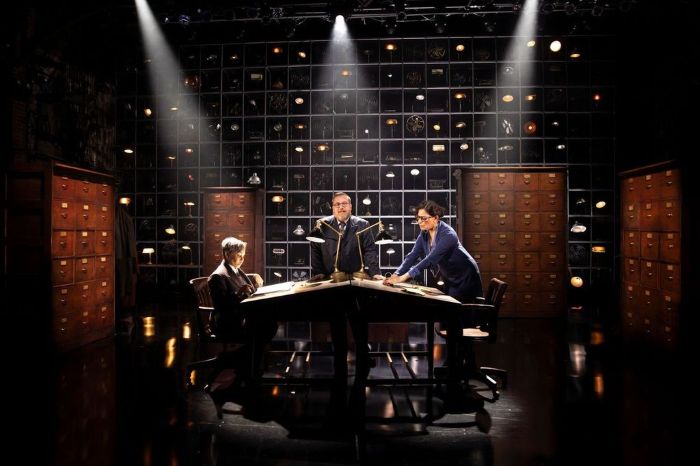
Mr. Zero has been an accountant for 25 years, sharing an office with his co-worker Daisy, never given a promotion or a raise but still devoted to his job, expecting to advance, and oblivious to the needs of his long-suffering wife. Mrs. Zero faces his silence, absence, and infidelity with incessant yammering, scathing insults, and anger, though, like him, remains in their unsatisfying situation, both clearly stymied by severe separation anxiety. When his boss, valuing efficiency over humanity, tells him he’s being replaced by an adding machine, it triggers a chain of extreme actions and reactions, the opportunity to understand and to forge a new path, or to repeat the same mistakes and drudgery ad infinitum. It should be noted here that this production contains depictions and discussions of violence and suicide, and when Mr. Zero does talk, he spews out shocking racist epithets and offensive anti-Semitic slurs, in a case of belittling others to feel better about himself and his status as a nobody (hence the name Zero).
The largely despicable characters and their insufferable personalities are nailed by a masterful roster of stars from the stage and screen. Daphne Rubin-Vega turns in a sardonic performance as the protagonist Mr. Zero, presumably cross-gender cast in part because of her petite stature, which makes him physically and metaphorically smaller than the others, as he stares blankly into space, diligently does his desk job, reveals his obsession with numbers and his unprofessional interest in Daisy, stoically accepts his fate, and walks away from what might make him happy.
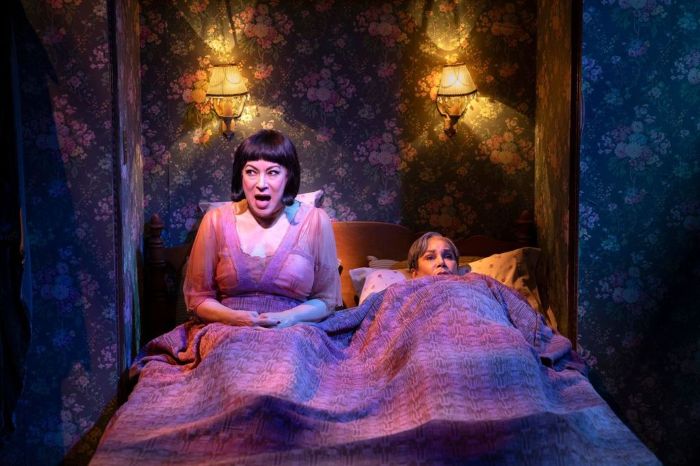
As Mrs. Zero, Jennifer Tilly looms over her husband. Her opening monologue, delivered to the unresponsive Mr. Zero in bed, goes on for a seemingly interminable length, with non-stop chatter that is at first prosaic, then confrontational, and increasingly abusive and hateful, bringing the laughs without missing a beat (or taking a breath!). Her over-the-top degrading, crying, and screaming escalates, as she brings him his favorite ham-and-cheese sandwich then storms out in a rage when he needs her love and comfort the most – even if he doesn’t show it.
Portrayed by Sarita Choudhury, a more outwardly controlled Daisy, who tolerates Mr. Zero’s unpleasant attitude at work, as she calls out the totals on a stack of receipts and he records them, harbors unspoken romantic feelings for him and an expressed suicidal tendency, most notably at the thought of being without him. When they’re reunited in the Elysian Fields (the paradise of Greek mythology, in which virtuous souls – or here, all souls – enjoy a happy and tranquil afterlife), they finally admit their mutual attraction, hear the blissful music that surrounds them (the 21st-century song “I Wanna Be Special”), and are elated to be together, before he’s back on the same old self-defeating path.
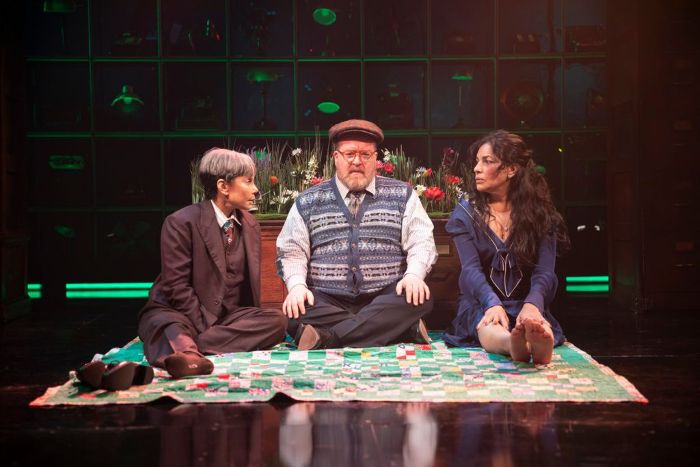
The engaging Michael Cyril Creighton rounds out the cast as the Narrator, directly addressing the audience, introducing the scenes, watching the action from a seat at the side of the stage, and offering his droll commentary. He also appears as “Everybody Else” in the show, from subsidiary figures, including the series of attendees at Mrs. Zero’s dinner party (for which her husband arrives late), rapidly changing from one guest to the next without moving from his center-stage chair, to significant characters, among them, Mr. Zero’s boss and the other apparently nonchalant deliverers of his fate. To avoid spoilers, I’m not naming who they are or what they do, but I can say, the touches of bleak gallows humor are often extremely disquieting and chilling; not everyone will find them funny, and the two-act show’s length seems unnecessary and sometimes redundant in delivering the message (and creeping us out).
That unsettling mood, referencing the darkest side of human nature, is enhanced by an expressive artistic design. Lighting (by Jeff Croiter), with eerie blackouts, strobe, fog, and haze effects, adds to the surreal tone, and a disquieting soundscape (by Stan Mathabane), including the unnerving shooting of stage firearms, increases the tension the audience is feeling. Vintage-style costumes (by Catherine Zuber, with wigs by Tom Watson) evoke the era and visually transform Rubin-Vega into a man, and the outfit Mrs. Zero wears to visit her husband recalls the darkness of film noir of the 1940s (itself influenced by German Expressionism of the 1910s-20s). A smartly functioning set (by Derek McLane) easily transitions from the office – with a full-scale back wall of cube shelving filled with desk lamps, electric fans, and adding machines, movable wooden desks and chairs, and rows of filing cabinets – to the bedroom of Mr. and Mrs. Zero, with the roll-in and opening of them, to the Elysian Fields, with a planter of beautiful colorful flowers that contrast with the monochromatic palette and darkness of the other locales.
While The Adding Machine is set in the 1920s, its themes of the isolation, exploitation, and elimination of dedicated but powerless employees resonates now as much as it did then, with the advent of AI replacing the human workforce (including actors) and the drastic cuts in original perceptive writing in favor of AI-generated pop-ups and social-media videos (and such notable publications as the Washington Post reducing or ending their theater coverage). It’s a timely production and a clear example of history repeating itself, much like Mr. Zero’s life does. He never learns; will we?
Running Time: Approximately two hours and 10 minutes, including an intermission.

The Adding Machine plays through Sunday, May 17, 2026, at The New Group, performing at the Theater at St. Clement’s, 423 West 46th Street, NYC. For tickets (priced at $38-109, including fees, with Pick Your Price performances on Sundays), go online, or find discount tickets at TodayTix. A livestream will be presented on Tuesday, May 5, at the 7 pm curtain time; tickets (priced at $39.99) include fees and a 24-hour replay, with the possibility of a limited on-demand release, subject to availability.