A few years before he co-wrote and starred in the play The Shark Is Broken, a behind-the-scenes dramedy about the making of Jaws, Ian Shaw looked in the mirror and saw Quint, the grizzled shark hunter played by his late father, the legendary actor Robert Shaw, staring back at him.
Ian Shaw was 47, the same age his father was when he played Quint in Jaws. He had mourned his father’s death “for a decade or so” — Robert Shaw died of a heart attack at 51 when Ian was 8 — yet his grief still felt unfinished.
So, with the help of his friend Joseph Nixon, the actor wrote a play about Jaws, cast himself as Robert Shaw, and crawled into his father’s sea-stained skin.
I saw this happen at Broadway’s John Golden Theatre in 2023, but I only half-perceived it.
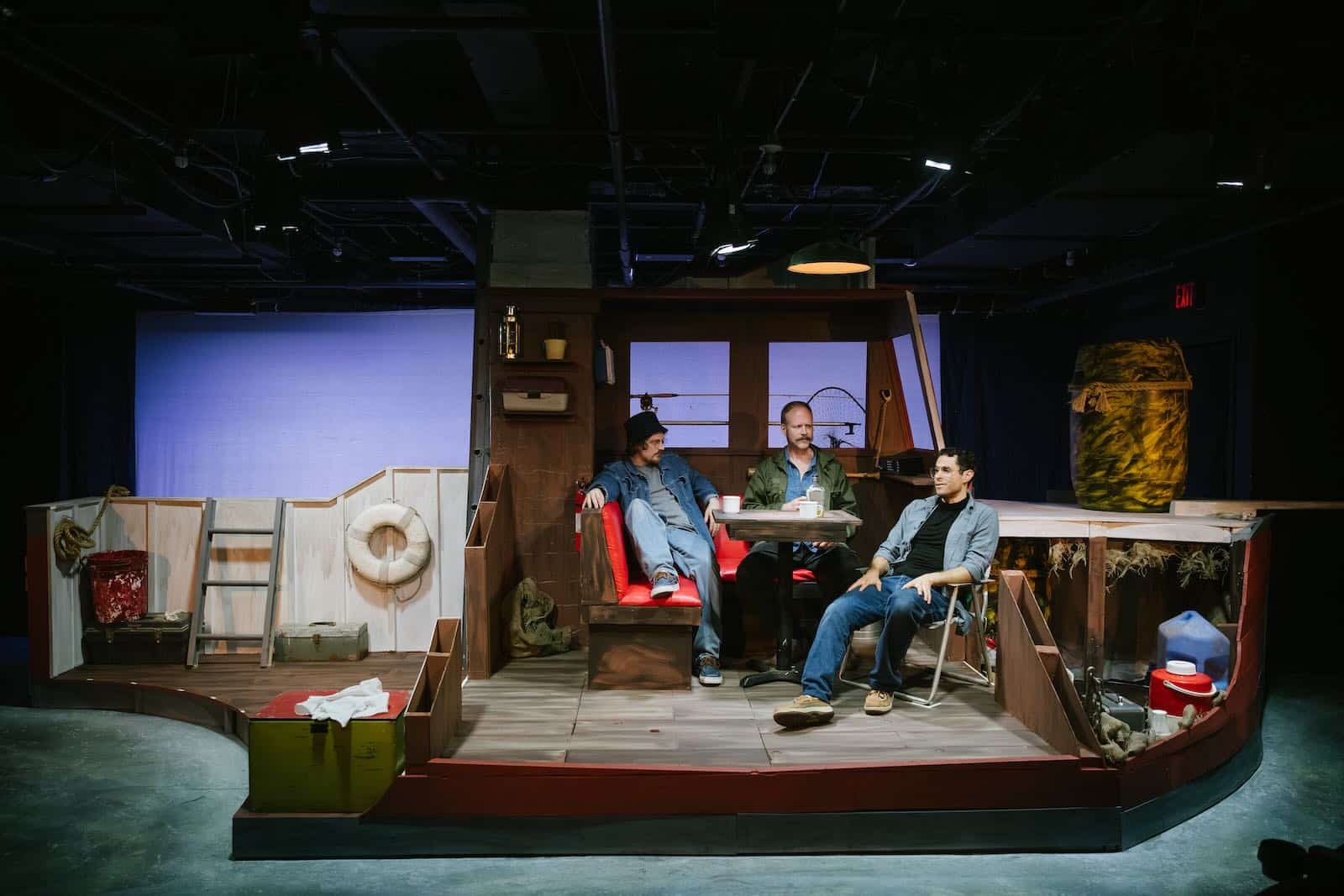
I saw the show again at Maryland Ensemble Theatre in 2025. In my review, I observed that the real drama in this play lies offstage, in the relationship between the son and his father.
Ian Shaw had spent most of his life watching his father’s films, reading his plays, even auditioning for his father’s friends (in a production of Hamlet, no less). He was circling his father, retracing his steps, but avoiding direct association with him.
Now, approaching 50, Ian Shaw arranged the audition he had been preparing for his whole life — playing his father on stage, in his most famous role, and attempting his most famous monologue, the USS Indianapolis speech from Jaws.
At first, I chalked this whole enterprise up to father-son competition. Now I realize that what Ian Shaw was doing was grief work. By portraying his father on stage, he was attempting to visit with him, not merely measure up to him.
Ian Shaw used his skills as an actor to make his father present again: he donned his Jaws costume, grew a mustache, drank, swore, fought, and performed Shakespeare.
In the play’s final scene, the three actors portraying Robert Shaw, Roy Scheider, and Richard Dreyfuss descend below deck to the cramped cabin of the Orca. Scheider and Dreyfuss fall into silhouette while Ian Shaw’s face is lit, soft as candlelight.
There, after repeatedly failing throughout the play to deliver the Indianapolis speech without stumbling over the words or collapsing drunk, Ian finally delivers it, just as his father did on screen.
At that moment, I couldn’t fully process what I was seeing.
In that darkness, Ian Shaw simultaneously summons his father, redeems him, equals him, and merges with him, as we in the audience bear silent witness to a kind of sacrament.
This went beyond theater, and thus, I believed, beyond the capacity of theater criticism to explain — which is why I couldn’t completely account for what went wrong in Maryland Ensemble Theatre’s production. Technically, nothing. As I wrote in my review, the Orca set and the film costumes were lovingly, painstakingly recreated. Actor Kevin Corbett competently performed the Indianapolis speech.
The problem is that Ian Shaw was born to play this role, in a way that no one else can.
In the original production, I saw the son become the father on stage in the dark. I heard the dead speak. I witnessed a miracle. What I saw in Maryland two years later was a photograph of that event, and that is why the production could not move me. But that is not the fault of the production. It is merely a biological reality.
It took seeing the MET production to fully understand what I witnessed in New York. Shaw summoned his father back from wherever the dead go and made him briefly, miraculously, one with him. That communion between father and son, the merging of the two in the play’s final scene, is the reason Ian Shaw created this play, and the reason to see it.
I wish I had told you this earlier — though I am not sure I could have. Critics are rightly wary of comparing regional productions to their Broadway counterparts because it is rarely a fair or illuminating exercise. I needed to see the MET production to complete my understanding of the Broadway production. I needed to see the absence of Ian Shaw in Maryland to grasp how important his presence is to the play. Some things can only be understood by their absence. The MET production taught me this, and I am grateful.
Ian Shaw has described the process of creating The Shark Is Broken as “therapeutic,” acknowledging that while he came closer to understanding his father, “I wouldn’t go so far as to say that I know him extremely intimately because these things are all fragments.”
That makes sense — Shaw had fewer than nine years with his father. Where else but in the theater could he attempt to collect those fragments and reconstruct a father he had so briefly known and barely possessed?
SEE ALSO:
‘The Shark Is Broken’ at Maryland Ensemble Theatre lacks bite (review by Geoffrey Melada, September 16, 2025)
Colin Donnell as Roy Scheider, Alex Brightman as Richard Dreyfuss, and Ian Shaw as his father, Robert Shaw, in the 2023 Broadway production of ‘The Shark Is Broken’ at the John Golden Theatre.