Cedric Neal has the most gorgeous and expressive hands. They hold worlds and tell stories. Medium brown, nails manicured with slick black polish and a bit of bling on one finger, those hands carve sinuous arabesques in the air to welcome the audience into the magic, mischief, and mayhem that is Pippin. The 1972 musical by book writer Roger O. Hirson and composer/lyricist Stephen Schwartz (now best known for Wicked) dazzles yet again with sharp-tongued visual, aural, and physical delights. Pippin was and is a full-on sensory experience of stagecraft, playing through July 26 at Signature Theatre’s intimate MAX Theatre.
Neal serves as the emcee — identified as the Leading Player. It’s the role that made Ben Vereen a household name. Though nameless, he’s a storyteller and keeper of the dark art of what he plies as the most spectacular finale ever seen, or so he says. With those undulous fingers and wrists and his magnificent voice, Neal narrates a tale as old as time and as current as the news updates on your iPhone. Easy on the eyes and ears, this musical plays with history and leans into politics in not-so-subtle ways. An adventurous quest, it’s also a thought-provoking morality check and a nudge into self-reflection and soul-searching, if the creators have their Brechtian way with the audience.
This 1972 show draws loosely — very loosely — on the real-life son of King Charlemagne, ruler of the Franks, who, by conquest, united much of Western and Central Europe during the 8th century. His son Pepin inspired Pippin, who claims he’s “going to live a life that is extraordinary, something completely fulfilling.” Thus, this is a picaresque, following Pippin as he encounters all manner of experiences from war to death, lust, sex, probable patricide, adventure, and the dulling mundanity of physical labor and family life.
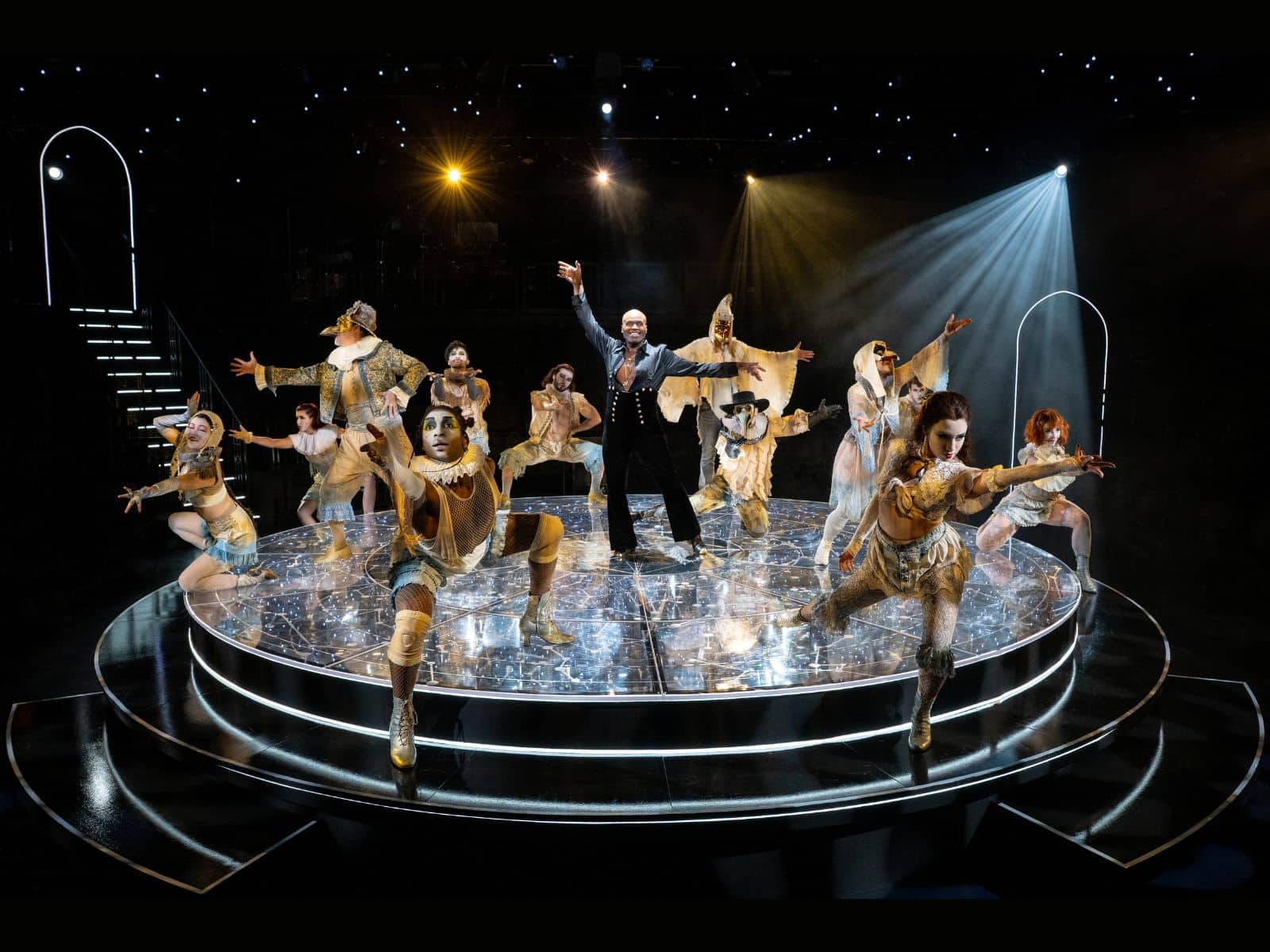
The opener, “Magic to Do,” is seductively sung by Leading Player Neal and the Greek chorus of beautiful Fosse-esque dancer/singers, who slink onto the Max Theatre’s in-the-round staging, inviting the audience in with risqué and lascivious looks. Pippin, clad in dirty Converse high tops, faded denim, and a polo shirt, enters as an ordinary recent college grad with tussled brunet hair and a guileless smile. His “I want” song — “Corner of the Sky” — comes early, and Brayden Bambino, lanky and earnest, warms up in this solo; it rightly takes time for him to grow into the role.
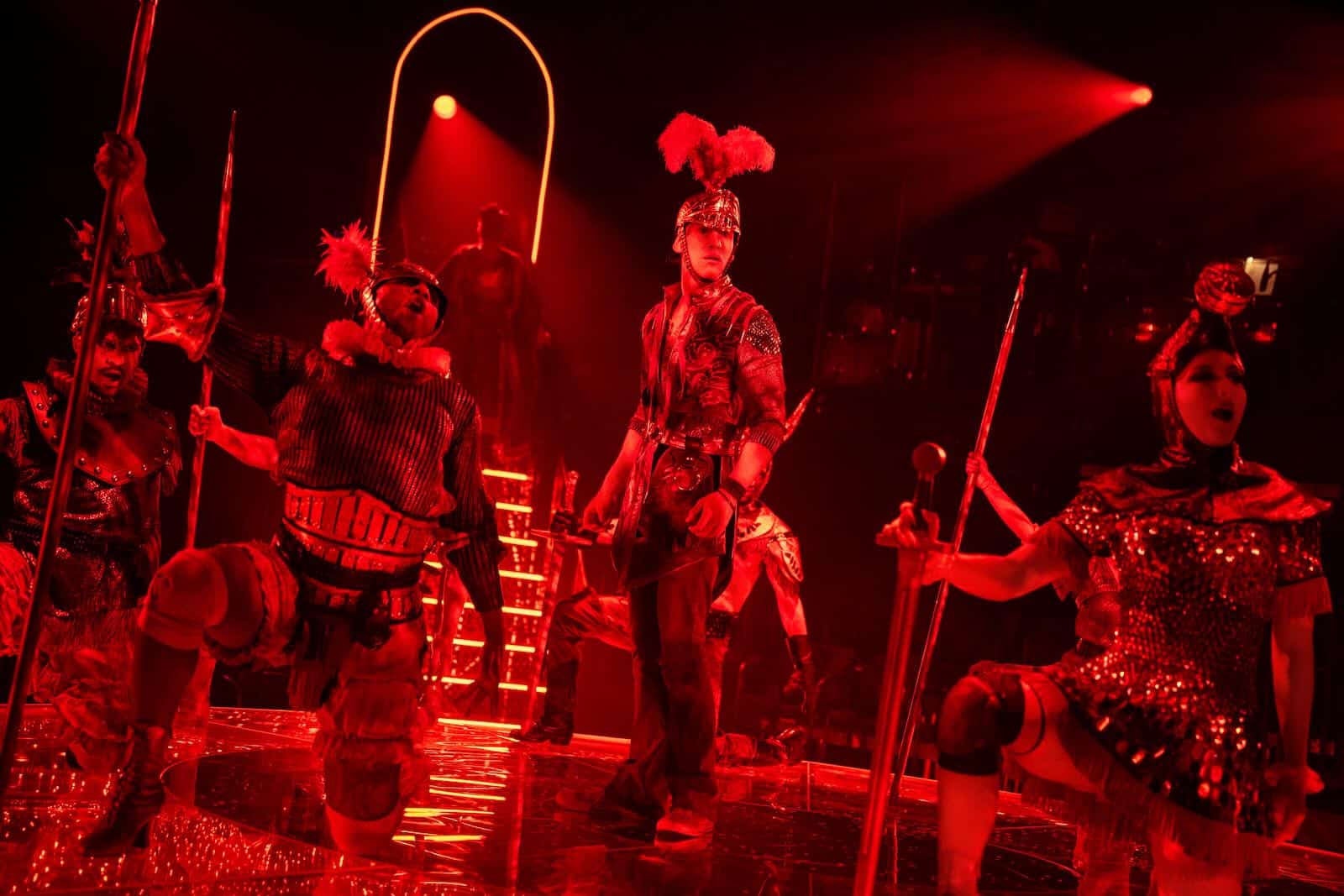
The education of this young man begins. In “War Is a Science,” his papa, King Charles (an avuncular and even comical Eric Hissom), schools Pippin and dumb-jock stepson Lewis on the strategies of war while a chorus of sexy armor-clad warriors readies for battle. The lesson was learned the hard way. The Leading Player returns with the gospel-arpeggio-embellished “Glory,” sung with churchy roof-raising vocal gymnastics. Next stop on this journey: a visit to granny’s. There, the incomparable Naomi Jacobson’s Berthe is not your grandmother’s grandma. Surrounded by four well-muscled male players, who satisfy her every whim, she puts the bump-and-grind into the sassy grandma stereotype. This is also where the Brechtian ideal — evident throughout as the Leading Player addresses both the audience and the performers directly — fully breaks that fourth wall. Led by Berthe, the connection between performers and audiences reaches its pinnacle with the tuneful song-and-dance number “No Time at All.”
Other women in Pippin’s life include his witchy/bitchy stepmother, Fastrada, who dotes on her dumb son Lewis, Ryan Sellers, playing up his machismo and immaturity. As Fastrada, Maria Rizzo leans into her curves, literally, poured into shape-hugging sparkly dresses that lure her husband into raising her allowance, and his heart rate. Crowd favorite — at least on opening night, judging by entrance applause — Awa Sal Secka plays Catherine, the rich widow, who finds battered and ego-bruised Pippin and nurses him to health. Sal Secka’s rich voice imbues both “Love Song” and “Kind of a Woman” with warmth and character, plus that belt she finesses.
The much-copied and influential choreographer Bob Fosse worked closely with Hirson and Schwartz in developing this musical. The Fosse imprint remains elemental to the book and music of the show, particularly in the morbid fascination with death, murder, war, self-improvement, and aggrandizement (see Fosse-helmed productions of Cabaret, Chicago, and All That Jazz). And Fosse’s signature 20th-century style with its splayed-fingered jazz hands, slouched shoulders, popped hips, and sharp-angled elbows, knees, ankles, and wrists, remains a defining characteristic of Pippin, even four decades after his death (which occurred here in DC at George Washington University Hospital in 1987).
Choreographer Rachel Leigh Dolan avoids imitation, yet the eight Players — excellent dancers all — find Fosse-esque qualities in the sardonic and sarcastic sexiness set forth in Dolan’s movement language. The curvaceous hip rolls and thrusts are there, along with pointed angles, but this is Fosse run through a 21st-century sieve. These dancers lean into the muscular, earthy groundedness that contemporary dancers favor in the new millennium, opposing the lighter, more precious stylized Broadway choreography of the 20th century. Fosse’s blueprint also remains in the famous “Manson Trio” — a song-and-dance number for two women and a man that is a signature moment from the original Pippin. And, yes, the Manson that Fosse referenced in this nomenclature was, indeed, the murderer, for whom the choreographer held a morbid fascination. The trio injected a hat-and-cane moment, with tricky bits of footwork and sleek poses. Dolan, true to form, reprises it, but with a modern 21st-century take — swords and helmets, a bit of skittering footwork, but it lives a separate life, less sinister, more warrior.
Similarly, an orgiastic group number, where young Pippin discovers, let’s say, his groove, hearkens back to Fosse’s autobiographical film All That Jazz, with a daringly explicit-for-its-time choreographed group striptease and orgy, with intimacy choreography by Chelsea Pace. Again, Dolan leans into Fosse’s sexiness while avoiding raunchiness, still leaving Pippin — and surely some audience members — hot and bothered.
Director Matthew Gardiner ably takes the best of what could have been a dated homage to ’70s-era rock musicals — Jesus Christ Superstar, Godspell, and the like — and molds it into a timely and timeless commentary that feels fresh and relevant. The in-the-round staging features Christopher and Justin Swader’s gleaming black, circular, raised playing space, which sparkles beneath with starry lights — marking the Holy Roman Empire as a singular world of wonder. The lighting on the mostly bare set, aside from sundries like carried-in tables, stools, and a swing, sees the musical dramedy through an emotional color-wheel of blues, roses, pinks, golds, and harsh fluorescent white, all devised by lighting designer (and current Tony Award nominee for Ragtime and Cats: The Jellicle Ball) Adam Honoré.
Erik Teague’s costumes draw inspiration from commedia dell’arte, Jacobean England, burlesque, vaudeville, and bohemian fashion in an eclectic yet enticing mashup. And while the original Pippin featured exaggerated clownish face painting, here the Players’ faces are dusted with a powdery white to create a subtle, mask-like look without the heavy clownish paint of the 1970s. The main characters are naturally made up. And, what can I say? When Signature costumes with stage lingerie — I’m recalling the company’s 2015 Cabaret — it’s always naughty in the best ways, classy, not schlocky knock-offs.
Longtime Signature music director/conductor/keyboardist Jon Kalbfleisch helms a magnificent 11-piece ensemble that plays up in the rafters with gusto, giving this intimate setting bold and bright musical power, from the recognizable thump of “Magic to Do,” to the feeling-laden reprise of “Corner of the Sky” sweetly sung by Ellison Bihm. (Signature’s production employs Mitch Sebastian’s modified 1998 “Theo ending.”) The score, too, is built as a musical pastiche drawing from rock, soul, vaudeville and burlesque, gospel, ballad, and musical theater. Eric Norris’ sound design keeps it all balanced. Finally, the eight excellent triple-threat Players serve as a supporting chorus, equally adept at unifying voices as they are at the physical story-supporting choreography.
Like many musicals from the late 1960s and early ’70s, Pippin is flashy, funny, and filled with outre innuendo about sex, love, and death; it’s far from comic in the traditional sense of musical comedy. Created during a period of political and social foment, when the United States was ensconced in the unpopular Vietnam War, and protests against the war and for Civil Rights prevailed, Pippin is more than just a counterculture musical. Fifty years on, it remains relevant, even prescient. The disillusioned and discontent youths who marched for freedoms and rights are now grandparents. Their grandchildren are now struggling to find meaning and purpose in a world usurped by politics and technology.We can see ourselves in the earnest Pippin as he searches for meaning and purpose. An Everyman, he represents us all, muddling through our increasingly cynical society, built on commodification rather than connection, commercialization rather than community. For those of us roiling from the upside-down-ness of our nation’s current political and societal discord, Pippin is both a fantasy and a reminder that we all need a purpose to make it through. There’s magic at play here at Signature.
Running Time: Two hours and 15 minutes, with one intermission.
Pippin plays through July 26, 2026, in the MAX Theatre at Signature Theatre, 4200 Campbell Ave, Arlington, VA. Tickets range from $47–$153 and are available online or by calling the box office at 703.820.9771. Tickets are also available on TodayTix.
The program is online here.
Content warning: This show contains adult themes, sexual content, adult language, drug use, representations of violence, war and death, and discussion of suicide. It also includes strobe and lighting effects, loud noises, theatrical haze/smoke, and a torch/fire.
SEE ALSO:
Signature Theatre announces cast and creative team for ‘Pippin’ (news story, April 19, 2026)